


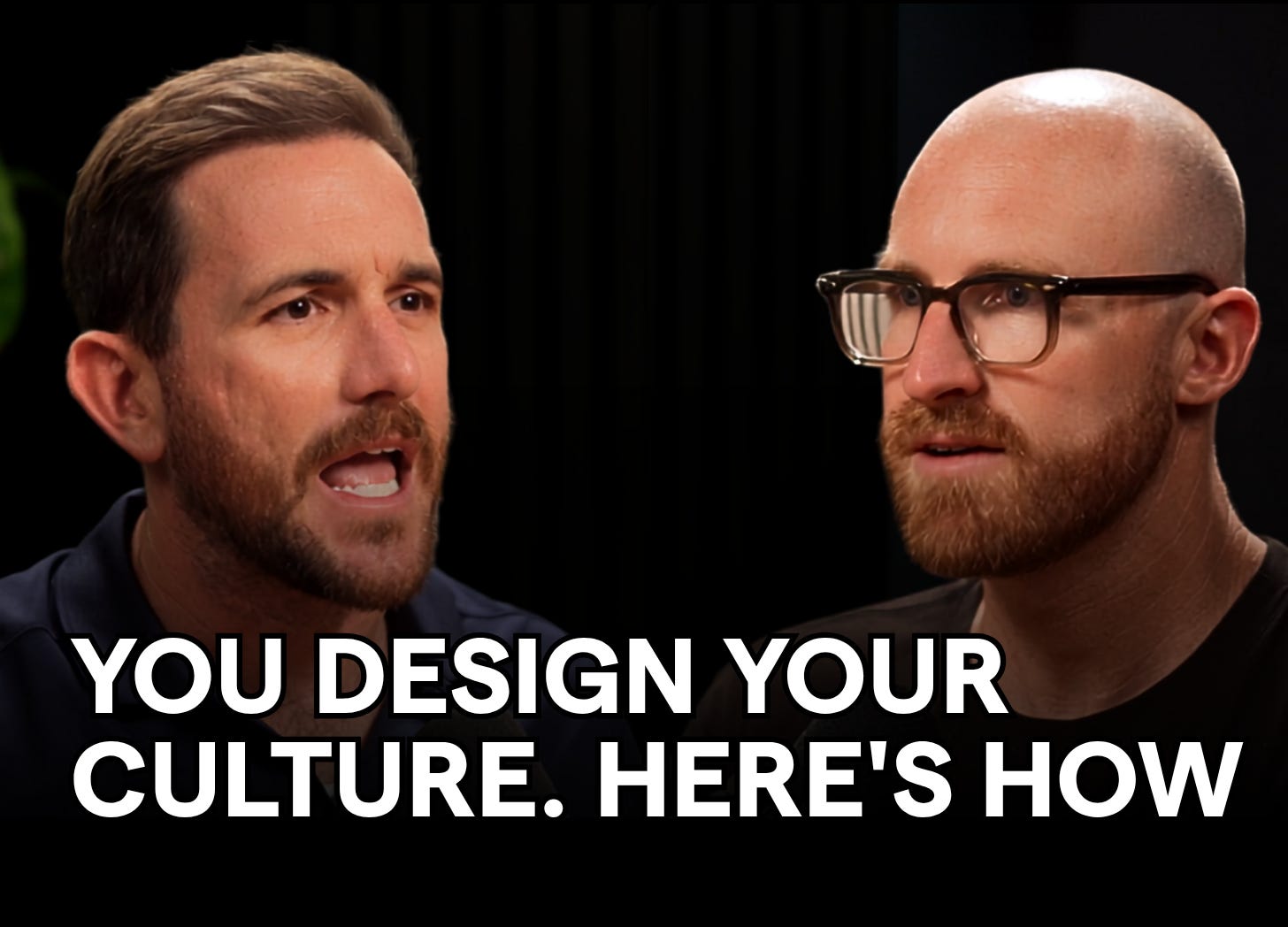
Ask ten leaders where culture comes from and you’ll get two answers. One camp says you design it. The other says it’s emergent, that it grows out of the people you hire and the most you can do is set a few guardrails and hope.
I land on the design side. The decisions you make, the way you handle a hard moment, the standards you keep, all of it hardens over time into the way things get done here. You’re choosing that, whether you mean to or not.
Jonathan comes at it from the other end. For him it starts with the people. Hire the ones who already embody the culture you want, almost without trying, and the rest emerges from there.
The longer we talked, the less those two views competed. Culture is shaped by who you bring onto the team, and it’s shaped by the choices you make once they’re here. Both are true, and neither one holds up without the other.
So the question I’d put to any leader is simple. Are you building the culture you claim to want through the decisions you make every day, or are you just hoping the right people showed up?
Episode Highlights:
[00:00:01] Is culture designed, or does it emerge on its own?
[00:02:14] You never check the box and call your culture “done”
[00:03:22] Why it always starts with who you hire
[00:05:15] The counter-narrative: American work culture is broken
[00:08:35] Untraining the 60-hour week and the four-day work week experiment
[00:11:00] Two philosophies: people-first vs. decisions-first
[00:13:19] Who carries the flag for culture on your team
[00:15:19] The hardest call: firing a high performer who’s a culture misfit
[00:17:12] How good short-term decisions quietly erode culture
[00:20:38] Stop handing your team the solution — protect their ownership
[00:24:36] What last year’s “grind year” cost, and how to unravel it
[00:26:14] Guardrails: scorecards and “the Seymour Way”
[00:29:44] Psychological safety and the freedom to fail
[00:30:31] Seasons of grinding and seasons of rest
[00:31:25] If you ask your team to grind, do you have to grind too?
Notable Quotes:
[00:05:45]: “I think work culture in general, especially speaking from an American standpoint, is bullshit.” Eric Ressler
[00:02:30]: “It’s like nature versus nurture. I don’t entirely agree that you can design it. It always starts with the people.” Jonathan Hicken
[00:15:50]: “The best SaaS companies were the ones who are like, ‘Hey, your results do not make up for the fact that you’re being an asshole, you’re out.’” Jonathan Hicken
[00:23:55]: “Culture is built by the consistent decisions and actions that you make as an org, not by your value statement or your posters.” Eric Ressler
[00:26:50]: “We recently started calling it the Seymour Way rather than core values. Because I can’t actually tell somebody what their values are. What I can say is, ‘This is how we do it here.’” Jonathan Hicken
[00:31:50]: “Anytime I’m asking the whole team to grind, I feel a moral obligation to grind just as hard, if not harder, than the rest of the team.” Eric Ressler
[00:32:45]: “A culture of trust is one where the team could see, ‘Oh, Eric needs a break and he’s taking a break, and I’ve got his back.’” Jonathan Hicken
Resources & Links:
The Five Dysfunctions of a Team by Patrick Lencioni — referenced at [00:29:51] on how a lack of trust unravels a team.
P.S. — Struggling to align your message with your mission? We help social impact leaders like you build trust-building brands through authentic storytelling, thoughtful design, and digital strategy that works. Let’s talk about your goals »
Full Transcript:
Eric Ressler [00:00:00]: All right, Jonathan, we’ve got kind of a meaty one here today. And today we’re going to be talking about organizational culture. And where this is coming from for me is, as you know, we work with a number of different orgs and we’re exposed to a lot of different cultures. And we’re lucky because we work with awesome teams and mostly awesome cultures. But over the years, you can imagine I’ve also seen some maybe not so healthy cultures. And it started to get me thinking, and I’ve thought about this a lot, what is it that creates good culture within any organization, but especially within a social impact organization? And what is it that leads to bad culture within an organization? And I know that you’ve been very intentionally designing your culture, and I’m using that word very intentionally myself because I do think culture is something that you design either by choice or by accident.
And I have some ideas that are formulating around how the sector might think about this differently and even some reflections around where some of my culture is not where I’d like it to be at Cosmic and reflections on how did it get there and what am I going to do to change it? So are you down?
Jonathan Hicken [00:01:05]: I’m so down. Let’s go.
Eric Ressler [00:01:15]: So let’s talk about first, how do you think about culture at the Seymour Center? And maybe even you’ve been in a number of different social impact orgs, some with healthier cultures, some with maybe not so healthy cultures. What’s your take on all of this?
Jonathan Hicken [00:01:30]: Yeah. Let me just set the stage as a beginning. So as we record this, I’m coming up on five years of my position here as executive director of the Seymour Center. And when I started, there was some staff that I stepped into supervising and a culture existed and no shade on that culture, but it wasn’t the culture I wanted. And now five years later, it feels like I’ve got the culture I want. And so I’ve been reflecting on it. In fact, even earlier today, I was doing some preparation for a staff meeting to sort of put all these pieces together. And I felt incredibly proud because I was like, “We’re there. We got this culture.” And I know it’s a snapshot in time. I can’t —
Eric Ressler [00:02:10]: You never checked that box and we’re done with our culture now.
Jonathan Hicken [00:02:15]: Yeah, did it. No. And so I’m feeling really grateful for what we have right now. And so I’ve just been thinking about what do I need to do to sustain that? So I think about culture in a couple of ways. One, it’s like nature versus nurture. I don’t entirely agree that you can design it.
Eric Ressler [00:02:35]: Okay.
Jonathan Hicken [00:02:35]: I think that it is emergent as much as you can put some things in place for that culture to emerge and sort of to guide it or put some guardrails on it. I think so much of it is emergent from things that you can’t control. But one thing is for certain, it always starts with the people. And so hiring the right people for your team, hiring the kind of people who naturally embody the kind of culture you want without even really trying is the single most important thing you can do to design your culture.
Eric Ressler [00:03:15]: Okay. So your claim here is that culture is emergent and culture is built sort of bottom up based on the people who you hire, and it just kind of evolves naturally on its own.
Jonathan Hicken [00:03:20]: 100%. Now I do think that executive directors, CEOs, leaders, they can tip the scale potentially in a way that others can’t. But you as an executive director, you cannot create the culture alone. I’ll stand on that soapbox. You cannot do it alone.
Eric Ressler [00:03:40]: Okay. So I think we have slightly different takes on this actually. And I think that our ideas are not totally at odds with one another. But I actually think that culture is something that you design. And I do agree that the people that are part of the team largely shape that culture. But I also think that the decisions that you make as a leader or as a team or both, and the way that you handle challenges, setbacks, situations, create a spoken or unspoken set of norms and values and ways of doing things that become the culture. And that it emerges based on a series of choices and things that develop, and then they just become the way it works here. And so to me, I agree it’s shaped by people, but I also think it’s shaped by norms and standards and this is how we handle situations like this here.
Jonathan Hicken [00:04:45]: All right. So I think that these things are compatible.
Eric Ressler [00:04:50]: I think so too.
Jonathan Hicken [00:04:50]: Yeah. And this is all semantic, but real quick, I think that when I say you can’t design it, what I’m saying is you can’t put the inspirational poster on the wall and be like, boom, we got our culture. Collaboration.
Eric Ressler [00:05:00]: Right.
Jonathan Hicken [00:05:00]: So I agree with you to a degree that it’s emergent in the sense that it is an accumulation of all these small moments. But I don’t always think you can force those things.
Eric Ressler [00:05:10]: I agree. Now I want to take this up just one level to kind of shape the rest of our conversation here, which is that my hope with this episode is that we can inspire a new counter-narrative and a new norm and a standard for what culture at social impact organizations is, which is kind of a big aim, but it starts with conversations like this. And the reason I say that — and I think this is actually something that’s emerging outside of social impact. I’m dropping an F-bomb for this one, Edith, you better watch out. I think work culture in general, especially speaking from an American standpoint, is bullshit. I think that the way that this has emerged in my professional lifetime is not always working towards a constructive and effective and, I will say, sustainable and healthy way to work.
Jonathan Hicken [00:06:05]: Okay. I don’t think we need to spend a ton of time on that, but unpack what you mean by that.
Eric Ressler [00:06:10]: So here’s what I see in the worst case in social impact especially, but just more broadly as it relates to organizational culture. Value around hustle, value around efficiency, value around urgency, a sense that you always have to be connected, always thinking. Not enough work-life balance, scarcity, bad power dynamics, no room for calmness, no room for space, no room for creativity, no room for failure, no room for experimentation. This is obviously not true at every org, but a lot of our work culture more broadly has been shaped in this way because of the conditions at large in, let’s just say, the world. And I think to build a healthy culture, you have to intentionally avoid or opt out of those tidal pulls of culture at large.
Jonathan Hicken [00:07:05]: And I think part of the problem is that a lot of that conversation is happening online, and there’s a natural bias to what people are having the conversations online. People who work in the online sector, whether that’s social impact or not, are online talking about work culture. And that exists. I was in tech. I lived that and that’s real. And then that trickles down. And I think the problem is that then we start to believe that is the norm. And if we look at ourselves or we look at others and they’re not operating that way, you start to think that they’re slackers or that they’re not serious.
Eric Ressler [00:07:45]: Exactly. And to be clear, I agree that a lot of this is based on online discourse, but it’s also based on — I’ve seen this within organizations. I’ve fallen trapped to some of these things over the years and had to really intentionally sit back and reflect on, wait, why are we doing it this way? Why do we accept that we have to hustle? I mean, if you think about even the context of what an agency culture typically is and what our culture is, they’re wildly different. Largely because I was like, “No, dude, we’re not going to do it that way.” We’re not doing that. And so this is why I have a point of view around — no, I think culture is designed, because I very intentionally as a leader at Cosmic made some choices about, no, we’re not going to work 60-hour weeks as a standard just because we’re an agency and that’s what you’re supposed to do as an agency.
And it wasn’t because people came in and said, “Hey, I don’t want to work 60 hours.” A lot of the folks on our team have worked those jobs and expected to work that job. And we actually had to literally untrain that behavior for a number of our employees. We work a four-day work week, for example. So all of this to say, I’d like this conversation to lean into how might we imagine a healthier, more sustainable, and I would argue more effective culture for social impact organizations despite the challenges around funding, despite the challenges around capacity. Because I think sometimes we lean on those as real, but also over-leveraged excuses for why we don’t build healthier culture.
Jonathan Hicken [00:09:20]: Yeah. I don’t think those external constraints are an excuse to have a bad culture. I think those are simply constraints within which to build a great culture. And you can’t sacrifice the people in order to overcome some constraints that are out of your control. So you have to acknowledge your constraints. You have to acknowledge that maybe funding’s tight. And sure, that is something we want to overcome, but I’m not going to sacrifice my people to do that. And I think what you’re getting at is sometimes that is the trade-off that we either knowingly or unknowingly make.
Eric Ressler [00:09:55]: And I would go a step further and I would say that there are orgs and leaders who, I would say sometimes even intentionally or knowingly over-extract value from their staff and value the outputs more than the way they treat their staff. And there is a balance here, right? Because I think if we go too far where the staff becomes the almighty and they must be protected at all costs and that staff gets to drive everything, then you start to get into this place where there’s no vision or leadership for the organization either. So I think this comes down to balance for me. And that’s something that’s tricky, just frankly. And we’ve struggled with that balance at Cosmic over the years. I strongly believe I want to take care of my people and we do. And how do we do that and hold people accountable, set high standards for craft, set high standards for accountability and ownership of the work, all those kinds of things. That’s a tough tension to balance in my opinion.
Jonathan Hicken [00:10:55]: So let’s go through our two sort of different but possibly compatible, possibly not philosophies on how to do this. So I’ll start. For me, I went with people first. I have a sense of the kinds of people I want to work with. And the kinds of people that are going to do the work that we do the best. And so when I’m hiring, I’m looking for that before I’m looking for qualifications, before I’m looking for resume. I’m like, are the people going to show up in the way that I think collectively is going to create that culture, because it’s the driver?
Eric Ressler [00:11:35]: Yeah, we’re 100% aligned there. And we do the same thing in our hiring process.
Jonathan Hicken [00:11:40]: But we all say that, right? We all say that, but it obviously doesn’t always happen.
Eric Ressler [00:11:50]: So if I could reflect on that for a second, I think it’s sort of like dating at some level, where everyone’s going to be on their best behavior when you’re in that courtship phase to a degree. And even sometimes the intentions are right. And I think this maybe sometimes comes down to, well, what does it mean that we want to be collaborative? How does that actually work? So what I’ve learned in hiring and setting culture is getting very specific about what does it mean when we say collaboration? What does it mean when we say ownership? I’m just making these words up, by the way. Because I think sometimes we get lost in semantics. A potential employee may have their version of what collaboration means, and then they come and they step into the org. They’re like, “Whoa, this isn’t what I think of when I think of collaboration.” So there’s a misfit in practicality versus in the concept itself.
Jonathan Hicken [00:12:40]: I also think that you have to hire — there has to be somebody on your team, and that may be you, but ideally it’s not, someone who’s almost like the flag bearer of culture that carries that. And we did that at the Seymour Center. And this was somebody who owns the visitor experience, meaning delivering awesome human-to-human experiences in our building. But this was also someone that I knew right away. I was like, “Oh, they care about culture and they’re going to drive and carry that flag for culture for the whole staff, not just on the floor.” And I think that’s really important to have.
Eric Ressler [00:13:20]: I agree. And here’s where I think we are very aligned. I also don’t think that culture is something that is designed top-down, responsible only for the founder to set and uphold. In the best case of this, it is a co-created thing, but it needs to gel after a certain amount of time as a team so that when there is something happening that’s not aligned with culture, it sticks out like a sore thumb where it’s just like, whoa, whoa, that’s not how we do things here. And maybe that’s because of one person acting in a way that’s not culturally right or because of a decision the team makes or the entire team makes. When the culture is strong and defined, it becomes painfully obvious when something happens that’s not culturally aligned.
Jonathan Hicken [00:14:05]: For sure.
Eric Ressler [00:14:05]: And to riff on that even more, I accept and expect and invite people on my team to help shape the culture, to have ideas around the culture and how to uphold it in different ways. So there’s this tension there for me where it’s like, I do think some of it is shaped by leadership. And actually I think the part that’s most shaped by leadership is actions. So if you have a stated culture or a way of being, it can be performative if you say one thing, but then you actually act in a way that makes it clear that cultural norm or standard or idea is just paying lip service to the idea versus actually embodying the idea.
Jonathan Hicken [00:14:50]: Yeah. Kind of what we’re talking about, and I’d go as far as to say as the leader, what you’re kind of trying to do is you’re trying to define in-group, out-group, where the in-group are the people who behave this way. And the out-group, they don’t behave that way, which means they don’t belong in this work or within this team.
Eric Ressler [00:15:15]: Which they may be great for another team.
Jonathan Hicken [00:15:20]: Exactly. That’s not necessarily that they’re a bad person. And so I would say another decision, and this is probably arguably the hardest one, is making the decision to let somebody go who’s not a culture fit. And can you make that choice even if they’re producing results? When I was in tech, this was a tough one. The classic example of the Apple salesman who just was crushing it.
Eric Ressler [00:15:45]: By numbers.
Jonathan Hicken [00:15:45]: Yeah. By numbers, but the worst person to be around. And I thought the best SaaS companies were the ones who are like, “Hey, your results do not make up for the fact that you’re being an asshole, you’re out.” And that’s a really tough decision to make for a leader, to let somebody go who’s a high performer on paper, but is not a culture fit. But that is an action, Eric, to what you were saying, of demonstrating you as a leader that you are serious about this culture. That is a really powerful one when you’re defining that in-group, out-group.
Eric Ressler [00:16:25]: Hey friends, real quick before we continue today’s episode, I’m Eric Ressler, founder and creative director at Cosmic. Cosmic is a creative agency purpose-built for nonprofits and mission-driven organizations. For the last 15 years, we’ve helped leaders like you nail your impact story and sharpen your strategy. But we’re not here to just leave you with a fancy slide deck and a pat on the back. We roll up our sleeves and help you bring our ideas to life through campaigns, creative, and digital experiences. Our work together helps you earn trust, connect deeply with your supporters, and grow your fundraising and your impact. If you value the thinking we share here and want it applied to your biggest challenges, let’s talk at designbycosmic.com. All right, back to today’s conversation.
So I want to share one other idea about how I think this happens, because what I don’t think usually happens is that there’s an idea around culture and then the leader or the org at large just kind of intentionally goes against that idea. I think what’s most common, what I’ve experienced at running Cosmic, is that we have a goal around what it means to work at Cosmic and how we show up and the way we want to do our work. And that there are short-term decisions that get made that run counter to that culture. And there’s sometimes even really good short-term justifications for why those decisions were made. But then because they run counter to the stated or the intended culture, they build and build and build, and then all of a sudden that becomes the culture. So for example, let me paint a picture of this in terms of something that we’ve struggled with at Cosmic that we’ve made some good progress on.
So one of the things I believe that’s very strong about our culture is we want everyone on the team to have ownership and agency in their work. And there’s a tension there in the dynamic because I’m our founder, but I’m also our creative director and we are a team. So by definition, we’re trying to do work together, and us working together is going to produce much better results than any one person doing their work in a silo, of course. And what has happened in the past is the team’s worked on something, they brought it to my desk. I look at it and I’m like, “Oh, I see exactly what the problem is here.” And my intuition in the early days of leadership and being a creative director was to present the solution to my team member. “Oh, this is a good start, team member, but here’s why it’s not working and here’s how you solve it.”
And what I’ve learned over the years doing this is that that is not a good leadership style or even a good creative direction style. A better approach is to say, “Hey, here are the things that are working. Here are the things that I think are missing the mark, and here’s why. How might you solve that?” And again, putting the agency and the responsibility and the ownership back on the team member in a constructive way, not a like, “Oh, I don’t have time for this. I don’t want to deal with it.” It’s like, “I want to help grow you as a professional.” But the trap is, “Oh, and this is due in two days, and we can either solve it by me giving the solution and be on time. Or I can say, take it back to the drawing board and we have to push that deliverable back.”
So in the short term, it’s very tempting to say, “Okay, I’m going to help you solve this. I’m going to roll up my sleeves and get in there.” But that doesn’t actually help the team member grow. So we’ve had to build in more buffer, especially for newer team members or new deliverables that we don’t have as standardized, or even just straight up sometimes like, “Hey, didn’t hit it the first time on the first attempt.” And so what I’ve noticed is that when I wasn’t as diligent about that, it started to create this culture of like, “Oh, nothing can go out the door without Eric seeing it first.” Or, “Oh, well, I’m not going to take this as far because I don’t want to bring it to Eric and then have him tell me to do it a different way and I’ve spent a bunch of hours on it.”
So it’s a tension there that we’ve dealt with, but I use it as an example because I think that’s how culture erodes.
Jonathan Hicken [00:20:35]: All right, I have two ideas for you on that example. One is, can you tell them to bring you back an idea in short order? Like, “Hey, think about this problem and bring me your idea in an hour.” And it’s just like you keep the pace, but you give them a chance to think.
Eric Ressler [00:20:55]: Yes.
Jonathan Hicken [00:20:55]: And if you don’t have that luxury of time, then can you name what happened shortly after the project shipped? Where it’s like, “Hey, we got that out the door. The client’s happy. That’s great. We got where we needed to go. I didn’t like that I kind of just gave you the solution there. How can we do that differently next time?” So it’s quickly naming what went wrong shortly after. I’m just spitballing, right?
Eric Ressler [00:21:20]: Those are great. And actually some of the things that I’ve done over the years and learned how to do better. And one of the things I learned early on is like, oh, we need checkpoints earlier in the process so that we can make sure we’re strategically aligned before a designer or a writer or a strategist or a developer goes out and burns 20 hours on a project for me to come back and realize like, oh, we had two very different ideas around what we’re trying to do here. And again, I want to be clear, I’m not even saying I always am the right fit to solve these problems. Now, I’ve been doing this for a long time, so I’ve done enough cycles to have an intuition about this where I think my superpower I have developed over the years is I’m a very good, deep listener at this point.
So I’ve developed a skill of being really good at understanding what clients are looking for and knowing if what we’re coming up with is truly hearing them and truly solving for what I’m hearing from them. And my team is really good at that too. But sometimes I have a spidey sense almost that I’m like, “Hey, this is cool. This is a good solution.” But I know exactly what the client’s going to say if we bring this to them. And I’m not always right, but I will say that’s probably my biggest superpower as a leader and a creative director.
Jonathan Hicken [00:22:40]: Yeah. And that’s why you have the role that you have.
Eric Ressler [00:22:40]: Right. And again, oftentimes my teammates will come up with better solutions to that problem than I ever would. But that’s a skill that — so what I’m sharing this for is like, yes, what I’ve realized is, okay, so those are some of the constraints. How do we make sure not to do these short-term things that — it’s not even really fixing the problem or even delivering better work at times, but it’s easy to fall into those traps. And I think that’s how culture starts to erode. And for a social impact org, it might be like, “Well, the grant’s due, so we’re just going to roll up our sleeves and do it.” Or sometimes it’s even like, “Hey, this isn’t a value-aligned funder, but if I don’t get this grant, I’m going to have to lay some people off.” And this is how culture starts to erode, just as some off-the-cuff examples for social impact orgs.
Jonathan Hicken [00:23:30]: Right. Where you start with, “Hey, we’re going to have to burn the midnight oil on this one grant,” and then it’s the next grant, and then it’s the next grant. And all of a sudden now you’ve set this expectation, not just with the person who’s staying up late, but for everybody else who’s seeing it, that success looks like staying up super late on grants. And so I better do the same because that’s what it looks like to fit in. That’s that in-group, out-group thing again.
Eric Ressler [00:23:50]: And what I would say is the point I’m trying to make here is that culture is built by the consistent decisions and actions that you make as an org, not by your value statement or your posters, to your point. And I think this is where you start to see sometimes even staff roll their eyes when you hear people talking about culture. It’s like, well, culture is really about, what are the choices that we make consistently over and over and over and over again? And sometimes you’re going to have to burn that midnight oil. Don’t get me wrong. Last year, for example, as I’ve shared on the show before, was a brutal year for us because of just the state of play in the sector at large. And we had to do some things that were to a degree counter to some of the culture.
So for example, we often had to work more than four days a week, which is part of our culture. We had to take on some projects that maybe weren’t as good of a fit for where we’re trying to go. And we did that with clear eyes, but this year, a lot of my work has been unraveling some of those new norms, mostly even for myself around how to build a sustainable and healthy way of working for me. And so I think it’s just something to keep in mind in terms of, well, how do we build stronger, more healthy, more sustainable cultures? To me, two things: question the norms. Do we have to do it this way just because that’s how everyone else does it? And how do we actually show up day after day, choice after choice?
Jonathan Hicken [00:25:15]: Because I think that culture is emergent from the collection of people, and I agree, to the sum of your decisions. I think there’s a couple of really important things that any culture, a positive culture, no matter what culture that is, because there’s many different flavors of it, needs to have in place. One is the right people. I started with that. The second is a set of tools that helps every single individual understand whether or not they are making the right decisions or the decisions in the style that match the culture. Something that they can self-check on and that they can hold others accountable to doing the same. So to your example of the executive director or founder or whatever stepping out of line, someone should be able to call you on that and be able to name that. And if they can’t, or that trust doesn’t exist, that’s a whole problem.
That’s a whole other independent cultural problem that nobody can actually call you on that. So just a couple of examples of things that I do at Seymour Center, some guardrails, so to speak. One is we define what success looks like numerically. So quantitatively, I think that’s an important part. Am I doing my job and am I doing it successfully? And when I show up to work, am I walking away being like, okay, I’m doing the kind of work that’s going to get results. We need that scorecard. I believe that. Everybody needs that. I think the other thing, and we have recently started calling it the Seymour Way rather than core values. Because one thing we’ve learned is I can’t actually tell somebody what their values are. We all bring our own values to the table. What I can say is, “Hey, this is how we do it at Seymour Center.” And so we call it the Seymour Center Way.
And these are five sort of behaviors. One of them is make it right. One of them is experiment, actually. One of them is better together. So these are like, “This is how we do work.” And I’ve mapped all of those elements to real work and real decisions that people on the team are making every day. For example, a visitor walks in, what does it mean when we are going to make it right versus when we don’t make it right? And so if you’re on the floor and you work the floor, here’s what that looks like and here’s that difference. So when you’re in that exact situation, you have the tool to make the choice, which you were describing in aggregate. When those things all add up, now we have created collectively the Seymour Way. So we’ve defined those things and made it really, really specific. So those are just two examples of tools that I’ve given my team to make sure that we are collectively doing it.
Eric Ressler [00:28:05]: Yeah. I love that point, which is you have to get out of the abstract here. And so this is, again, why I think that it comes through modeling a lot of times. And that doesn’t mean only leadership modeling. The whole team models to the rest of the team what culture is. And you say the Seymour Way. I think that’s a great way of, in two words, describing culture. This is how we do things here. One thing I’ve also learned is that a lot of it comes down to just clear, respectful, but clear communication of just like, “Hey, I expect this from you because X, Y, Z. Because this is our culture, because I want you to learn,” whatever the reason is. “I’m here to support you, but I expect you to own this and take it home.” Because otherwise you can start to build this culture of resentment or vagueness where I’m just like, “Is this my job or not? Should I be doing this?”
As a team member, even as a leader sometimes I’m like, “Is this my role? Is this what I should be doing? Should I be coming in and firefighting on this thing? Or should I say, hey team, I trust you fully to take this over the finish line. And by the way, if it doesn’t go well, I’m here to support you.” So some of this I really do think comes down to the term being psychological safety. Team members, and really this goes from the bottom up, feeling like they can fail and be supported by the rest of the team. Because I think a lot of times culture gets really bad when people are afraid to fail or afraid to step out of their bounds or they’re going to be blamed for something. Or at times it might even be just like confusion. Am I the right person to do this? Should I do this? Am I allowed to do this? So I think a lot of it comes down to just clarity of communication and safety.
Jonathan Hicken [00:29:50]: Yeah, you’re talking about, I think, trust, fundamentally speaking. At least that’s how I interpret it. And there’s this great book, Five Dysfunctions of a Team. And one of the fundamental dysfunctions is a lack of trust. And I think everything falls apart if that doesn’t exist. And what you have just described, I think, is a scenario or a set of compounding decisions that would create a lack of trust. And I think at the beginning I talked about culture’s not something that’s stagnant. You can’t say it’s done. And I think part of that, even within a healthy culture, there are ebbs and flows.
Eric Ressler [00:30:30]: Of course.
Jonathan Hicken [00:30:30]: In terms of what is required of the team at that moment. And the easiest way to put it is there are times when we need to grind, and there are times when it is appropriate to relax. And in fact, it’s healthy too. And in those moments of grinding, as leaders, we need to do two things. We need to build a culture of trust that people know that we will return to that moment of relaxation. And I can trust that we will get there again. Otherwise, there’s this fear that we’re going to be there forever and we’re going to grind there forever. So you as a leader need to know and recognize when you are in these different seasons and be able to build a team that trusts you to get back to those periods of peace or those periods of homeostasis or whatever you want to call it, right?
Eric Ressler [00:31:25]: Yeah, that’s a great point. And I think to reflect on that, I’d love to get your take on this. When we are in a point of grinding that’s team-wide — now look, everyone on my team, there’s times where they got to grind, and there’s times where they get to rest and things are a little more chill just depending on the client work we have, where we are on the project, all that. But last year was a grind year. And I made a really intentional choice. And it’s like, I don’t know that I could even not do this, but anytime I’m asking the whole team to grind, I feel a moral obligation to grind just as hard, if not harder, than the rest of the team. Because I think it’s really unfair in my opinion to be a leader and just push your team to grind while you’re not. You’re like, “Well, this is a you-grind problem. And I’m sitting up here in my lofty golden chair, just kind of reaping the benefits and extracting value from you.” So to me, especially for a small team, if you’re a leader and you’re asking your team to grind because of whatever reason, you got to roll up your sleeves right there with them.
Jonathan Hicken [00:32:25]: That’s a slippery slope because your season may not always match the season of people on your team. And so the slippery slope is you actually stay yourself in grind all the time because you need to grind. If you’re grinding when they’re grinding, but then you need to grind when you need to grind, and you’re always grinding, right? And then you burn out. So a culture of trust is one where the team could see, oh, Eric needs a break and he’s taking a break and I got his back.
Eric Ressler [00:32:50]: Yeah, fair.
Jonathan Hicken [00:32:55]: So yeah, yes, the team needs to see you grind.
Eric Ressler [00:32:55]: Yeah.
Jonathan Hicken [00:32:55]: Do they need to see you grind at the exact same time?
Eric Ressler [00:33:00]: Yeah.
Jonathan Hicken [00:33:00]: No.
Eric Ressler [00:33:00]: I think that’s a really fair point. And I think that that is frankly a trap that I fall into because kind of one way or another, I’m always in some form of grind. Because if we’re busy, I’m grinding. If we’re not busy, I’m grinding to get busy. And so that’s where I say I’ve had to build in some very intentional structures, boundaries, lifestyle around how do I make sure to stay healthy for Eric? Because the thing I’ve definitely learned is when I’m not happy and healthy, the whole team’s not happy and healthy, especially being a small agency. So Jonathan, I think this has been a good primer into some of these things. I hope this is inspiring. I know this is top of mind for a lot of teams right now, and it always has been, but I think especially right now, teams are trying to figure out how do we settle into this new chapter of either our org or the sector at large?
And I think what I’m hoping is that we could collectively reimagine healthier ways of doing this work long-term, especially in the social impact sector, but just generally, because I think especially with AI coming in and all this stuff, the trap is just going to get deeper and deeper to just do more and more and more and more with less and less and less. And that’s just not going to work long term.
Jonathan Hicken [00:34:15]: No, it’s not. So I would say leave folks with this. Hire the people who contribute to your culture, fire the people who detract from it, and give people the guardrails and decision-making tools so that that aggregate culture emerges.
Eric Ressler [00:34:30]: All right, Jonathan, thanks for riffing on this one.
Jonathan Hicken [00:34:30]: That was fun. Thanks, Eric.
Eric Ressler [00:34:35]: If you enjoyed today’s video, please be sure to hit like and subscribe or even leave us a comment. It really helps. Thank you. And thank you for all that you do for your cause and for being part of the movement to move humanity and the planet forward.