


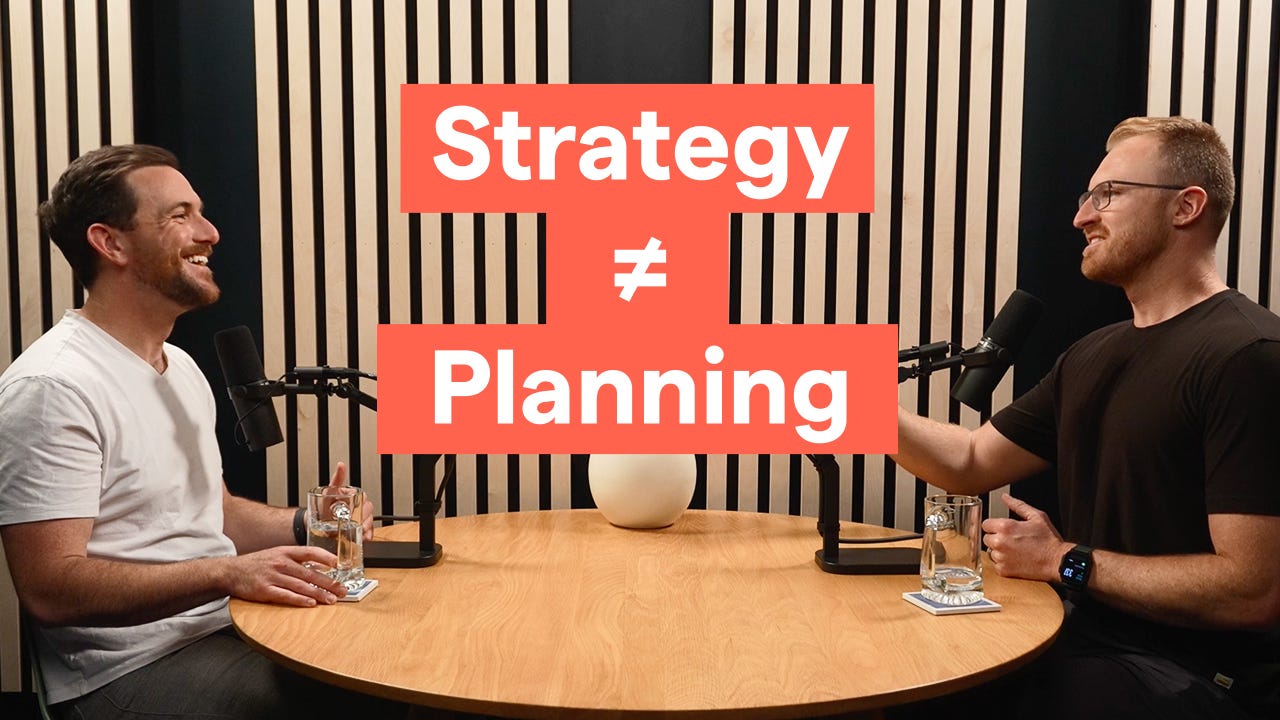
Everyone claims to be strategic. But what does that word even mean anymore?
In this episode, Eric and Jonathan dig into a question that comes up constantly: what actually separates strategy from tactics, and why do so many strategic plans end up collecting dust? Eric makes a bold claim: that strategy, at its core, comes down to one word: conviction. Strategy is not frameworks. Strategy is not 200-page slide decks. Strategy, at the end of the day, is having clarity and conviction about who you are, and more importantly, who you are not.
The conversation gets personal when Eric admits he lost that conviction at Cosmic, drifting toward service expansion before recognizing the pattern he’d seen in dozens of client organizations. Jonathan pushes back, pressure-tests the idea, and shares his own experience applying this thinking at the Seymour Center.
If you’ve ever sat through a six-month strategic planning process that ended in a fizzle, this one’s for you.
Notable Quotes
Eric [00:04:30] “There is a very strong conviction about who they are, but even more so who they are not.”
Eric [00:04:45] “Strategy is mostly about what are you saying no to versus what are you saying yes to.”
Jonathan [00:07:03] “I’ve been in a number of boardrooms on a number of strategic plans, and the impulse I find for most people is to go tactical. And to call it strategy.”
Eric [00:07:43] “It’s like trying to build a house without understanding what you’re even building. You might have a bunch of plans for the drywall and the framing and the tiles — but no one even knows why they’re building it.”
Eric [00:10:00] “I see this happen with the orgs we work with and I was blind to it for a long time — sort of like frog in boiling water.”
Jonathan [00:15:15] “My professor described photography as an extractive art rather than an additive one. When I’m saying no to things, I’m taking a photograph and excluding everything except the only thing I want to see.”
Eric [00:16:06] “The near enemy of conviction is having that conviction work in a moment in time and then never evolving. The conditions change, the sector changes, and you stay stubborn. That’s the near enemy.”
Eric [00:25:47] “The longer your strategic plan is, the more useless it is. 90% of strategic plans don’t actually matter and don’t actually get used by organizations.”
Eric [00:28:58] “Passion is not a strategy. It’s an important element. But you need conviction that not only do I believe in the mission, but I have a deeply held belief that this is how it should be done.”
Eric [00:29:22] “You can take any framework in the world, any approach — and if you don’t know what to say yes and no to, you don’t have a strategy.”
Resources & Links
Email the show: podcast@designbycosmic.com
Thanks for reading Designing Tomorrow! Subscribe for free to receive new posts and support my work.
Full Transcript
Eric Ressler What the fuck even is strategy?
Jonathan Hicken Does that word even mean anything anymore? I think strategy is a set of decisions that have good reasons behind them that you turn into action.
Eric Ressler If I had to choose one word to summarize everything, it would be conviction.
Jonathan Hicken You’re saying that there’s a hard separation between strategy and tactical execution.
Eric Ressler Strategy is mostly about what are you saying no to versus what are you saying yes to? And the longer your strategic plan is, the more useless it is. I’m Eric Ressler.
Jonathan Hicken I’m Jonathan Hicken.
Eric Ressler And this is Designing Tomorrow. Jonathan, today I want to talk about something that comes up a lot in my work and I think it comes up in your work too. I know it does actually. And let me kind of set the stage here a little bit. So sometimes people reach out to us to work with us and they ask a question that I find kind of interesting and a little bit funny too. And the question is, do you guys do strategy?
Jonathan Hicken Do strategy. Yeah.
Eric Ressler And every once in a while I have this kind of sick urge to be like, “Oh no, we don’t do any strategy work. We just tell us what you want and we’ll just make it happen.” Which is obviously kind of silly. But I think the reason people ask that is because what the fuck even is strategy?
Jonathan Hicken Does that word even mean anything anymore?
Eric Ressler Right. So I think I’m hoping today we can break down what does strategy even mean? What does strategic thinking mean? How does that loop into what we call in the social impact space commonly strategic planning? And how do we do that better in a way that’s actually constructive? I know you do a lot of this work at the Seymour Center. I do a lot of this work through our client work at Cosmic. So what do you think? Should we send it?
Jonathan Hicken Let’s get into it.
Eric Ressler Okay. So I want to ask you, what the fuck even is strategy, man?
Jonathan Hicken Man, okay. I think strategy is a set of decisions that have good reasons behind them that you turn into action.
Eric Ressler Okay.
Jonathan Hicken That’s what I’m going to put on the table as the starting position.
Eric Ressler All right. So those are your chips.
Jonathan Hicken That’s my opening bid.
Eric Ressler So okay, here’s how I’ve been thinking about this. I think there are a lot of flavors of strategy that all get lumped into this one word and they’re all different and they all serve a purpose. I think it also gets conflated with tactics, like tactics and strategy. So I’ve been thinking about in prep for this episode, just like as a little background, we do a lot of strategic work, quote unquote. There’s no agency in the world really that’s going to say they’re not strategic. And at the same time though, there’s a lot of agencies out there that are like, “Oh, we’re different because we’re strategic.” And it’s like, well, who’s going to claim they’re not? But that doesn’t mean that everyone actually is strategic. And the longer that I’ve been doing this work, the more I think our work really is strategic. And it’s really made me think about like, what does that even mean? How is that different than us just being creative only or us just being tactical only? And so I really started to kind of try and think deeply about this. I’ve read different authors and there’s all kinds of strategic frameworks out there.
You think about some common ones like the theory of change, right? Strategic planning processes. There’s a million frameworks for how to do that. We’ve talked about that before. By the way, I think we are slowly building an anti-audience of strategic planners who secretly hate us because we kind of talk shit on strategic planning on this show more than I think I mean to, but let’s just do it.
There’s also brand strategy, right? How is that different than strategic planning? There’s work that you do around building a case for support that’s highly strategic. So there’s all these different flavors of strategy, but I started to think about like, what is it that is similar about all of that kind of work? And there’s a couple themes that come up for me, but I’m going to put my chips on the table.
Jonathan Hicken Let’s hear it.
Eric Ressler And I’m going to say that at the end of the day, if I had to choose one word to summarize everything, it would be conviction. Conviction. Conviction.
Jonathan Hicken Okay. Let’s hear it. Unpack that for me.
Eric Ressler So the reason why I go there is because I think what I’ve noticed when I work with orgs who are deeply strategic and actually live that strategy, right? It’s not just sitting on a deck. It’s not a 200 page doc that’s collecting dust. It’s not this thing that everyone does for six months and then gets back to their real work, but where it’s like really truly embodied within the organization, there is a very strong conviction about who they are, but even more so who they are not. And so to me, strategy is like mostly about what are you saying no to versus like, what are you saying yes to? And to me, that means you have to have conviction because it’s one thing to have an idea about what your strategy is. It is an entirely different thing to actually live that idea and make those hard choices and say those nos when it’s really hard to do that.
Jonathan Hicken Okay. Counterpoint.
Eric Ressler Okay.
Jonathan Hicken You say conviction.
Eric Ressler Yeah.
Jonathan Hicken And where my mind goes is to like the classic tale of the charismatic leader, the person that speaks the loudest and speaks it well and is convicted about what they believe. But I don’t think you’re describing that right now.
Eric Ressler Right? Maybe. Maybe a little bit because I think what makes those leaders charismatic and what allows them to have conviction is they’re actually very deeply strategic. Not always, but often. And sometimes that strategy can be masked or overshadowed by their charisma or by their personality or by their network or all these things. But I think you get there by actually having a lot of clarity around who you are, who you are not, and where you are going, which to me, that is strategy more so than the how you’re going to do it, which is tactics, not strategy, or the plan, which often is used to mask a lack of conviction and boldness. It’s like, “Well, we need to raise 10 more million dollars, so we’re going to invest 20% more in our development team and et cetera.” Yes, all those things matter. Of course, these things need to be broken down, but only if there is a strong conviction underpinning all of it.
Jonathan Hicken If let’s say you have that conviction — by the way, I like this. I like this, partly because I relate to it and I want to convince myself that I’m strategic for this reason.
Eric Ressler Yeah, but let’s poke holes in it.
Jonathan Hicken Please. Yeah. I want to pressure test it because I want to be clear. You’re saying that there’s a hard separation between strategy and tactical execution.
Eric Ressler Yes.
Jonathan Hicken And so you can have a strategy that’s absent a sort of a tactical plan to get there.
Eric Ressler Yes.
Jonathan Hicken Okay. You think those things can exist separately?
Eric Ressler I think they should exist separately. I think they are connected and interrelated, but different. And I think they get very commonly conflated in our space.
Jonathan Hicken I agree with that. I’ve been in a number of boardrooms on a number of strategic plans and the impulse I find for most people is to go tactical. What are we going to do and how are we going to do it? And to call it strategy. So we’ll get to that, picking that apart for a second.
Eric Ressler Yeah.
Jonathan Hicken When you think about strategic thinking, strategic development, you are doing this totally absent of how are we actually turning that into work?
Eric Ressler Not totally absent. It’s a prerequisite. That’s the difference. That’s the distinction for me is like, if you don’t have that clarity and that conviction and that confidence in it and the willingness to actually embody that, not just talk about it, but actually do it, then basically nothing else matters. Everything else is like, it’s like trying to build a house without understanding what you’re even building and you might have a bunch of plans for like, “Well, this is how the drywall is going to go up and the framing and here’s the tiles we’re using.” But no one even knows why they’re building it or what they’re not building. That’s kind of a metaphor you might use to think about it and then people call that strategy.
And so I see this show up in a few different flavors and I think what often happens is there’s this kind of mission creep and mission drift that can happen where there might even be a really strong strategy or conviction or theory of change or use your buzzword to describe essentially like, “This is who we are and this is how we do our work and here’s why it matters.” And we should maybe unpack what some of these ingredients are a little bit later, but that can kind of start to happen and then things change, right? Leadership changes, new opportunities come into being or a new grant will come in and then all of a sudden like, oh, we spin up this program over here and all of a sudden there’s like not really a coherent strategy anymore or a coherent conviction. And actually, I want to talk a little bit about how I’ve been thinking about this at Cosmic as part of this episode too, as just like an example.
Jonathan Hicken Yeah. Often in designing tomorrow and our conversations where you’re kind of bringing the lens of seeing lots of different organizations doing lots of different kinds of work and I’m bringing the conversation over the lens of an active executive director in the space. But I actually think this is one of those cases where you as the founder and creative director of Cosmic comes into play because I want to hear about Cosmic. How are you thinking about strategy and how does conviction come into play for you?
Eric Ressler So I think like maybe partly why I was excited to do this episode and suggested the topic, and this again came through one of our fried chicken dinners, which one day we got to start inviting the audience into one of these things.
Jonathan Hicken This last dinner was a banger by the way.
Eric Ressler That was good. We are apparently incapable of doing one that’s under three hours. I’m starting to realize as far as schedule. But I’ve actually realized that I’ve lacked conviction in our strategy at Cosmic and it’s this thing that, and maybe I feel this more than other people might, but this also started to happen in a way that’s like really funny because I see this happen with the orgs that we work with and I was blind to it for a long time, sort of like frog in boiling water kind of situation. And I think what happened for me is like, I understand our sweet spot and I started to see how our sweet spot connects to all of the other equally important elements of a successful brand. And so if I had to really describe our sweet spot, the way that I would think about our work and what we’ve done for the last 15, 16 years in this space, outside of the space, we help people understand who they actually are, what sets them apart as an organization, which can be really hard to do on your own, and then how to best communicate that with confidence and conviction.
How that shows up shows up in a bunch of different ways, but that’s really what we do. The work is transformative, the work is sometimes highly emotional. It can almost feel like therapy at times to really dig deep to get past that surface level like, “Oh, well, we’re this kind of org in this space.”
Jonathan Hicken And I can vouch for that because I’ve been on the client side twice now, and so I can vouch for that. That does happen.
Eric Ressler So to me, however that shows up, if it’s a rebrand or a website overhaul or an impact report or a campaign, that’s our approach to the work. That’s our sweet spot. But what I noticed over the years is doing that work is transformative, but it is not comprehensive. Getting that clarity is foundational, but there’s all the other parts that matter as well.
Jonathan Hicken You’re talking about fundraising, you’re talking about team development, you’re talking about whatever, all that stuff.
Eric Ressler Yeah. Even more like direct response marketing, which is also really important, but not our sweet spot. And I found myself being tempted by these different pathways of like, “Oh, and what if we did that too?” And clearly our clients need help with this and we should help with that too. It’s a common agency trap of scaling services. And it’s kind of a similar thing that can happen nonprofits with grants or whatever it is. This sounds familiar. So it’s like, I’m aware of this and yet it happened to me too. And so what I realized is that I started to lack conviction about what our sweet spot was and to own that and to say no to the things that were like, “Yeah, that’s in our wheelhouse. It’s on the outskirts, but sure, we could start there.” And my brand strategy right now at Cosmic and where we’re going is to just double down on that sweet spot for a couple reasons.
One, I believe strongly it’s important and I’ve seen the benefit of that work to be truly transformational internally, externally for our clients and people need it and people want it. And there’s a bunch of different ways for me to grow the business to expand. And I don’t even mean grow in terms of headcount or revenue, but just to do this work more fully and more meaningfully over time. And yet I think actually the best thing that I can do for our brand is to just really, truly understand that’s our sweet spot and get better and better and better and better at it and just like own that. For the social impact space, there’s other things I could do in terms of like, should we double down on a particular focus area or category? But I’ve pretty intentionally decided not to do that. But it’s this weird reflection that I came back to that’s like, that is us and that’s enough.
That’s enough.
Jonathan Hicken So what the fuck is even strategy? I think what I’m hearing from you is it’s conviction, but I heard a couple of pieces, so I just want to make sure I’m hearing this correctly. One, there’s almost a self-awareness piece.
Eric Ressler Huge self-awareness piece.
Jonathan Hicken A self-awareness piece. And for a while there, it sounded like you started to lose a bit of that sort of clarity in your own self-awareness.
Eric Ressler Kind of like organizational self-awareness, but also personal self-awareness.
Jonathan Hicken I’m sure. Yeah. I’m sure on the leadership side too. But like Cosmic, you were like, for a moment there, you were losing sight of, or actually kind of losing grasp on the self-awareness.
Eric Ressler I think losing grasp and confidence.
Jonathan Hicken Yeah, and confidence, sure.
Eric Ressler But keep going because I want to come back to that thread.
Jonathan Hicken Okay. So that’s one thing I’m hearing you say. I’m hearing you also say like a brutal ability to say no, and to saying no to the things that you’re not informed by that self-awareness.
Eric Ressler Yes.
Jonathan Hicken And actually I love that. I just want a quick tangent because I think actually I think about photography a lot when it comes to this element of strategy of seeing what you are and seeing what’s not. Because I took this photography class at college once and the professor described photography as an extractive art rather than an additive one. And that has stuck with me for decades. And I often think about when I’m saying no to things, the picture that comes to mind for me is I’m taking a photograph and I’m excluding everything except the only thing I want to see. Anyway, so I think like there’s that like — and you’re a photographer actually, so this is part of your natural skillset. Part of what you’re just saying is you’re extracting all the stuff that’s not necessary and you’re only putting in frame the things that are in alignment with your self-awareness and that conviction.
Eric Ressler Yeah, I think that’s right. Now here’s what makes that really hard. The near enemy of that is like having that conviction and having that work in a moment in time and then never evolving, right? Like this is our spot, this is who we are, this is what we do. Meanwhile, the conditions change, the environment change, the sector changes, the needs change, the problem changes, and you stay stubborn in that. That’s the near enemy of that conviction. And so it’s tough because you have to know when to evolve and when to iterate, and you have to know when to be true to who you are at your core and what sets you apart.
Jonathan Hicken I mean, those things aren’t necessarily mutually exclusive though, right?
Eric Ressler Definitely not.
Jonathan Hicken Yeah. I mean, you could be convicted about Cosmic’s role. The industry may change and how we communicate may change, but transformations for social impact organizations, that’s not really going anywhere. I don’t think that’s going anywhere anytime soon.
Eric Ressler Right. So this comes down to like, how do you frame that conviction? How do you think about it? If I put myself in the bucket of defined by our deliverables or our tactics, then you see some agencies that like we’re a HubSpot agency or something. That’s a dangerous conviction to have because you’re attaching yourself to another brand or a particular platform that you can’t control. You see these startups who build on, back in the day would build on Twitter and then Twitter would change their API and they’re basically extinct overnight. So they are not mutually exclusive, but I want to acknowledge that it is difficult. It is difficult to both have that conviction and clarity around like, “This is who I am,” being really bold and protecting that, knowing where those boundaries should be, setting those boundaries, consistently holding them in a constructive way for your team, and saying no to a lot of things that are enticing, exciting, even aligned in some ways, but not perfectly aligned.
And I’ve heard this said in a different way, which is like, and it gets into this kind of self-help oversimplification sometimes for me, but it might be a helpful heuristic at some level, which is like either hell yes or no. It’s just like everything either needs to be hell yes or no. To me, that’s a little overly simple, but it is closer to the truth than not.
Jonathan Hicken When I imagine this decision making, I’m just thinking about my own, the way I think about strategy here, I’m constantly cross-referencing with how it’s actually going to play out. And so I want to unpack this a little bit because, just to be clear, when I use the word strategy, it’s everything we’ve been talking about, right? Or actually we’re trying to figure that out. But tactical one, that’s a little bit clearer to me like what a tactic is. And the tactic is like, what’s the actual work? What are we actually going to do? It’s the how. So I do think about the how even when I’m thinking about strategy and to me, these things aren’t clearly uncoupled. And so for example, I love this book, it’s called Good to Great, and it’s one of my favorite business books. And one of the things that they talk about is first the who, then the what. And so I think fundamentally, one of the things that I go to constantly is who is on my team, where are our skills, where are our strengths and weaknesses?
Are there other skills I need to bring onto the team in order to accomplish said strategy? And if I set a strategy that’s misaligned with the people that I’m working with, then that strategy is for not. So how does that fit into the conviction mentality?
Eric Ressler Well, I think that is partly where this gets tough because there are going to be times potentially where the strategy needs to change and you don’t have the right people in the right seats to help move that change forward. There are other times, I think, and this is probably more close to where I came from, where that’s just the wrong strategy because you don’t have the team to support that strategy. And maybe that’s a sign you’re getting out of bounds a little bit, right? Is this our core strength as an organization? Do we have the talent, the expertise, the experience, just the right alignment around that approach? And so I think there’s the who, that’s a very important part of this. I wouldn’t want listeners to think that, oh, I don’t have the team, so that’s the wrong strategy, because I don’t think that’s always true.
Sometimes I think you have to be open to like, there’s this new strategy that is right for the moment, that there’s a need that no one is filling, that we are, even though we’re not currently able to fill that need, we are best suited to fill that need out of anyone else that we’re aware of in the space. But that’s going to require training, that’s going to require growth, that’s going to require recruiting. That happens all the time and should happen. But I don’t think that you should build a strategy that you can’t logically figure out how to support with the right people, with the right tactics.
Jonathan Hicken Yeah. All right, fair enough. So the conviction comes from either, do I have the right team or can I build the right team? I mean, that has to be a question in the development of a strategy, doesn’t it?
Eric Ressler I think so for sure. And I think, again, my point with this is that I don’t think there’s a deficit of that kind of thinking as much in our space as there is of the deeper strategy work. I see a lot of strategic plans that outline who to hire, which programs to invest more and which programs to invest less than, but they are not underpinned by a coherent strategy or some kind of conviction about really who they are. Sometimes also I’ll just say this gets masked or conflated with, “Well, we have our vision statement and we have our mission statement.” And if those are done excellently, they can serve as a strategic anchor or a north star for the organization. That doesn’t happen very often, just straight up. How many people do we work with that are constantly regurgitating their vision to us? Very few.
And those get done in these retreats and then they get put on the website and then they get frankly largely forgotten. And so this goes deeper than messaging, it goes deeper than language. And it often comes frankly from like, how did the organization start? What was that spark? What was the core DNA? So for example, just to bring my own DNA back into this, if I had to choose one word to describe who I am, it would be designer. I’m a designer, I’m a creative person, I’m a musician, et cetera, et cetera. But professionally, design is my mental model of the world and I see everything through that model. So no matter what we do, no matter how we describe ourselves, no matter how we position ourselves, if it’s not designed forward, it is not going to be aligned with that conviction that I need to have to be able to say yes to certain things and no to others.
And I have a pretty broad view of what design is, so that works for me. But that’s where I would often look is like, what is that kind of core spark, that initial seed that everything grew from as part of the DNA of the organization?
Jonathan Hicken Yeah. And I mean, I relate to this. I think about my conviction that public spaces can be powerful catalysts for social change, like physical spaces. And that conviction drives Seymour Center strategy of becoming this hub for local resilience. And so I believe in the power of public spaces, and that is fundamental to how we’re building our business here. And I’ll sing that from the rooftops. So I think in that regard, I certainly relate and I see the power of that, even conversations with my own team and with donors and other stakeholders here of, if I show up with conviction, it’s almost like the self-fulfilling prophecy where they can become, actually the strategy can emerge.
Eric Ressler I think why I landed on the word conviction is because by definition, in order to have conviction in any meaningful way, it requires that you have some kind of strong belief as an organization and/or as a leader. And if you don’t have that strong belief, you kind of by definition can’t have conviction or confidence in that approach. And I think that that is, to me, if I really had to boil down strategy out of all these different — and again, hey, there’s frameworks for things. I’m not poo-pooing all those frameworks. You should never have a theory of change or whatever. That’s not the takeaway. The takeaway here is none of that matters if you don’t have some kind of deeper, strategic underpinning, some kind of belief that drives this work that you can have conviction in. And that also means that you act accordingly, right?
You have that conviction and sort of by definition, you can’t have conviction if you don’t act on it. That’s just an idea. Conviction to me is an active word. It’s a verb, right? It is something you do. It is not something you think.
Jonathan Hicken I do want to poo-poo some of the strategic processes.
Eric Ressler Let’s go there, man.
Jonathan Hicken Because even — I was at lunch today, literally, with a few other executive directors of nonprofits, and multiple people said that they had done this six month strategic planning thing, and it had ended in a fizzle, and they had just spent months on this thing, and really not a lot came out of it. And where my mind goes is, were those strategic planning consultants pressing these individuals to define what they’re convicted about?
Eric Ressler Probably not. So I mean, look, I’m going to hop on the strategic planning negative bandwagon here for a second. So we have received hundreds of strategic plans at this point. I’m going to make a couple claims. A, the longer your strategic plan is, the more useless it is. B, 90% of strategic plans don’t actually matter and don’t actually get used by organizations. Now, is there value in going through a strategic planning process? Of course there is. Going through some kind of retreat to do that, working with a consultant to do that. Of course. I think so. Yeah.
Jonathan Hicken Even just a minute ago, we talked about the value of having a third party perspective to help you see who you really are, right? So yes, there is value.
Eric Ressler I think the other thing about strategic plans is that, and this comes back to the word conviction for me, it’s one thing to have a plan and to put it in a deck and to try to embody that into an organization. It’s another thing to actually do that plan. And this kind of comes back to some of the ideas around design thinking even around testing assumptions early in the market, getting early prototypes and validation of those ideas early because plans are just plans at the end of the day, right? And they do not — they’re by definition imperfect. And I’m not saying you shouldn’t have a plan and everything should just be done with vibes or shooting from the hip where I know we’re in a vibes economy right now, but I don’t think that’s a responsible way to steward donor dollars in the world.
And at the same time, I’ve seen so many strategic plans and strategic planning processes skip that deeper work and they feel a little bit tactical most of the time. It’s all about the how. And maybe it’s just it’s hard to transfuse that deeper experience that maybe the org went through that we weren’t part of. But I honestly think that it would be a lot better to really just rapidly get to the core of this as quickly as you can, just enough strategy and then test it. Test it in the real world as soon as you can.
Jonathan Hicken Yeah. Go listen to the minimum viable strategy approach episode we did a little while ago. I mean, we break it down a little bit more like how to actually do it in that episode. I’m hearing some advice in here for future executive directors or social impact leaders, right? Which is almost like if you are in the process of choosing whether or not you’re going to join said organization or not, I think what I’m hearing you say is you got to ask yourself, are you really convicted about this? Is there some deeply seated belief you have that fits into the work of the organization you’re considering joining? And if you don’t feel that conviction, should you really do it?
Eric Ressler I think that’s a great test. Yeah. And I think that there’s a lot of feelings in this space around — and for good reason, I believe in this work, I believe in the cause, I believe in the mission, and I think that that is important, but it is not enough.
Jonathan Hicken It’s not enough. I totally agree.
Eric Ressler It’s not enough, not because it’s not good enough, but because that is not a strategy, right? Passion is not a strategy. It’s an important element, but you need to have that conviction that not only do I believe in the mission, but I have a deeply held belief that this is how it should be done. This is the way we’re going to do it. This is what is a yes and what is a no. At the end of the day, you could take any framework in the world, you could take any approach to this in the world, and if you don’t know what to say yes and no to, you don’t have a strategy.
Jonathan Hicken I’m thinking about homelessness as an example here, right? Like you may be thinking, yeah, homelessness is something I care deeply about and I think it’s really important for us to solve, but do you believe deeply in say the housing first strategy to solving this problem? Do you believe that deeply at your core or do you just sort of generally believe that homelessness is something that we should be working on?
Eric Ressler Yeah. I mean, I think that’s a good test that you could do for any niche, for any kind of focus area. So hopefully this is a good way. We didn’t get into all the details around different frameworks of strategy, but I just hear this word being thrown around to the point where it’s basically ubiquitous and there’s no definition around it. So I think it was good to just kind of unpack what does it mean to be a strategic thinker in this space? And this is my version of it. Other people can come up with their own, but it’s the closest that I got.
Jonathan Hicken Well, hey, honestly, like you’re saying, and I’m like, gosh, that works for me. That works for me in my position as an executive director. I’d actually be really curious to hear if other listeners think this fits.
Eric Ressler Yeah. So listeners can email us at podcast@designbycosmic.com. We get those, we read them, so please do. And Jonathan, yeah, thanks for riffing with me on this one today.
Jonathan Hicken All right. What the fuck is even strategy? I think we got there.
Eric Ressler We got a little closer at least. All right. Thanks, Eric. All right. If you enjoyed today’s video, please be sure to hit like and subscribe or even leave us a comment. It really helps. Thank you. And thank you for all that you do for your cause and for being part of the movement to move humanity and the planet forward.
Good discussion, thank you. From my own perspective, strategy has been taffy-pulled beyond any real meaning or value. I've foynd myself saying "pragmatic" more than "strategic" when it comes to planning requests, especially within the past 2-3 years.
I've also noticed less demand for strategic plans/planning by client orgs themselves and more demamd/requirement from funders that proof of a plan (any plan) emerged or evolved during something that involved strategy.
To be fair, I do know groups that tout their adaptive, reactive, creative, innovative etc selves more than thier strategic personae. But saying something is strategic instead of proving it's effective, valuable, beneficial, useful is just weird.
Dislcosure: I say this as some who "does strategy". But the actiony/implementy kind not the thinky kind. 😎