


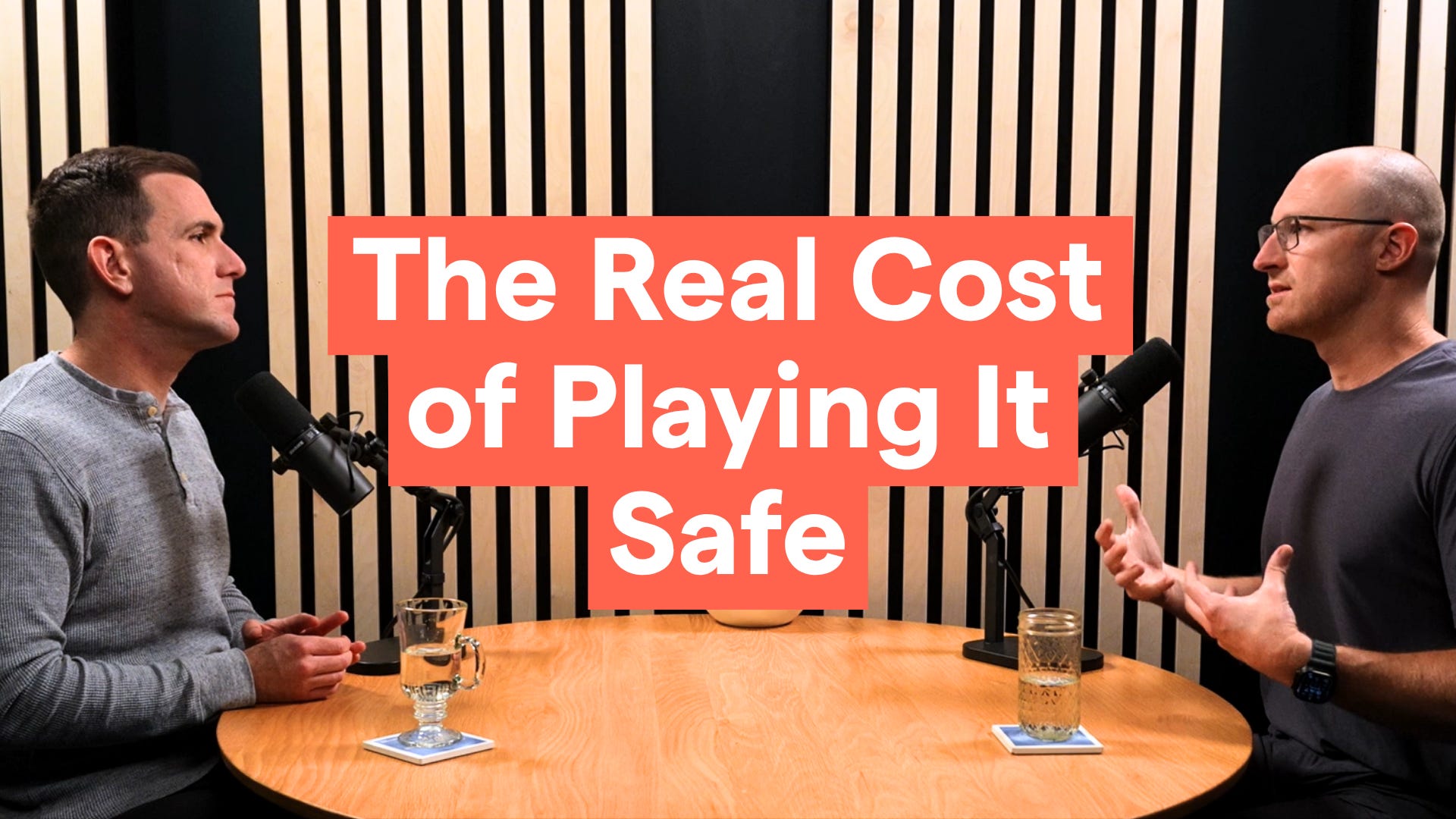
Jonathan recently learned that the Seymour Center is about to absorb a permanent new expense in the $150,000 to $200,000 range. On a $2.2 million operating budget, that’s roughly 10% of the whole thing, and it’s not a one-time hit. This is a structural cost that will be there every year going forward. The instinct for most leaders in that situation is to pull back: tighten the budget, pause the big swings, and try to right-size the organization around this new reality.
The problem is that the Seymour Center is in the middle of what Jonathan describes as a liftoff moment. The initiatives are fundable, the visibility is growing, and the conversations he’s having with donors right now are some of the strongest he’s ever had. Contracting wouldn’t just save money. It would change the story he can walk into those rooms and tell.
There’s a saying Eric brings up from the business world: never need a deal. Funders are wired to pick up on desperation, and even if contraction doesn’t make you desperate, it moves you one step closer to that energy. Organizations in motion attract investment. Organizations explaining why they pulled back are playing a different game entirely.
Eric shares his own version of this tension from running Cosmic through the pandemic and the USAID funding fallout, periods where he faced the same question about layoffs and pay cuts. He’s never done either in 16 years, partly because rebuilding a team costs more than carrying one through a rough stretch. But some of those calls were risky.
The conversation also gets into the ego side of these decisions. Jonathan admits he’s constantly checking whether the urge to push forward is serving the Seymour Center’s mission or serving his own ambitions as a leader. They explore when contraction genuinely is the right call, what nonprofit mergers look like in a shrinking funding landscape, and why Eric remains underwhelmed by how the philanthropic sector has responded to the structural challenges hitting organizations across the country right now.
Episode Highlights:
[00:00:30] Contract or keep pushing? The fundamental question.
[00:02:00] The outdated overhead myth and why it makes budget shocks worse
[00:04:00] Building reserves as a moral question, not just a financial one
[00:05:30] The power of flexibility that reserves actually buy you
[00:08:00] Eric’s pandemic-era decisions at Cosmic: no layoffs, no pay cuts in 16 years
[00:11:00] What contraction would actually look like at the Seymour Center
[00:12:00] Why liftoff windows are sacred and rarely repeat on your timeline
[00:14:00] Funding the gap: earned income, price increases, and philanthropic bridge funding
[00:17:00] The story you can tell funders when you’re in motion vs. when you’ve pulled back
[00:20:00] Does the upside of the risk outweigh the downside of contraction?
[00:20:30] Separating ego from mission in high-stakes financial decisions
[00:22:30] The case for nonprofit mergers in a shrinking funding landscape
[00:27:00] A call to funders: pivot funding and why philanthropy is still falling short
Notable Quotes:
[00:12:30]: “I think we’re in one of those times right now, and I don’t know if the external conditions will ever quite look like this in terms of where we’re positioning ourselves and the promise that we’re making.” Jonathan Hicken
[00:13:05]: “Energy is magnetic. You can feel it, and when you have it, use the lever, man. When you have it, focus that energy because you never know when that’s going to happen in the same way.” Eric Ressler
[00:17:00]: “I can go to those meetings right now and sit down at the table and look at these people in the eye and both confidently and authentically tell the story of this liftoff story. If I start to contract, I can’t do that.” Jonathan Hicken
[00:18:10]: “There’s a saying in the business world: never need a deal. I think we’re wired as humans to just be super attuned to desperation.” Eric Ressler
[00:20:50]: “You got to be ultra clear as a leader about who is this for and how much of this is your own ego versus how much of this is what’s best for the organization.” Jonathan Hicken
[00:28:55]: “We’re in a moment right now where because of this situation, we have an opportunity at a global scale to reimagine what the sector looks like and that’s exciting.” Eric Ressler
Resources & Links:
Seymour Marine Discovery Center — Jonathan Hicken’s ocean science center at UC Santa Cruz
Visibility Beats Impact — Designing Tomorrow podcast episode
P.S. — Struggling to align your message with your mission? We help social impact leaders like you build trust-building brands through authentic storytelling, thoughtful design, and digital strategy that works. Let’s talk about your goals »
Full Transcript:
Jonathan Hicken [00:00:00]: Eric, recently I learned that the Seymour Center is going to be facing a new expense that makes up 10% of my annual budget.
Eric Ressler [00:00:10]: Fun.
Jonathan Hicken [00:00:10]: And it’s coming out of nowhere.
Eric Ressler [00:00:10]: Okay.
Jonathan Hicken [00:00:15]: And I have this really big fundamental question right now, which I think many of our listeners are probably also thinking about, which is do I contract or do I keep pushing forward on my current pace? And so I want to dig in to this fundamental question with you today.
Eric Ressler [00:00:30]: Okay. Let’s do it, man.
Jonathan Hicken [00:00:40]: All right, let’s go. So Seymour Center, we run about a $2.2 million operating budget and we’ve got this new expense that’s going to be in the 150 to 200,000 a year range. And it’s coming out of nowhere. I’m not going to get into where it’s coming from or why it’s happening, but the fact of the matter is it’s coming. And at the same time, we are at this inflection point as an organization where I think we are on the proverbial launchpad and the rocket engines are firing up and we’re about to take off. And so there’s this tension I have, which is do I contract to quickly absorb this new expense or do I start dipping into a healthy reserve? We have a healthy reserve. Do I start dipping into that to achieve liftoff and build the business that will sustain this new expense?
Eric Ressler [00:01:35]: Yeah. I think first of all, I love the topic. I think so many people in our space in our sector are dealing with various forms of budget cuts and contractions and challenges that hit finances at the top line. So really excited to dig into your specific situation and hopefully walk away with some actionable tips and even more than tips, mindset around how to navigate something like this as a leader. So my first question is, is this a one time budget cut? This is one year or this is in perpetuity for you?
Jonathan Hicken [00:02:05]: This is in perpetuity and it’s a systematic new expense, right? So it’s an expense. It’s not a loss of funding. And so this expense is going to persist. Fundamentally, I need to now build a business that can sustain that expense. So I’m faced with this question of, do I contract as the immediate response or do we keep the pedal to the metal?
Eric Ressler [00:02:30]: The first thing that’s coming to mind for me that reinforces one of my beliefs is that there’s this model or this benchmark that’s really, in my opinion, way outdated and needs to change culturally, which is, “Oh, well, you should be running maybe 10 to 15% overhead and 85 to 90% direct program expenses.” What happens now? So now you just have zero overhead or 5% overhead. Not that those are your exact numbers probably, but so now there’s this pretty substantial expense that comes in that’s in perpetuity, that’s just going to have to be cost of doing business for you. And it’s been cool to watch as a partner, as a friend, as a colleague, this moment of momentum and expansion. I think it’s worth noting that you are in a unique position and that you have some reserves. And that’s not uncommon, but it’s not guaranteed either.
So some of our listeners may be facing a similar situation with zero reserves or very little reserves. So I think we should acknowledge that that gives you a position that gives you more choices than if you had no reserves. If you had no reserves, there really wouldn’t be a choice, right? Other than trying to rapidly build a new model or find some additional pivot funding or sustaining funding to keep going in the new model.
Jonathan Hicken [00:03:45]: One other factor here that might be unique to us is that we also have earned income because we’re a science center and aquarium, right? We can sell tickets, we can rent the facility. So there is this option of raising prices. Now that has a bunch of other implications about who can and can’t access our space, which might be something we want to talk about in a minute. But to the point of reserves, we did make it a priority to build those reserves over the last few years to build this rainy day fund. For us, it actually came from a place of a COVID fear because we knew if COVID happened again, that was so detrimental to the budget we needed to have that nest egg. Thankfully that hasn’t happened, but now we have this reserve sitting there. And so there’s also this moral question of, is this impact money that needs to be deployed anyway?
And so there’s this pull in that direction to say, well, we should mobilize that money because it’s there. It’s not delivering impact right now. On the other hand, if we spend it down, now I’ve just risked the organization by pulling that nest egg away.
Eric Ressler [00:05:00]: What comes to mind for me listening to all this is a couple things. One, the power of having reserves and I know that it’s easy to say, we’ll build some reserves. It’s another thing to actually be able to do that, but it’s coming up as an example of the power of that flexibility that it gives you. And I think that there’s a lot of orgs that don’t have those reserves and then they face these challenges that suddenly become existential. So that’s one point that I think is important to acknowledge. And then the second point is that I really like the way that you frame that, this money here that’s not delivering impact. And what it’s making me think about as a leader is there’s always these risks that you have to think about responsibly stewarding for your mission. I think there’s a risk balance that’s good to strike as a leader where if you’re too risk averse all the time, you’re basically guaranteed to never grow and never improve in my opinion.
But if you’re too risky, there’s a threshold at which you’re just literally playing it fast and loose and it could have potential negative downstream effects to the staff that you owe a responsibility to, to the impact, to the community that you serve. So my initial reaction to this is that you have this rainy day fund, these reserves that you’ve built up and you had earmarked it specifically for another COVID. But I wonder if maybe it should have been thought about, and maybe you did think about it this way, as just a reserve for unexpected setbacks at different scales, right? Another COVID-like situation would be really challenging for a place-based organization, but this is another form of that challenge. What comes to mind for me is that the rainy day or the reserves are not a long-term solution and I don’t think that you’re proposing that they are, but it could be used strategically to help you get through to the next level and reimagine or reinvent the business model with this new expense in mind without losing the momentum that you’re building up right now.
Jonathan Hicken [00:07:05]: If we don’t mobilize that money, I mean this is the other side of the risk, right? You just laid out what happens if we go too far with the riskiness, right? If we get fast and loose, we’re totally out of money, now we put ourselves in a vulnerable position, another unexpected setback could happen and now we’re screwed. But then there’s this other side of, okay, what’s the implication of contracting now and what does that mean in terms of the promise we’ve made our community and the impact that we have promised we’re going to deliver if we pull back now, how many years is it going to be before we can get back to this moment again?
Eric Ressler [00:07:55]: I think about this a lot. So I’ll share a similar example from running Cosmic, which is early in the pandemic we had a similar challenge. Everyone went through some kind of challenge there where anytime in our space in the work that we do that there’s some kind of period of major uncertainty, and we saw this in the pandemic, we saw it again with Trump’s reelection and the USAID cuts and just all the DOGE stuff. When orgs in our sector understandably contract or wait and see and it’s difficult for them to plan, that has a direct impact on our bottom line at Cosmic because the kind of work that we do requires people to make big moves and have some level of certainty about their path and their future. And so we’ve had periods where we’ve had to pull from reserves or have similar existential questions, do we do layoffs? Do we do pay cuts? How do we manage this? And the thing that I’ve always struggled with there is, first of all, I’ve never laid anyone off. I’ve never done pay cuts in 16 years and I’m proud of that. And also one of the reasons I’ve made some risky moves, just to be frank about it, is because I’ve spent so much time building up the people on my team that have deep expertise and knowledge in our work and I just have so much that I value about that and I know how expensive it is to recover from turnover or to recover from having to... It’s like you take a step back, but it takes three steps to get back to where you were or to where you’re trying to go as an organization. So sometimes that’s the responsible move, sometimes that’s the necessary move.
I don’t judge when organizations make those calls. And in certain ways, I sometimes respect leaders that do it because especially in our space, when you’re doing that, we’re not talking about tech layoffs here, right? We’re talking about people who have passion for this work, leaders who have passion and respect for their team, having to make really difficult decisions. And I do have respect for leaders who make those choices boldly and intentionally and in a human way that acknowledges the strife that causes on individuals in the community. But I think it’s a riskier move in certain ways if you have the ability to reach into deep pockets or into reserves that you have or to find a creative pivot funder or something or even an emergency fund or something like that that allows you to keep that momentum going. That’s usually my personal instinct, but I know that that’s not always what’s happened and we can talk about what I’m seeing at the sector level too. But I want to keep hearing a little bit more about what would contraction look like for you?
Jonathan Hicken [00:10:40]: Contraction would look like basically hunkering down and focusing on some core programs and turning our attention away from some of these big swings like Seymour Studios, right here, right now. We could pull back from this and move the investment to core programming. Just for example, that is a viable option for us. We could say, “Hey, look, now’s not the time to achieve liftoff. Let’s right size the budget with this new expense and maybe it’s two or three years down the road, let’s try again.” And that’s our eyes on the prize a few years down the road. And there is a fair question to be asked right there, which is, all right, bro, so what, three more years? The ocean’s not going anywhere, the community’s not going anywhere. What’s the problem?
Eric Ressler [00:11:35]: Yeah.
Jonathan Hicken [00:11:35]: You look like you are...
Eric Ressler [00:11:40]: I’m cringing here a little bit and the reason I’m cringing is because it’s just like I feel like moments of potential liftoff are sacred and getting all of the conditions in place for that to happen can be really, really hard and some of that stuff’s not even fully in your control. So when there’s this liftoff potential, this window of opportunity to turn it off, it just feels so hard to do that because it might be three years from now, but maybe three years from now, there’s a whole new set of challenges that you could never plan for.
Jonathan Hicken [00:12:15]: And this is, I think the timeliness of it is, I think in business of any kind, there’s a certain amount of luck, right?
Eric Ressler [00:12:20]: Absolutely.
Jonathan Hicken [00:12:25]: And being at the right place at the right time with factors that are totally out of your control. And I think we’re in one of those times right now and I don’t know if the external conditions will ever quite look like this in terms of where we’re positioning ourselves and the promise that we’re making. It’s almost like the other side of me, right, in contrast with the “chill bro, three years is no big deal.” The devil, so to speak, on this shoulder is being like, “Dude, this opportunity’s never going to come again.” You got to go now and you got to go hard. And if you get it, that flywheel starts turning and you will right size the budget.
Eric Ressler [00:13:05]: My other point of view on this is that energy is magnetic. You can feel it and when you have it, use the lever, man. When you have it, focus that energy because you never know when that’s going to happen in the same way. And I do think we need to be careful about, there’s a lot of limiting beliefs or you can go too far the other way around like, “Oh, this might never ever happen again. And this is all luck.” And I know that’s not what you’re saying, but just trying to put myself and our listeners’ shoes here for a second. So this all comes down to at some level just making the best choice that you can as a leader and acknowledging that these decisions are difficult. I guess my question would be, let’s tease out the trajectory where you draw from the reserves and you plow ahead and you use this energy. How are you thinking about solving this new structural deficit that you have or this new structural expense that’s basically asking you to increase your overhead or your operating budget by at least 10%, if not more, to cover this new expense? What are your ideas around how to fund that long term?
Jonathan Hicken [00:14:20]: First is some of that growth or some of that transformation that can occur is going to happen within the space. And so we’re going to be delivering more value in the space to visitors, which will justify a price increase. And so I think in our market there is room for some price adjustments. I don’t think we could make those price adjustments now before we’re delivering that additional value. So part of it is achieving liftoff, delivering that value in the space and that justifies the price increase. So that’s part of it.
B is that I think some of these big swing initiatives are highly fundable particularly from private foundations and major donors and we would build into those financial proposals, be transparent about where we are with our budget and what we’re trying to make up and work with the funder, work with the partner to be able to right size that budget, just being very open about it. And I have some leads on that and these are conversations I’m planning to have, but part of it would be buoyed by philanthropy or be bridged by philanthropy.
Eric Ressler [00:15:35]: Hey friends, real quick before we continue today’s episode, I’m Eric Ressler, founder and creative director at Cosmic. Cosmic is a creative agency purpose built for nonprofits and mission driven organizations. For the last 15 years, we’ve helped leaders like you nail your impact story and sharpen your strategy, but we’re not here to just leave you with a fancy slide deck and a pat on the back. We roll up our sleeves and help you bring our ideas to life through campaigns, creative and digital experiences. Our work together helps you earn trust, connect deeply with your supporters and grow your fundraising and your impact. If you value the thinking we share here and want it applied to your biggest challenges, let’s talk at designbycosmic.com. All right, back to today’s conversation.
I think the other thing that comes to mind for me is we just did an episode recently about how important visibility is and a lot of these big swing moves that you’re making right now are building massive visibility for the Seymour Center, which will also in theory, and I think you’re starting to see some of this potentially, you tell me, higher visitation, right?
Jonathan Hicken [00:16:40]: Exactly.
Eric Ressler [00:16:45]: So it’s not even just about raising prices, but filling capacity and making sure that you always have the right number of people coming in every day.
Jonathan Hicken [00:16:45]: It’s hard. I mean, I’m having conversations with funding decision makers right now in a variety of sectors that I can go to those meetings right now and I can sit down at the table and look at these people in the eye and both confidently and authentically tell the story of this liftoff story. And I can tell that story because I believe it and it’s happening and it’s now. If I start to contract, I can’t do that. That wouldn’t be true to what we’re doing, right? It would be a different story.
Eric Ressler [00:17:25]: That’s a really interesting, but I think important point, which is that so much of your success in growth and fundraising is being able to have a true story that you believe that you can tell the story with full transparency and excitement that we are building something here and we are in motion. That’s what funders want to see. They don’t want you to come in and say, “We’re stuck and we need your help.” I mean, really forward looking progressive funders that you maybe already have a relationship might come in and help you pull you out of a pickle. But there’s these downstream, even maybe subconscious problems that I know this is true for me. There’s a saying in the business world that never need a deal. I think we’re wired as humans to just be super attuned to desperation. I’m not saying you would be desperate if you were to contract, but you would be one step closer to desperation, right?
Jonathan Hicken [00:18:25]: Yeah, it would be a different tone for sure.
Eric Ressler [00:18:25]: It’d be a different tone and people get excited about organizations in motion who have energy. And so there’s this flywheel we talk about a lot. And so I guess maybe one thing that comes to mind for me is, and I have some thoughts on this, but I’d like to hear yours first, when is a contraction or maybe another version of that that I’d like to introduce to this conversation, a merger with another organization because of a contraction, when is that the right call? When is that actually the responsible thing to do or maybe even the most impactful thing to do?
Jonathan Hicken [00:19:00]: Well, I think the scenario, and this is where there’s probably variation in the circumstances, because there may be times where right now we’re sitting talking about the Seymour Center’s position at the moment and there’s these two extremes, right, opportunity that’s big and exciting and then there’s this contraction piece. I think there are going to be some people who are in a situation where maybe they don’t have that big opportunity in front of them at that moment and so a big swing doesn’t make any sense.
Eric Ressler [00:19:30]: So in that situation would be business as usual or contraction.
Jonathan Hicken [00:19:30]: Correct. And in that case, it’s an easier and maybe the wiser choice to say, “Hey, look, the upside on just plowing through isn’t clear, doesn’t have such a payoff that we need to really put ourselves at risk.”
Eric Ressler [00:19:45]: So one way listeners can think about this is, does the upside of the risk paying off outweigh the downside of a contraction?
Jonathan Hicken [00:19:55]: I think that’s the simplest version of this. Yeah.
Eric Ressler [00:20:00]: So you have to have some kind of case to make that the risk has a potential outsized payoff.
Jonathan Hicken [00:20:05]: Yeah. And I think as leaders, and this is one of the things that I’m scrutinizing for myself on a regular basis, is my own personal stake in this decision and making sure I’m deliberately separating what Jonathan wants to do versus what is best for Seymour Center. And those things aren’t always perfectly aligned if I’m being totally honest, right?
Eric Ressler [00:20:35]: Yeah, that’s fair. I resonate with that.
Jonathan Hicken [00:20:40]: And so that is a question that I’m constantly asking myself. And so to the point of this simple calculation, does the upside outweigh the risk of de-risking, you got to be ultra clear as a leader about who is this for and how much of this is your own ego versus how much of this is what’s best for the organization?
Eric Ressler [00:21:05]: I think another way to think about that would be putting yourself in the shoes of the beneficiary, right? So the people that you serve. What choice is going to serve them best, which I think you’re always thinking about intuitively as a leader in the social impact space. But when you’re talking about deficits and budget cuts and loss of funding, it’s pretty easy to get into the operational mindset of just, how are we going to make the budget work? Who are we going to have to lay off or what programs do we need to contract to make this work or how do we change the nuts and bolts of the org chart? That’s immediately where your mind starts to go. And I think maybe thinking about it from the point of view of the beneficiary or whoever it is that you’re delivering value or impact for could be another important lens to consider.
Jonathan Hicken [00:21:50]: There’s no question about that. And that is ultimately, in my opinion, just speaking personally here, in the position I’m in right now, I really do believe that this liftoff will deliver more value to the people that we’re trying to serve.
Eric Ressler [00:22:10]: Which is why you were doing it in the first place.
Jonathan Hicken [00:22:10]: Right, exactly.
Eric Ressler [00:22:10]: Everything you do should be working towards that anyway. In one way or another. But it’s just interesting to think about it from those different points of view. So should we talk about mergers and...
Jonathan Hicken [00:22:20]: Yeah, this one’s fascinating.
Eric Ressler [00:22:20]: So this comes from me just observing, well, a couple points, honestly. So as we all know, there’s been massive changes to the funding landscape and ecosystem in the social impact space over the last couple of years. And what I’ve observed is that there are a number of orgs who basically faced a decision to either spin it down and wrap up shop or have some kind of major fundraising miracle happen, which hasn’t been happening as much as it had in the past, or to merge. And I am intrigued by this trajectory of merging and partly because I do frankly think there’s too much redundancy in the space in some cases, not in all cases, and that sometimes that call might be the right call and sometimes these challenging scenarios create a little bit of truth and clarity in what maybe always was the right choice.
Now when resources start to evaporate unexpectedly, you can see more clearly, this makes sense, even maybe would’ve made sense before anyway. And so now we can combine forces, have our resources less distributed across different orgs all working on the same issue. Now I also want to say mergers often also don’t make any sense and sometimes these are explored simply because the finances pencil out better, but the impact wouldn’t actually be any better than if the two orgs existed separately. So I don’t know, I’m on the sidelines on this. I’m not involved in any mergers or anything.
Jonathan Hicken [00:24:00]: So I actually tried to architect one.
Eric Ressler [00:24:05]: Oh, really?
Jonathan Hicken [00:24:05]: Yeah. Not at Seymour Center. I was the chair of the board of another environmental organization in town. And for one reason or another, there was actually market saturation as a part of it where environmental education in this region, there are a ton of people doing marine and environmental education. And I pitched a merger with another organization, the other board chair and we started moving down the path a little bit on that. We ultimately ended up not doing it, which in hindsight was probably the right decision not to do it. But there’s something powerful about that concept that is, I think as a leader, this is probably in large part where ego comes into play.
Eric Ressler [00:24:50]: Oh, absolutely.
Jonathan Hicken [00:24:55]: And even when it comes to marketing and branding and positioning and stuff.
Eric Ressler [00:24:55]: Totally.
Jonathan Hicken [00:25:00]: Now you’ve got this struggle between whose message, whose brand comes out on top, because this is not an acquisition.
Eric Ressler [00:25:10]: Right. Well, and that’s another form of it though. But I think about that. We’ve had opportunities to either be bought out or to merge and I feel like absolutely my ego has come into those decisions, “Hey, I’m used to being the founder. I’m used to being the face of the org. I have a certain amount of pride of what I’ve built that now gets diffused a little bit.” I think it’s a little different if you are a nonprofit, but there’s a lot of those same issues that I think come into play and I do think that mergers can absolutely backfire too. So I’m not here being the pro merger guy, but I’ve seen more of them happen because of the funding landscape. I think I wanted to include it in the conversation because I’m thinking about our listeners who are facing similar challenges, but from either lack of funding versus extra expenses.
So I think that’s something to consider if you’re in this situation. “Hey, can you partner up with someone else?” Or even not for the whole org, can you take a program that, if you’re really honest, isn’t your sweet spot and eating up a certain percentage of your budget, can you retire that and double down on the thing that is your sweet spot? That’s another thing I would be considering in this situation.
Jonathan Hicken [00:26:20]: Interesting. And even in our situation, I think that’s a fair question and a fair path to explore. I think in my current situation, each program here is a fundamental piece of the puzzle. And so the thought crossed my mind that that option I don’t think is... It’s the third of the three. But I think for some organizations it needs to be on the table. Anything from the sector, is there anything, I mean, maybe mergers and acquisitions is what you’re seeing. Is there anything else that you see that we haven’t touched on?
Eric Ressler [00:27:00]: I think one thing I would say is that, and we’ve talked about this before on the show, a call to action for the philanthropic sector, the funding element of this is there are a lot of orgs out there that need pivot funding. That’s something I’ve seen a lot of also, orgs who are being forced to pivot because of the funding landscape or the environmental landscape or the political landscape where the work still needs to be done, but the way we used to do it isn’t going to work anymore. So how do we pivot? So there’s these moments in the life cycle of any social impact org where there’s moments of growth, moments of pivot and that usually requires extra capacity from a funding side of things. I would like funders to be more open to funding that kind of work than I think I’ve seen them be.
And I will say there are some progressive funders who are doing this right now. There are pivot funds that got spun up in this moment. I will continue to feel underwhelmed by the philanthropic sector in this moment. I’m waiting for my mind to change on that. It is in certain cases, but I’m still largely underwhelmed by how philanthropy has stepped up in this moment or hasn’t stepped up in this moment. There’s a lot of orgs that need this kind of funding right now. So any funders who are listening, I would like to think any funders listening to our show are already on this path, but tell your friends at the next foundation meeting that they need to up their payout limits. They need to be willing to fund these pivots. They need to be willing to connect and network people in their portfolios or people asking for funding because there’s a lot of folks who are facing new structural barriers who’ve been doing good work for a long time that are systemic in nature.
It is not because they did anything wrong. Really tried and true models that used to work that were best practices aren’t flying anymore and we need to as a sector rethink that. To end on a slightly more positive note, I do think we’re in a moment right now where because of this situation, we have an opportunity at a global scale to reimagine what the sector looks like and that’s exciting. It’s going to take all of us coming together. It’s going to take building trust back with government partners. It’s going to take the philanthropic sector stepping up. It’s going to take social impact leaders, the practitioners, the nonprofits to come in more imaginatively, more innovatively, et cetera. But it is an exciting moment to frame it that way. It’s like, “Hey, we know there’s problems with how the sector runs. Let’s not let these problems go to waste. Let’s come together and rethink how we can do this more sustainably and more equitably as we reinvent the sector.”
Jonathan Hicken [00:29:35]: Hear, hear, man. Appreciate it, brother. All right. Well, thank you for helping me think through this one, Eric.
Eric Ressler [00:29:40]: Yeah, man. Hopefully this is helpful. All right. If you enjoyed today’s video, please be sure to hit like and subscribe or even leave us a comment. It really helps. Thank you. And thank you for all that you do for your cause and for being part of the movement to move humanity and the planet forward.