


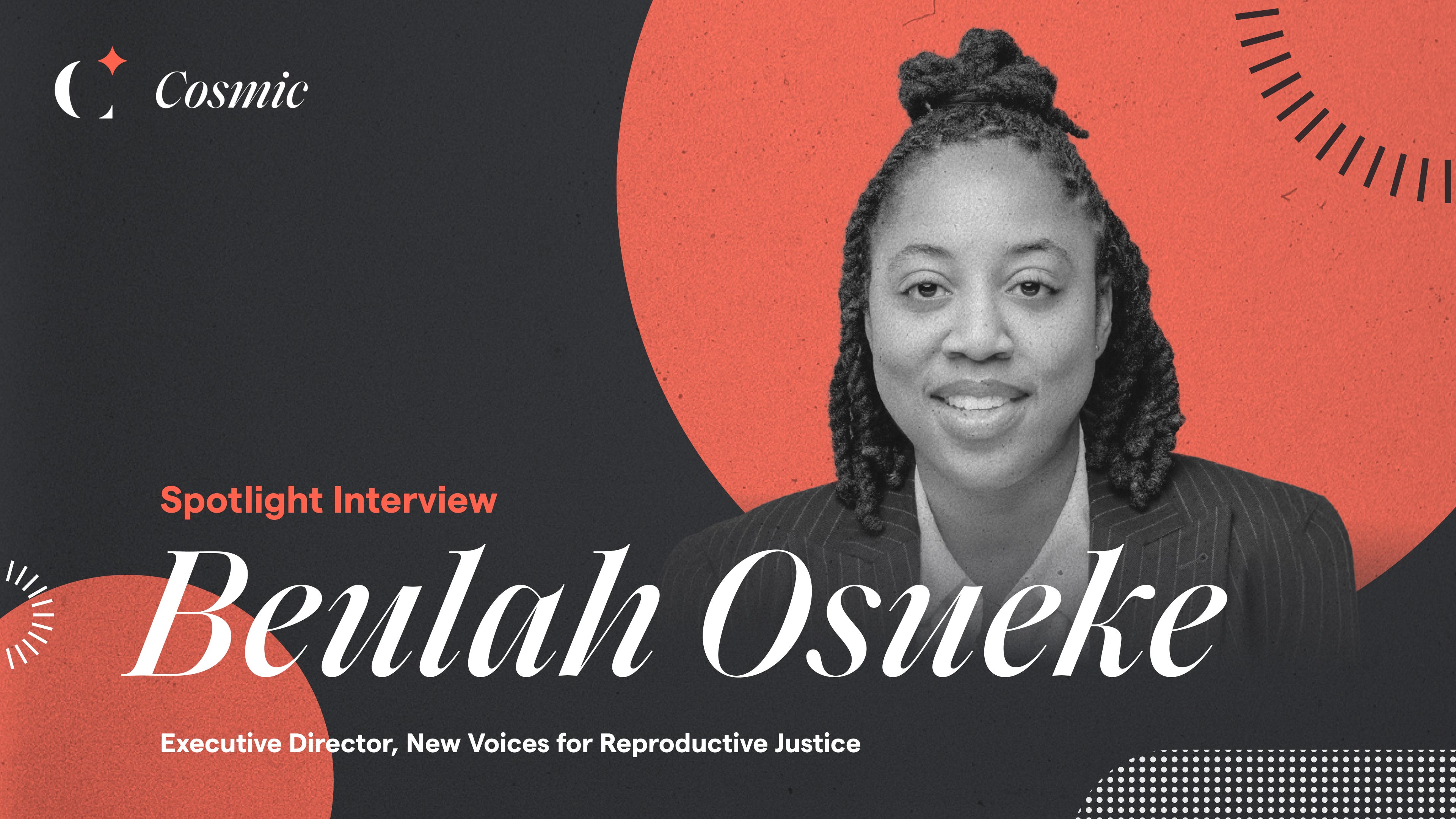
In the social impact sector, we talk a lot about systems. Structural barriers. Root causes. Power structures. And that framing matters. But I’ve also watched systems-focused thinking become its own kind of trap — this top-down, abstract, sometimes alienating thought process that can unintentionally distance itself from the very people it aims to serve.
Because systems aren’t just structures, policies, and laws. They’re people. And you can’t change a system by imposing solutions from above. You have to build with the people living inside it.
My guest today calls herself a practical radical. After her father died when she was eleven, it was basketball that saved her. A team became her second family. And for eight years, she coached high school girls in West Philadelphia, taking a program from zero wins in her first season to state champions in her last.
She believes deeply in what sports can do for young people. But she also noticed something: for some kids, sports is a hobby. For others, it’s a lifeline. We celebrate the ones who make it out — the scholarship winners, the champions — but we rarely ask about the far greater number who don’t. And we almost never ask why so many young people need a lifeline in the first place.
To explore what it actually means to be a practical radical, I wanted to talk with Beulah Osueke. Beulah is the Executive Director of New Voices for Reproductive Justice and the founder of PILR, a new initiative transforming youth sports into spaces of wellness, equity, and growth.
This interview has been edited and condensed for clarity.
Eric Ressler: You have a really interesting background—psychology, sports, social justice, reproductive rights. In our pre-discussion, you talked about being interested in the intersection between sports and social justice. How are those things related?
Beulah Osueke: I love sports. I’ve loved sports ever since I could walk and run and saw my older brother on a soccer team and wanted to do what he was doing. When my father passed away when I was 11, it was a AAU basketball coach and a new team of sisters that really held me during a period of grief. At the time, I was a kid—I didn’t know I was grieving—but sports and basketball in particular is what came in and saved me. So I think a lot of my fondness for sports and basketball and coaches and team come from that.
But I also recognize that with sports, there’s this desire to accomplish high feats—getting a scholarship, going Division I, winning a championship. And I realized that if you don’t have the foundation of your needs met—psychological safety, food, a warm place to sleep at night—you’re not going to be able to get there, or it’s going to be extremely hard.
Oftentimes when I think about sports, people like to highlight all the barriers and the resilience that people navigated. I’m asking: why do people have to navigate those barriers? Why do we require resilience of individual people as opposed to making tenacious structures and systems that look out for the good of people?
For me, I was introduced to a world of possibilities through sports—an avenue that saved me, an avenue that introduced me to people that became a second family to me. And with social justice, I think it helps ask and answer the question why. We can really look to create more solid foundations so that fewer kids have to be resilient and there’s more equity at the forefront.
I think we live in a society that often exalts people for having to navigate really tough situations, but our society doesn’t equally ask why and look to put an end to those strained circumstances.
Eric: I want to tug on that thread because I think it’s fascinating. Sports requires resilience, and there’s some good in that—these challenges you have to overcome, these personal transformations that can happen. At the same time, especially in America, there’s this meta-narrative of pulling yourself up by your bootstraps, working hard, grinning and bearing it. I don’t think that’s all in bad faith, but there are structural issues that run counter to that narrative. We’re not all starting with an equitable start in life.
It’s not an either/or. There should be individual resilience building and transformation and cultures that allow people to have those powerful human experiences, but we also want to get everyone starting as close to equal as possible.
Beulah: Yeah, I agree. There are themes that show the brilliance of communities. Think about the grassroots effort—that one kid that has all this talent and the neighborhood might pull together to get that kid resources to set them up. Think about these athletes that are crying because they put so much into it. Sports can really elicit that human component. Music unifies people, sports unifies people. You can have people on different ends of the political spectrum rooting for the same team.
But what I’m touching on is: there are some people that get to play sports as a hobby, and there are some people that are playing sports as a lifeline. If we continue celebrating the ones that make it out but don’t analyze and assess the higher percentage of people that don’t, we don’t get to the root of the problem. What ends up happening is we individualize that story—whether success or failure—and there’s many more kids that don’t have access to what they need, that are just kind of falling off to the wayside. And it’s like, “Well, you deserved it.”
Along with that meta-narrative of resilience and personal overcoming is another narrative: that if you don’t have good things, you deserve poorness. That narrative is driven into kids’ heads early on who are in the midst of survival.
One of the things about social justice that became the biggest relief to me once I started getting into it was realizing that my misfortunes were not from my own personal failings. We have inadequate systems and structures that are not looking out for us all on an equitable lens, but also that kind of keep things in place. There’s this perpetuation that those that are wealthy and rich deserve it because they’re smarter or whatever, and those that are not deserve it because they’re lazy. That’s a lie that I think is deeply rooted in capitalism—to encourage people to stay on that hamster wheel instead of inquiring, “Why don’t I have my basic needs?”
When it comes to the intersections of sports and social justice, what I most love about it is that anyone and everyone knows what sports is—has either played, has a child that played, had a family member that played. But sometimes social justice can be very pie in the sky. So I love the marriage of the two. I love the marriage of anything social justice and something that’s practical, because I believe in being a practical radical—showing people what’s possible through the lens of what already exists and just improving what already exists.
Eric: You mentioned that this on-ramp to sports was kind of your first exposure to even the concept of social justice. That led you to becoming an executive director at a social justice organization. Can you talk about what that transformation was like?
Beulah: I did play sports in my adolescence and I’m now the executive director of a reproductive justice organization. But in between those two very different realities, I actually entered movement work through a faith-based organizing entity called POWER—Philadelphians Organized to Witness, Empower, and Rebuild. I was a communications director there. I knew nothing about social justice. I just knew what I lived. I knew what I navigated.
That experience was transformative. I got introduced to a God of righteous anger. I got introduced to the principles of faith broadly, Christianity more specifically, that talks about giving your shirt to the naked, feeding the hungry. Never before in my adolescent years had I connected the teachings of Christ to social justice. It felt like this holy essence, this holy being, is caring for the people that are pushed off to the side. But most of the teachings I had received were about prosperity gospel—follow these rules and you’re going to be rich and wealthy, you’re going to have all the cars.
I was never before introduced to the grounded discipline and commitment of being a person of faith living in a world of perpetual and insurmountable inequity. When I participated in POWER and did their communications work, my eyes were so open. I was sitting alongside priests, imams, pastors, atheists coming from different fields of faith saying, “This is not right. And our faith tells us to do X, Y, and Z.” It helped me release myself from toxic theology—the faith or religions that are like, don’t do this, don’t do that, but don’t tell you what to do or give you a practical guide.
I was introduced to people that are passionate and unapologetic about pursuing a better life, not just for themselves, but for what Reverend Dr. Martin Luther King called the beloved community. That was my introduction to justice.
But at that particular organization, there was restricted funding that limited the issues we could focus on. I participated in a fellowship that introduced me to the Black radical tradition, and I got kind of radicalized. I was like, “This is nice, but we don’t talk about queer issues. We don’t talk about women’s rights. This feels inadequate. It feels insufficient.”
I was lamenting to a friend—you know how it goes when you’re unhappy with a job—and she sent me a job description for a communications manager position at New Voices, the organization I’m currently at. I entered as a comms position, and four to five promotions later, I’m now the ED.
I really think it’s critical that my entry point into the reproductive justice realm was actually through faith, because a lot of people act as if being a person of faith and someone who advocates for the complete bodily autonomy and freedom of all people are at odds with each other. For me, they actually complement each other.
Eric: What I’d like to talk about is your background in psychology and communications and how that informs your worldview and leadership style. We work with a lot of social impact organizations with executive directors whose background is in research or science or policy. Communications can feel like this squishy, unscientific, weird amalgam of storytelling and vibes. How do you think about communications in this work, and how important is it?
Beulah: I’ve definitely been exposed to people that think comms and psychology is soft science and not necessary. I think that’s interesting—we can bookmark that for another day.
For me, I love the fact that I started in psychology. Actually, toward the end of my graduate program, I was like, “I can’t do this for a career. I’m going to take people’s stuff home with me. It’s going to bleed me out.” But through a leadership lens, I’m so grateful that I did it.
One of the first misconceptions I unlearned as a psychology student was that I don’t have the answers for people. People have the answers. A skilled psychologist, a skilled communicator, a skilled coach, a skilled person that knows how to facilitate someone else’s growth—they know the right questions to ask, the observations to make. They know how to shepherd people to their own epiphanies.
Given that I used to coach high school, it’s not as meaningful or worthwhile if you give answers to someone else, because that’s your answer for them.
I think both communications and psychology help you identify circumstances, teach you to be very observant. You can have your own articulation and conclusion, but it’s really your duty—particularly when you’re in a leadership position—to help pull that out from the person who might not be seeing it for whatever reason. They might be too close to it. They might be navigating some adaptive strategies or coping mechanisms.
I actually think that people skilled in psychology and communications have a sense of clarity—not judgment, but clarity and observation—that makes the implicit more explicit. Comms, psychology, all the “soft, not real stuff,” whatever—provides very fertile ground. Whereas other backgrounds or disciplines are more black or white, more “it has to be this way.”
It’s interesting that you say most other EDs have that background, because I can kind of see it. Maybe we need to push for more EDs with backgrounds in psych and comms.
Eric: The solutions exist and they are in the community. To some degree, social justice orgs’ job is to help shepherd and surface and amplify and support and build infrastructure for those ideas. How do you do that in your work, especially around reproductive justice, especially in a time with so many barriers from a policy and federal level?
Beulah: Whenever I talk about reproductive justice, I like to make sure there’s a grounding and shared understanding. There’s a reproductive ecosystem with three primary pillars: repro rights, which looks at legality; repro health, which looks at the actual healthcare people receive and the quality; and repro justice, which examines access. Something can be legal and the highest quality, but if people cannot access it—if poor people can’t access it, disabled people, elderly people—then it’s not equitable.
I like to make that distinction because people often conflate them all together or don’t even know there are three separate pillars, which is okay. That’s the role of education and bringing people into the fold.
I’m the executive director of a reproductive justice organization. Reproductive justice was founded by Black women. It centers Black women and people that are marginalized by their gender, sexuality, social markers.
Honestly, the first year of being an ED was a lot of cleanup. That’s not surprising to anyone—anyone that has come after a founder knows there’s a lot of cleanup you have to do. Financially, administratively. The organization invested a lot of professional development into my staff capacity because a lot of my team members come from divested communities. Education isn’t great, or family structure is challenging.
I also want to name that you have to make sure you have a solid foundation or base, because otherwise your initiatives aren’t going to make sense, or you as the individual person are going to have to be at the helm of everything, which is not sustainable.
The second thing I realized once we got our foundation settled is that this is too pie in the sky. I do believe academics and the academy play a role in social justice work, but we have readily adopted language that’s not accessible to everyday people—or the people we want to reach. I’m not saying dumb it down. I’m saying make it accessible.
One of the things we did at New Voices that I’m very proud of is we launched Political Homes for People—we call them the People’s Portal. Wherever people are, they enter the People’s Portal and we’re granting them access to trainers, speakers, a new way of thinking and being and looking at the world.
We have hubs in each of the cities we operate—Cleveland, Pittsburgh, and Philadelphia—where people come together on a monthly basis, talk about their current conditions, talk about why they think that is, what’s the source. And together they arrive at this collective: “Ah, it’s not me. It’s misogyny. It’s not me. It’s X, Y, whatever reason.”
From there, we don’t just stop at this new awakening or awareness. We plug people into tangible, concrete, accessible, and ongoing ways to chip away at that injustice. So twofold: you have this individual, personal-level community building—”Oh my God, I see how this is true for my life and what’s possible for my life”—but then you also have what’s possible with collective action, with sustained engagement.
I’m oftentimes critiquing people that share a post or attend a rally and they’re like, “I’m done. This is enough MLK for the day. I’m good.” The struggles are hidden, boring, tedious—but there is huge possibility between that first awakening and seeing shifts in structures and systems and realities.
Eric: I want to talk about language. We spend a lot of time helping clients understand that using simple, plain language is not dumbing down their message. Even if you’re trying to reach people who know the jargon, it’s still, in my opinion, a defense mechanism. It shows a lack of confidence in truth and knowing, because if you really deeply know something, you should be able to say it plainly. That’s not easy—it’s actually quite hard.
If you look at the true experts, the true thought leaders, they’re going to be the first to say, “I don’t know all of the answers. I’m still learning every single day.” That curiosity and beginner’s mindset is what allows you to achieve excellence.
Beulah: It’s so funny, Eric—we’re talking about big words and I heard you just sneak in “obfuscating” and I’m like, there you go.
Eric: Yeah, see, I’m guilty of it myself.
Beulah: One of my favorite words is “proliferate,” and anytime I use it I’m like, someone’s going to be like, “What does that mean?” I love that word.
But I totally agree. This is why my relation to sports and social justice are inseparable—because I could very much see myself using these fancy languages, getting defensive, and people are like, “But why? How does that make sense?” if I didn’t coach.
I’m learning about this new movement, reproductive justice. I’m like, “What the hell? What is this? There’s a movement for Black women, by Black women?” And I’m also coaching young Black girls in West Philadelphia that don’t have all the provisions as children that they should have. These are kids telling me, “Coach B, I want to go Division I. Coach B, I want to win this championship.” And they don’t have consistent housing.
What I realized was my formal career in RJ was the theory, and coaching was the practice. They were oftentimes in tension with each other. But I think that’s why I’m very here—I’m very optimistic, I think we deserve so much more than what we’re getting—but I’m also like, we cannot be too pie in the sky because we lose the very people that we say we’re advocating for.
There’s a thought leader named Andre Banks who has this phrase called “cultural intelligence” that really resonates with me. He defines cultural intelligence as the ability to read the emotional and material conditions of the city and then craft a campaign that tells the truth people were already living.
That’s what I think you and I are saying. The role of the organizer, the role of the academic, the role of the person who believes in a better reality than what we’re currently existing—it isn’t to be pie in the sky, off in the corner with your smart friends throwing around fancy terms. As Toni Cade Bambara tells us, our role is to make the movement irresistible.
How do you help people realize? How do you empathize with people and say, “I know how that feels. This sucks. This should not be how it is.” You don’t just stay there—you say, “Look what’s possible.” And you don’t just stay there. You walk alongside them every step, regardless of the challenges, regardless of the hopelessness, regardless of defeatism. That is liberation in practice.
It is not doing the same thing that our current government officials do and looking down on our people. We have to be very careful to build power with our people, otherwise we’re going to replicate the very same power structures that we’re now critiquing.
Eric: Let’s pivot to your latest initiative called PILR. Tell us about how it came to be and what you’re most excited about.
Beulah: I am so excited about PILR. If you’re listening to this, just know that I’m smiling super big.
PILR is essentially a community-building model where young athletes, parents, and coaches all collaborate to transform youth sports. We envision an even playing field where every young athlete is fully supported—not just on the court or on the field, but in all things that they do. Our mission is to transform youth sports into spaces of wellness, equity, and growth.
I coached high school girls basketball for eight years. The first season, we did not win a game—we were 0 and 18. The last season, we were state champions. A lot happened between that first and eighth season. That’s where I really got grounded in realizing it doesn’t matter what I develop on Xs and Os. My kids can have the best swag. We can have gyms full of people. If I’m not conscientious of what these kids are navigating when they’re out of my view, I cannot show up and support their holistic development the way I want to.
I developed PILR because I did not get the support I needed as a coach. A lot of coaches are extremely powerful and influential and do not have a support system. They don’t have a community of values-aligned people. They don’t have access to entities or institutions or individual leaders that can help push their mission forward, that can help fortify their leadership.
We’re in development mode, looking to launch next March around March Madness. We want to provide support, clarity, and guidance to parents and guardians, coaches, and community members that want to play a role in championing young people in their lives.
I have a brilliant innovation director and a brilliant creative director. I’ve been ideating PILR for years, and now it feels surreal that we’re at a point where we’re about to have a seed gathering—we bring in 50 people that we’ve socialized this idea with and start testing our assumptions. This is what we assume people need. How do we compare that to what people actually want?
From October until March when we launch, we’re going to go through a number of rounds so that when we officially launch and introduce it to people, people see themselves in what PILR offers. I’m envisioning chapters across the nation where anyone that’s part of the sports ecosystem can tap in and get what they need—whether it’s material support, education, or just relationship.
Eric: I want to go deeper on that. I’m hearing elements of co-creation, elements of idea validation. That makes perfect sense based on how our conversation has gone—really truly rooting people at the center of this work, not coming in with a solution but creating the solution with the community. Share more about how that’s gone—assumptions that were tested, surprises or validations in that process.
Beulah: Eric, you’re really good at your questions. I’ll be glad to share about that.
Because I was a coach, one of the assumptions I made was that coaches are who need to be invested in. Coaches are the ones there with the kids. I was able to recruit two brilliant team members that are actually currently working pro bono, as am I, and they’re both parents. From there, I went from the hyper-focus on coaches to: oh wait, it needs to involve parents and guardians and young people too.
It was really hard for me to release that idea of focusing on coaches. I’m like, coaches are always thrown under the bus, always disregarded. But I trusted the process. I trusted these brilliant people I brought to the forefront. Now you cannot convince me that it’s not at least those three entities.
With that, I’m also like, coaches need workshops, we need leadership development sessions. We’re actually now leaning towards developing a wellness-centered playbook with different modules—how to navigate race, how to navigate gender, how to navigate these social justice concepts. If we kind of deflower them and just have them at face value, kids deal with it all the time.
I know so many Black kids whose parents have them at white-dominant schools for better resources, but the kids are navigating racism. Their white counterparts are saying, “You’re only here because you’re good at basketball.” That’s so dehumanizing. So we have modules for that. But we also have modules for how to create strategic and fruitful partnerships in institutions and beyond. We also have literal budgeting—when I was a coach, I had to budget a little bit of money.
That’s an assumption we’re making—that people would appreciate this wellness-centered playbook. So we’re going to do an empathy map. But also, if the data from our empathy mapping tells us people actually just want to be in community, then that’s something we have to release, because our real users are telling us what they want.
One of the things I’m really enjoying in this period is that we have parameters, structure, aspirations, ideas of what we need to do to get there—but we also have flexibility. You cannot offer something for a community and you cannot say something is co-created if you’re not willing to make shifts once people show up and give you free wisdom.
We’re literally saying these are assumptions because we don’t know, and we’re trusting people to tell us what would actually gain traction for them.
Eric: This is exactly the right way of doing this kind of work. If you come in too vague and say, “Hey, what do you all need?”—there’s not enough structure, nothing to react to yet. Coming in with assumptions based on life experience, coming in with a rough plan but a willingness to truly listen and change your beliefs—which is difficult as human beings—that’s hard.
If you’re truly going to do co-creation or community-based work, you have to be willing to listen to what the community tells you, even if that’s not what you want to hear. It’s an art and a science. Because if it’s completely democratic and you’re trying to solve all things for all people, you water down your focus. You get into mission drift or mission creep—we start here, then we’re adding auxiliary things on, and we don’t have the resources or capacity to do that work well. Now we’re trying to do 10 things and not doing any of them very well.
Beulah: Precisely. You know how it is, Eric, when you have this idea—you’re a founder, innovator, entrepreneur. I was talking about this with someone and she was like, “Well, you don’t want to say just parents. Some kids don’t have parents.” Most of my kids do not live in a two-parent household. I know that.
But I also know for the stage we’re at, I need to say parents. Because if you start watering it down—guardians, caretaker—what does that mean? Then it gets into, how do we define X, Y, Z? I’m saying parent because a non-parent can function as a parent. Of course I also want to say parents and guardians to acknowledge the vastness and the roles that people play. But I’m trying to get schmoney. So I’m saying parent so I can be clear that I know what we’re talking about: the young person themselves, the parent or parental figure, and the coach.
To your point, it is so difficult to have specificity and also the appropriate amount of flexibility. And that makes me think about leadership. A lot of people think leaders should have all the answers, leaders should be warriors—strong men, strong women. No. The most effective leaders are actually servant leaders. They’re the people that say, “I have this toolkit, I have these abilities. If I’m going to support this person getting from point A to point B, I have to figure out what their barriers are, what their potential blind spots are, and what from my toolkit can I pull—but also what from their toolkit might they not be acknowledging.”
I always feel like people either pay for it on the front end or back end. When you lead through servant leadership, when you’re truly collaborative, you pay for it on the front end. There’s a lot of ego death that has to happen. People can mess with your vision. But if you’re steadily holding onto your North Star—the best-laid plans of mice and men often go astray—you’ll eventually get there. You have to be willing to adjust as signs are coming to you.
Eric: I think it’s a tough balance. This is something I struggle with running my small organization of eight people. We’ve been around for 15 years. Our North Star has changed many times.
Because of my background in design—and in my opinion, good design requires empathy and curiosity—if you get those two things really dialed, good design flows more freely from them. That by definition means there are many ideas I have around what I want my organization to be and how I want to help people, and then there’s the reality of where different organizations are coming to us needing help.
We serve this niche of social impact organizations. I’ll be blunt: we are not structured or a good fit to help organizations in the startup phase. That’s not our skillset. For a long time, I wanted to offer something to those people because I care about the work and want to see everyone succeed. But I had to come to a point of clarity: we’re actually not serving them by taking them on and not doing our best work.
Instead: here’s a bunch of free resources that can help you get started. Here’s partners more fit for your stage of organization, so that we can get much better at the types of clients we’re best fit to serve.
Little examples like that, as well as big ideas I get jazzed about where I can see the vision—then there’s the hard work of getting validation, and sometimes not getting validation. Putting ideas out there, experimenting, and saying, “You know what? This experiment failed.” That’s a negative framing, but a failed experiment is actually one of the best outcomes because that’s the fastest path to learning.
This is the hard work of leadership—building new solutions and challenging the status quo of what has been versus what could be. But if you approach it from a lens of curiosity and experimentation, it’s way more fun too.
Beulah: Absolutely. Thank you for sharing that. I resonate so much with what you offered.
I really want to introduce the word discipline. Many people that want to do good in the world can be accused of having bleeding hearts. When you have a bleeding heart, anyone that needs anything, you want to give them anything they need. That does not allow you to pour into whatever your vision is, to have a judicious nature about yourself. That’s something I’m learning.
When I became ED, so many people came to me with requests—jobs, money, favors. I’m not going to lie, it kind of hurt my feelings. I’m like, I’m a human. I’m the same friend before I entered this role. I felt like people were reducing me to a favor. I processed this with my therapist and she said, “I can see how it can feel that way, but perhaps people are just being resourceful. They don’t see it as taking from you. They’re like, ‘This person is positioned to help me.’”
When I think about innovation and the ideas I have, people are not necessarily trying to pull me off track. People are like, “How do I benefit from this? How would I want to switch it or shift it to meet my needs?” So I do think there’s a level of discipline and commitment.
It’s easier to say yes than it is to say no. Saying no is really hard. I appreciate that mindframe switch you had. I don’t want to say I love rejection, but I don’t hate rejection as much as I used to—because it’s data. I’ve been rejected from so many things, but it’s data. It also doesn’t steal your time, because maybe it’s not meant to be.
Eric: The word discipline is really important. What I’ve found is that discipline requires strategic clarity. If you don’t have strategic clarity—if you don’t know deep down what is my identity as an organization and as a person—then there’s this “maybe this is for me, maybe this isn’t.”
I don’t think strategic clarity is something you have and then you have it the rest of your life. It’s consistently evolving as the organization grows. That’s been my experience personally and watching clients we’ve worked with for close to a decade. Strategic clarity is something you constantly need to have tested. But when you have it, it makes it so much easier to make quick choices that you know are right—because you have guardrails and discipline.
When you have that, it feels almost like a superpower. You’re like, “I know so clearly what is a fit and what is not a fit.” And I know that saying no is the right choice for me and whoever I’m saying no to—especially if I can connect them with someone who’s going to be the right yes for them.
This is actually a great place to wrap up, but before we do, I’d love to give you an opening to pitch anything you’d like—where people can follow you, how people can support you who are inspired by this conversation. This is your plug zone. Go for it.
Beulah: Thank you. Well, first of all, again, thank you for having me on. This has been fun.
People can find me on LinkedIn—just look up my name, Beulah Osueke. I accept any request that comes. I won’t be like, “Who’s this stranger?” I’ll just accept it.
And yeah, I’m really excited about the work that my team and I are doing with PILR. You can just type in PILR training. Our website will come up.
The last thing I really want to offer is: I can imagine the people that listen to this or read this are innovators, entrepreneurs, great individual thinkers. I really want to encourage people to build a village. Build a village of people that are equally bright, people that might have a little bit of different perspective—because I have learned so much from being vulnerable, from leaning onto people and recognizing I can be wrong and I can be shifted.
One of my favorite quotes, and I’ll wrap up with this: “What’s destined for you is far greater than what you desire. This is why surrender is essential.”
The first time I read that, I was like, “What a loser take.” But it’s actually—you could be looking at something that is minute compared to what is possible for you. But what you were looking at was possible with you as an individual, versus you submitting yourself to community and the brilliance that comes with that.
I just want to lift that up: sometimes it can feel like we’re losing or going the wrong way, but there’s submission and yielding to anything beyond us as individuals that is required for us to take that next leap. And I’ll stop there.
Eric: Beautiful. I think that’s an incredible message and one that’s really important for our time in history right now. Beulah, this has been amazing. Thank you so much for joining me today.
Beulah: Thank you again for having me.
Beulah Osueke is the Executive Director of New Voices for Reproductive Justice and the founder of PILR. Find her on LinkedIn or learn more about PILR at pilrtraining.com.