


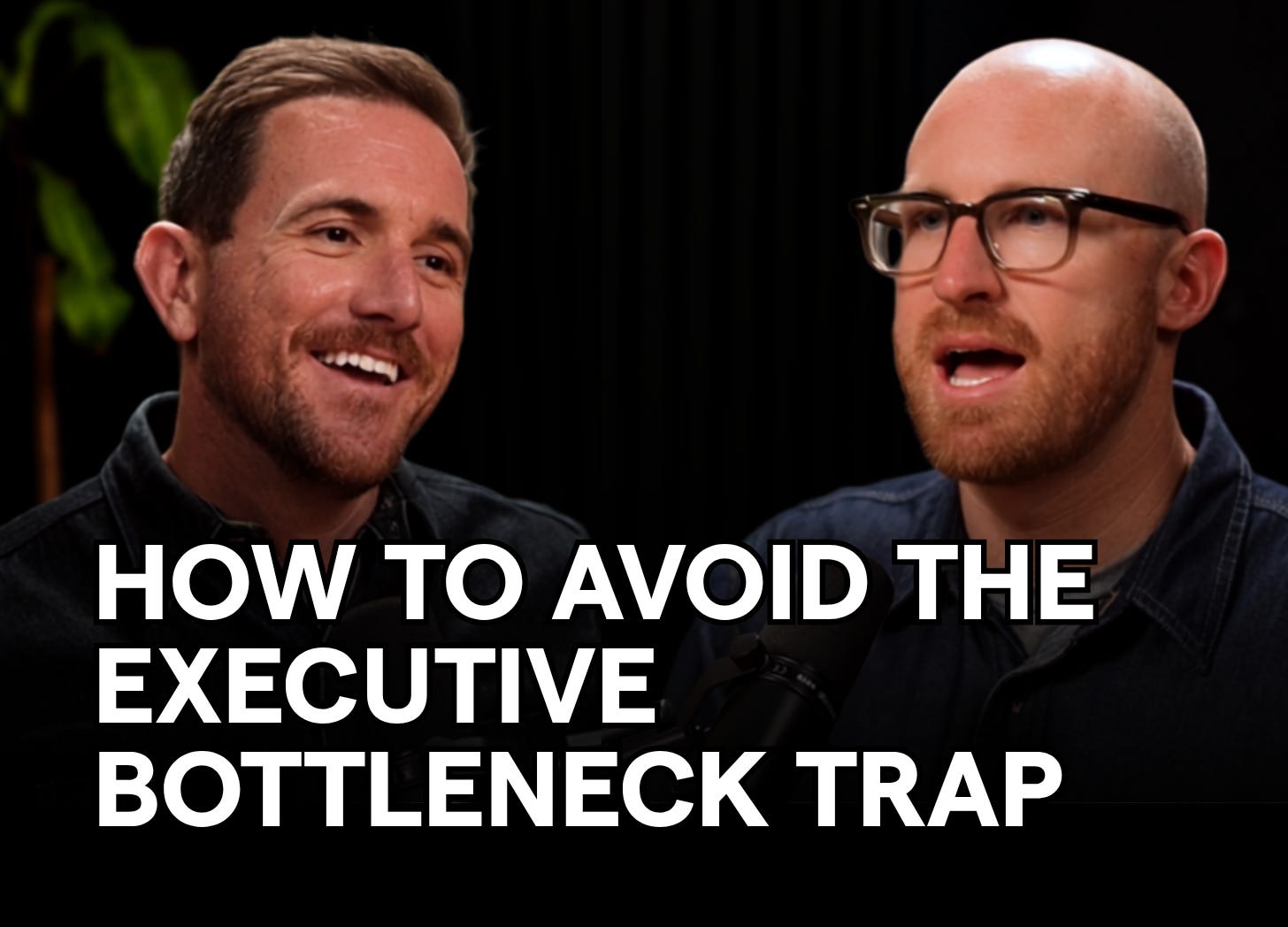
I have this problem, and I have it bad.
At Cosmic I’m the bottleneck on more things than I should be. Work piles up behind me, approvals wait on me, momentum stalls because it has to pass through my hands first.
Some of that is right. I’m the founder, I lead strategy, clients hire us to work with me directly.
The problem is the rest, the work I hold onto because explaining it feels slower than just doing it. It’s due, I’m late, so I tell myself it’s just this one time. Then I look up and I’ve done that one time five times.
Jonathan doesn’t get stuck here as often, and he pushed me on why.
For him it comes down to self-awareness: knowing exactly what only he can do, being honest about what his team does better than he does, and being good enough at failure to let someone stumble a few times on the way to owning something. I’m still working on all three.
The talent on your team usually isn’t the problem. We went back and forth on where the line actually sits, what should stop with the leader and what we cling to out of ego or perfectionism.
I don’t think there’s one clean answer. The questions I keep coming back to are simple: am I the only one who can do this, am I the best one who should, and is being the person it all runs through serving the mission or just protecting how I see myself.
Episode Highlights:
[00:01:05] The bottleneck problem, named out loud
[00:03:05] Why being the bottleneck feels so bad
[00:05:05] The real fear behind not letting go
[00:07:15] Perfectionism and the near enemy of high standards
[00:09:20] The capacity gap you build without meaning to
[00:12:08] Right sizing your role as the stakes rise
[00:16:10] The ego question every leader has to confront
[00:17:12] Getting good at failure as a leadership skill
[00:21:00] “Just this one time” and how it multiplies
[00:25:35] What EDs and CEOs should actually own
[00:30:20] The time audit that pulls it out of your head
Notable Quotes:
[00:02:35]: “I’m a big believer in hire people that are better and smarter than you, and then let them cook.” Jonathan Hicken
[00:03:50]: “We have high standards at Cosmic. The near enemy of that is everything must go through me personally to hit those standards.” Eric Ressler
[00:17:35]: “I think one of my superpowers is I’m good at failure. I’m good at knowing what failure is acceptable and what failure is not.” Jonathan Hicken
[00:21:00]: “Just this one time I’m going to do it. And then all of a sudden I’ve done that just this one time five times now.” Eric Ressler
[00:26:05]: “You hear stories of executive directors copy editing every single email that goes out. That is the most catastrophic failure of that organization.” Jonathan Hicken
[00:29:20]: “It almost comes down to self-awareness. Being really aware of what your strengths actually are.” Eric Ressler
Resources & Links:
Cosmic: Eric’s creative agency for nonprofits and mission-driven organizations
Drafting Our Strategic Dream Team: Eric and Jonathan’s past episode on YouTube
P.S. — Struggling to align your message with your mission? We help social impact leaders like you build trust-building brands through authentic storytelling, thoughtful design, and digital strategy that works. Let’s talk about your goals »
Full Transcript:
Eric Ressler [00:01:05]: All right, Jonathan, I’ve got a juicy one today. So the topic today is, how do we get EDs, executive directors, CEOs at social impact orgs, out of the bottleneck position?
Jonathan Hicken [00:01:25]: In the sense that we’re blocking stuff from getting done?
Eric Ressler [00:01:25]: Yes.
Jonathan Hicken [00:01:25]: Yeah. Okay. Man, there are so many reasons and so many opportunities. Let’s go.
Eric Ressler [00:01:35]: So this is something I see sometimes, not all the time. And let me just have a moment of vulnerability here. I have this problem and I have it bad. And some of that I think is actually not always wrong. There are certain things that at Cosmic I should be the bottleneck for. I should be the owner for. Probably the same for you. But also, I’m impressed with how you run the Seymour Center, how you empower and build up the team and not be the bottleneck on things that you shouldn’t be the bottleneck on.
Jonathan Hicken [00:02:05]: Oh, thank you. Thank you.
Eric Ressler [00:02:10]: So tell me, spill all the secrets. How’d you do it?
Jonathan Hicken [00:02:10]: Oh, man. Okay. The thing that comes to mind first is a deep understanding of what I am personally good at, especially as it relates to the rest of my team. What am I uniquely capable of doing, both in my skillset and in the time that’s available? And the same goes for everybody on my team. What are they uniquely good at? I’m a big believer in hire people that are better and smarter than you, and then let them cook. So it’s being uniquely aware of what they’re good at, and trusting them to go. Setting guardrails on when I need to know about things and when I don’t, and making sure that’s really clear. I could keep going, but let me pause. What’s going through your head immediately?
Eric Ressler [00:03:00]: I’m speaking partly from my own experience at Cosmic and also observing a lot of executive directors who are the bottleneck. Let me just start by saying, when you are in a bottleneck state that is beyond what’s right, and you can sense that, it sucks. It feels bad. I can feel it when I’m in that position. And I can feel it when I work for people or with people who I can tell are in that position too. It leads to all these downstream problems where things pile up, they don’t get solved, momentum gets lost. Everything has to go through the executive director before it gets approved. And there’s parts of this that I struggle with. Part of it is because we have high fucking standards at Cosmic, and I’m proud of that. But the near enemy of that is everything must go through me personally to hit our standards. This is a nuanced thing, because we’re a small team. When you work with us, part of it is you work with me directly. I’m the founder. I lead a lot of our strategy work. So some of that’s not even wrong. But where I feel sensitive to it is where it’s like, I know I shouldn’t be doing this thing, but it’s easier for me to just do it than to work through it with someone on my team, because it’s due and I’m late on it. These are the excuses that go through my brain that even as I’m doing them, I’m like, this isn’t right, but I’ve just got to white knuckle it and get it done. And I think that happens a lot for people. So is it my perfectionism? Is it my lack of organization? Is it some of those things that hold me personally back here? Or is it deeper than that?
Jonathan Hicken [00:05:00]: Well, let me ask you a question. When you’re feeling that bottleneck thing, what is your fear? If you were to let somebody else on your team take it, what’s the fear there?
Eric Ressler [00:05:15]: First, there’s the caliber fear. When we’re doing work for clients, we want to come through on our promise that we’re going to deliver S-tier caliber work. And my team is capable of that, especially for the things they’re uniquely qualified for. There are things everyone on my team is way better at, at least ten things, than I am. And then there’s the stuff that doesn’t fit neatly into that box. You hire a team because you get more than one person. Even though we have specialty, the true value is in the collaborative nature of our entire team. Co-creation is a buzzword, but truly, oftentimes we’re unlocking the ideas through collaboration with our clients.
Jonathan Hicken [00:06:10]: Yeah. Your team is incredible and they’re amazing at what they do, but clearly there’s still a disconnect. Because if that were plainly true, you wouldn’t have this problem. Which makes me think, are there certain skills that either you’re not hiring for or that you’re not developing within your team that’s creating this gap, where you’re the only one who holds that particular talent or scope?
Eric Ressler [00:06:40]: There are parts of the team structure where things do fall squarely on my plate to do the work for clients.
Jonathan Hicken [00:06:50]: As they should.
Eric Ressler [00:06:50]: For clients is one flavor of that. Also, big picture strategy work for Cosmic, that’s my job. I don’t want to delegate that. I want to include the team, but that’s not something I’d ever ship off to one of our designers to figure out.
Jonathan Hicken [00:07:10]: Business operations, whatever. You want them thinking about client work.
Eric Ressler [00:07:15]: So back to the core questions, why does this happen for me? One is, we’re delivering important client work and I want to come through on my promise to clients that I’m going to be part of that work. It’s not always easy to fully delegate. There’s stuff that absolutely I can and do delegate all the time, but there’s also stuff where I feel like I can add value and have an impetus to do that. So, full disclosure, some of this is my own perfectionism, my own care and passion and deep integrity. I want to make sure a client never feels like we aren’t coming through on the promises we made to them.
Jonathan Hicken [00:07:50]: Well, what I’m hearing from you is that you see yourself as the holder of a certain type of integrity that nobody else is capable of meeting.
Eric Ressler [00:08:05]: I think that’s the dangerous place to get to, because I actually don’t think that’s true for our team. And I say that with pride, in the sense that I’m proud of the team that I’ve built.
Jonathan Hicken [00:08:15]: I trust that too. I’ve worked with them. They’re amazing.
Eric Ressler [00:08:15]: It’s true to a degree that in my mind, as the founder of the agency, ultimately the buck stops with me, in the sense that any problem is my responsibility. Not necessarily to solve, but I own it. I’m never going to throw a teammate under the bus, because even if they did something quote unquote wrong or not to our standards, that’s still my problem as the founder of the firm. So there’s some element of that. But if you take it too far, it can go to a place of lack of trust, or perceived lack of trust, and that can be felt by the team, or by the client, or in the case of a social impact org, the supporter or the beneficiary or the partner. So I’ve been doing a lot of work on that. Some of it is training. Some of it honestly is systems. Some of it is permission. Some of it is my own letting go, my own self work of how much of this is imposter syndrome or whatever else.
Jonathan Hicken [00:09:20]: Let me put a positive spin on this. What you’ve done really well is define the roles and responsibilities of the people on your team so clearly that it enables them to be successful and creative. You’ve set them up for success in their particular role, and that’s laudable. That’s something leaders should do. But what you’ve unintentionally created for yourself is this gap of capacity to do the kinds of things you’re uniquely capable of doing. That doesn’t necessarily need to be true. Now we’re talking about bringing other people onto the team, and there’s, can we afford that, and a lot of other questions.
Eric Ressler [00:10:00]: This is exactly where it gets nuanced. I’ve made some strategic choices about who we are and what that means for my role as the founder. This is often also true for nonprofit executive directors or social impact CEOs. A lot of it is team size. We’re right now an eight person agency. By definition, all of us are going to wear more than one hat. We’re not big enough for each of us to have one singular role that’s 100% of our time. As you get bigger, you have more team support and maybe you start to delegate, shed, or reassign some of those roles to specialists. Think about even the two person new-idea nonprofit, you’re both doing everything all the time. That’s natural. So some of this is around strategic choices I’ve made to stay small. And another strategic choice is I want to stay deeply embedded in the work right now. I like doing the work. It keeps me motivated, keeps me grounded, keeps me real about how we position ourselves. Not as an academic or theoretical exercise, but grounded in the actual pain and problems our clients serve, because I’m in there in the trenches with them.
Jonathan Hicken [00:11:30]: You realize you’ve created a pretty risky problem for yourself as Cosmic grows. And by grow, I don’t necessarily mean team size. In terms of impact, as you take on more and higher stakes work, the stress on you is going to continue to grow. That’s not going to get smaller in the structure you’ve built. And by the way, we’re using you as a case study here.
Eric Ressler [00:12:05]: A case study, unintentionally.
Jonathan Hicken [00:12:05]: But the same goes for any executive director in the same position. You aspire for deeper impact, for more important work, and you as the executive director need to hold some of that. I do, in my own role. And what I’ve learned is, as those responsibilities scale for myself, you have to right size everything else going on in the organization. I can’t keep doing the thing I was doing last year, because I need to make space for this. So now I have a tough decision. Do I kill the thing I was doing and we’re just not going to do it anymore? Sometimes that is the case. Or do I delegate that to somebody else on the team, which puts them in a position where we need to kill something they’re doing. Ultimately, I think that’s how teams up-level over time, this cascade effect of taking on new things and killing other things. And sometimes we as executive directors get in the position where we don’t do the killing part. The result is we become that bottleneck, because it just builds up to the top and we have to hold onto it.
Eric Ressler [00:13:15]: Yeah. I’ve definitely experienced this, and I’ve seen other executive directors experience it too. Some of this, for me, is intentional choices I made. We were talking about this before we were recording. In our current trajectory, we’re positioned intentionally as a practitioner-led, bespoke design and brand strategy firm, which means people expect to work with the founder at a small agency. A downside of working with a big agency is you meet the founder, you get the pitch team, and then the work starts and you get handed off to the B team. That’s something I’m sensitive to. I never want that to be the experience. So I’ve made some choices that lead to me being involved in client work, which means I can’t also do X, Y, Z. And how we define growth is not only headcount. The way I think about growth is we do deeper, more impactful work for more impactful organizations. It does mean there’s more pressure on me, higher stakes on me, but for the whole team, so it gets distributed. But I still am the bottleneck in ways that are good and right, but also at times in ways that are bad and wrong. That’s a really important distinction. The easy way to think about it is, am I the only person who can do this? Maybe, maybe not. Is that right or wrong? Maybe it’s right, maybe it’s wrong. Am I the best person to do this? Maybe, maybe not. A very simple set of questions you can ask. What are the parts that energize me and light me up? And what are the parts that feel like a total brain drain? There are parts of the work I could do all day and you wouldn’t have to pay me. And there are parts that are just the necessary grind of being a business. Those are the things I reach for first to try and either hire up for or delegate. So that’s one way I’ve personally worked through this.
Eric Ressler [00:15:20]: Hey friends, real quick before we continue today’s episode. I’m Eric Ressler, founder and creative director at Cosmic. Cosmic is a creative agency purpose-built for nonprofits and mission-driven organizations. For the last 15 years, we’ve helped leaders like you nail your impact story and sharpen your strategy. But we’re not here to just leave you with a fancy slide deck and a pat on the back. We roll up our sleeves and help you bring our ideas to life through campaigns, creative, and digital experiences. Our work together helps you earn trust, connect deeply with your supporters, and grow your fundraising and your impact. If you value the thinking we share here and want it applied to your biggest challenges, let’s talk at designbycosmic.com. All right, back to today’s conversation.
Jonathan Hicken [00:16:10]: We have to confront ego in this conversation. And that’s not just for you, not just for me, but it’s part of the reality of carrying this title or this role in our organization. Is this something I’m doing because it validates my sense of who I am and what I can bring to the table? Or is this about what I think is best for the organization? And those two things don’t always align.
Eric Ressler [00:16:35]: They don’t always. They do sometimes though.
Jonathan Hicken [00:16:40]: They do sometimes though. And when you find that, that’s kind of the sweet spot. This is best for the organization and I love doing it and I’m good at it.
Eric Ressler [00:16:50]: That can be a sweet spot, but it also has, in my opinion, a limit. Because that can all be true and you could still be a bottleneck and way over capacity.
Jonathan Hicken [00:17:00]: Well, that’s true. You may have hired the wrong team and so you create this condition where you really are the only person who can do that thing. But the fundamental thought here is there is ego in this.
Eric Ressler [00:17:10]: 100%.
Jonathan Hicken [00:17:15]: I had a coworker here. We went on a walk for one of our check-ins and he said, “Jonathan, something that’s really unique about you is that you don’t take anything personally. And the rest of us do.” And he said, “You actually need to be careful about that.” One of the things I took away is that I think one of my superpowers is I’m good at failure, and I’m good at knowing what failure is acceptable and what failure is not. Especially in this role of delegating or trusting the team, I have a keen sense of, it’s actually okay if we fail on that, or it’s okay if we fail a couple times as part of that person’s learning process. I go into these conversations knowing, and often communicating very clearly, this probably is not going to go very well the first few times you do it. Eventually this is where we need to be, this is what success looks like, but it’s going to take some time to get there, and it’s okay if you fail. Now, the work we do is relatively low stakes in the big scheme of the world.
Eric Ressler [00:18:25]: At the Seymour Center?
Jonathan Hicken [00:18:25]: Yeah, yeah.
Eric Ressler [00:18:25]: To a degree, yeah. Compared to some other orgs.
Jonathan Hicken [00:18:30]: Compared to some other orgs, right. So there’s a certain degree of failure we can play with, and I want to acknowledge that. But my ability to not take things personally and accept failure in some situations, and maybe this gets me in trouble sometimes, is part of what allows me to create the space for the team to take on these new responsibilities.
Eric Ressler [00:18:55]: Yeah, I think that’s dead on, because I’ve definitely had times, and I’ve observed this in other executive directors too, where it’s like, well, it has to be me because I’m the only one I know isn’t going to screw this up. Sometimes that might be real. But if that’s always the case, and there’s a pattern there, it points to some potential problems. In the past, I’ve had that experience where I’m like, well, if that’s true, that’s actually a big problem for a model. That’s not scalable, that’s not sustainable. So why do people get stuck in these roles, this scenario where they become the bottleneck in perpetuity? This is something we frankly deal with sometimes, where we can’t get approvals on things because we can feel that executive directors are the bottleneck on other parts of the org, so they don’t have the time we need them to give us in order to do our work. So we see it from that purview. Why does this happen? Okay, failure’s not an option and they’re the only person who can do it. Or the cost of sitting still to create the new system or do the training always feels like it’s not worth it. This is something I run into sometimes, where it’s like, well, I could delegate this, but it’s actually faster for me to just do it, because I know what I want and I know I can do it. It’s faster than trying to explain it to someone, develop my thoughts, give it to them, have them do it, then review it. So you could come back at me and say, well, dude, you’re not actually delegating. You’re just overseeing. That’s a difference. True delegation means you hand it off and you trust it’s going to be taken care of.
Jonathan Hicken [00:20:40]: Well, that’s a little oversimplification. You need to set people up for success, define what success looks like, all that stuff. But fundamentally, dude, you know it’s an investment, right? And investments take time. That is the cost of doing business in some cases.
Eric Ressler [00:21:00]: And here’s the trap. Just this time, just this one time I’m going to do it. Just one time. And then all of a sudden it’s like, well, I’ve done that just this one time five times now. And if I had just done it the first time, I wouldn’t have had to do it the other four times.
Jonathan Hicken [00:21:10]: I want to talk about accountability in this too. One of the things that works in my team is that we’re very results oriented. Everybody on the team, regardless of role, has a clear sense of duties and a clear sense of measurable results they’re accountable to. Because we’re also a small team, ten full-time staff, there’s a lot of collaborating and sharing and wearing multiple hats, but everybody’s an owner of something specific. I’m often involved in the work in some way. But the reason delegation can work, and the reason I don’t get caught in the bottleneck trap as often, is because if I’m holding somebody accountable to a measurable result, and I am the reason they’re not hitting their result, they know they’re allowed to call me out on that. They’re allowed to hold me accountable to my role in helping them be successful. That clear set of expectations, clear roles, and a culture receptive to giving each other tough feedback in every direction, that unlocks my ability to make those decisions about where I should or shouldn’t be involved.
Eric Ressler [00:22:30]: So I’d love to hear from your perspective, clearly you’ve thought deeply about this. How do you make a choice about what is squarely your role and responsibility, the things that only you could or should do, versus the things you shed? For example, recently you’ve taken an intentional step into being much more of the PR arm of the Seymour Center, through the Science Solutions Santa Cruz podcast and other things. That’s a lot of time and energy. That time was being spent somewhere else. So have you had to shed some things? How do you think about balancing all of it?
Jonathan Hicken [00:23:15]: I was actually going to use the Science Solutions Santa Cruz podcast as an example. Every step of the way in this organization’s development since I’ve been here, I’m constantly asking myself, what does the organization need in order to reach the next step? What’s missing today that needs to exist a year from now? And how is that going to happen? Oftentimes my role here has been the initiator, starting the new thing, with a clear sense in my head of, if I start that new thing, what happens a year from now when I’m no longer doing it? I think about that with the podcast too. I knew coming into this year that my most important contribution to the Seymour Center’s success was going to be money and visibility. Funding and visibility. Those were the two things I needed to focus my personal attention on. The podcast was one of the ways we’re going to work on the visibility part. And I asked those same questions. Who is most uniquely capable of doing that particular role? At that time, that was me. I am the person most positioned to do that piece. But even coming into this venture, in my mind I’m already thinking about who’s going to be the next host, what’s the next show going to be, how are we going to grow this, so I don’t actually have to be that, but the quality and impact of that venture doesn’t decrease.
Eric Ressler [00:24:45]: Which doesn’t necessarily mean you’ll make that choice, but you’ve at least thought about, am I signing up for something in perpetuity here? And to a degree, you kind of don’t know until you try, but you’ve got a contingency plan in place.
Jonathan Hicken [00:25:00]: Right. And look, I hope we don’t kill the podcast anytime soon. And if we do, that’s not the end of the world. We’re going to be fine. I continue to believe in it and I continue to spearhead it. But I’m already thinking about, what is required of the host or the producer to make it successful? And is there a world in which somebody else could do that? I actually think the answer’s yes.
Eric Ressler [00:25:25]: I think so too. So at a high level, maybe we could riff on, what should EDs and CEOs actually be responsible for, at large?
Jonathan Hicken [00:25:35]: I’m not sure there’s one answer to that. And I authentically say that, because every organization has a different composition of people and talent, problems, ecosystems. But what is required is that the executive director is keenly aware of their own skillset as it relates to everybody else’s around them. It’s your job to find that Venn diagram, that little slice where you’re like, I am going to accelerate our success or our impact if I take this role. You hear these stories of executive directors who are copy editing every single email that goes out, and I’m like, that is the most catastrophic failure of that organization, because there are a million people who can write a good email. Most people on your team can write a fine email. I’m not uniquely capable or positioned to do that work. But maybe some of us fall back to it because it’s safe, because it’s easy, because whatever. So to answer your question shortly, I really don’t believe there’s one thing.
Eric Ressler [00:26:45]: I think that’s fair. If there were one thing, and this also is maybe not this cut and dry, I think that for most orgs, the CEO or executive director should own vision for the org. And I don’t mean that vision should be only theirs, or that it shouldn’t be informed by others. We just did our fantasy drafting episode of your strategic team, which was super fun, and we talked about all the people who should be part of your strategy and your vision. But I do think at the end of the day, for most orgs, vision should squarely fall in the ownership of the CEO or the executive director. Maybe even deeply informed by many other stakeholders, but at the end of the day, who’s going to sign off on it and spearhead it or initiate it? Agree?
Jonathan Hicken [00:27:35]: No.
Eric Ressler [00:27:35]: Okay.
Jonathan Hicken [00:27:35]: I think in reality that’s probably 90% true for most organizations. I think that’s widely true.
Eric Ressler [00:27:40]: But not 100%.
Jonathan Hicken [00:27:40]: But not 100%, right. Because you might have someone on your team who is an incredible storyteller and they can tell a fucking story. And you’re the executive director, you’ve got that title. Some executive directors would be like, okay, I’m going to be the one who stands up and tells the story, even though I’ve got this powerhouse on my team. But that’s where that awareness comes in. Where you’re like, actually, I’m more of a finance ED, or I’m more of a programs ED, but that person’s a hell of a storyteller. I want them really owning the articulation of where we’re headed.
Eric Ressler [00:28:15]: Yeah. That’s slightly different than what I was thinking of, but I hear what you’re saying. It actually maybe works for vision too. So I’m going to say I agree generally that there’s no every ED or every CEO must own these parts. So maybe the better way of thinking about it is, what are my unique strengths, even as an executive director or CEO? You talk about the finance CEO. That’s legit. I’ve worked with some CEOs and executive directors who are really weak on some of those other things that other CEOs are good at, but man, can they run the books. And because they’re so good at that, and because they have the rest of the team to support their deficits, that is the best thing they could possibly do. Then their org is greatly resourced. They’re not constrained. They don’t have the scarcity mindset.
Jonathan Hicken [00:29:05]: Exactly.
Eric Ressler [00:29:05]: I don’t think there is even, and it’s so obvious in hindsight, there’s not any one flavor of a CEO or executive director. So the clear takeaway for me so far is, it almost comes down to self-awareness. We’ve been talking about that a lot on the show, because it is so important. Being really aware of what your strengths actually are. And the ego thing, which we touched on, I think is so true. And frankly, something I struggle with. Even as someone I think is pretty humble overall, there are things where I’m like, no, this should be me. And how much of that is ego versus truth? I don’t think those things are perfectly aligned.
Jonathan Hicken [00:29:45]: I was just coaching someone on my team who recently got a promotion, who’s stepping into a leadership level she hadn’t been in before. I believe she has the skills to do it. One of the things we talked about is, hey, you’ve got a team of people who are really, really capable at X, Y, Z thing, and right now you’re still too involved in it. You actually need to step back. You need to define what success looks like, but the essence of the coaching was, what are you uniquely good at? What is your team uniquely good at? And it’s time to make space for both of those.
Eric Ressler [00:30:25]: I think that’s true. And in reflection, as we work toward wrapping this up, even in those moments where there may be some ego involved, maybe there is, maybe there isn’t, it just feels like crap to be the bottleneck. No one wants to be that. What I think about a lot is when I’ve found myself in that state, and it happens, it ebbs and flows. Luckily at this point it’s still a problem, but I’ve done a lot of work with the team to figure out how to release it. And it’s a constant thing, because it’s not static. We’re constantly moving and changing, adding new initiatives. Oftentimes, similar to you, I’m spearheading some of those. I’m trailblazing it, testing it, experimenting. And then at some point I need to delegate, hand off, operationalize it. So it’s this always fluid thing. But what I’ve found most helpful is, when I find myself in that state, I literally sit there throughout the week over the course of a couple weeks and write down everything that I do. And I score things. Love this, hate this, drains me, however you want to score it. Then you just look objectively back at how you’re spending your time, and is that the right way I should be spending it? That’s a good exercise, because it takes it out of the abstract, out of the conceptual, out of the emotional. It’s just, objectively, what did I do, and is that what I should be spending my time doing in my current role, in our current trajectory as a company?
Jonathan Hicken [00:31:55]: Yeah. And you could do that, obviously if you have a giant team this is less possible, but you could do that for the other people on your team. You should. Here’s what they’re doing, here’s what they’re succeeding at, here’s what they’re not. That’s the exercise when you do it for yourself and your team. Now you’re starting to see, oh, okay, here’s really the mosaic of the skills on this team, and that might unlock some insights about how you might move work differently.
Eric Ressler [00:32:20]: Yeah, I think that’s right. So hopefully some of these tips and this way of thinking about it leads to some of these bottlenecks going away, or at least getting a little bit wider, for some of our listeners. Thanks for sharing all your secret sauce, Jonathan.
Jonathan Hicken [00:32:35]: Yeah, thank you, Eric.
Eric Ressler [00:32:35]: If you enjoyed today’s video, please be sure to hit like and subscribe, or even leave us a comment. It really helps. Thank you. And thank you for all that you do for your cause and for being part of the movement to move humanity and the planet forward.