


Every social impact leader wants more people to know about their work.
Almost none of them want to be the one posting about it. Putting yourself in front of an audience feels like ego, or a distraction from the mission, or simply not something an executive director has time for.
The reasons leaders give are genuine: not a comms person, not trying to make it about themselves, afraid of getting it wrong. None of that explains why the work still isn’t reaching who it needs to reach.
In this episode, Saralynn Finn and I dig into what changes once someone gets past that resistance: story stems, a repeatable format for turning an ordinary moment into a post worth reading, and the difference between posting out of obligation and posting because something actually needs saying.
The approach holds up because it’s built on evidence: which patterns actually perform, why a personal page beats a brand page every time, and how long it really takes for a post to reach its full audience on LinkedIn’s slower-moving algorithm.
Saralynn brings real client stories into it, including a nonprofit CEO’s 90-day experiment that changed her mind entirely. I bring my own inconsistent LinkedIn habits too, admitting exactly where I’ve fallen off since the two of us last talked.
This is a second conversation, picking up where an earlier episode on visibility left off. By the end, it’s got me wanting to get back in the game.
Episode Highlights:
[00:02:00] Why LinkedIn is the fastest-growing platform for anyone over 30
[00:04:00] Story stems: the copy-meme format built for LinkedIn posts
[00:06:30] Story stems get three times the engagement of posts without them
[00:10:00] Madeleine Ballard’s 90-day LinkedIn pilot, and what it actually delivered
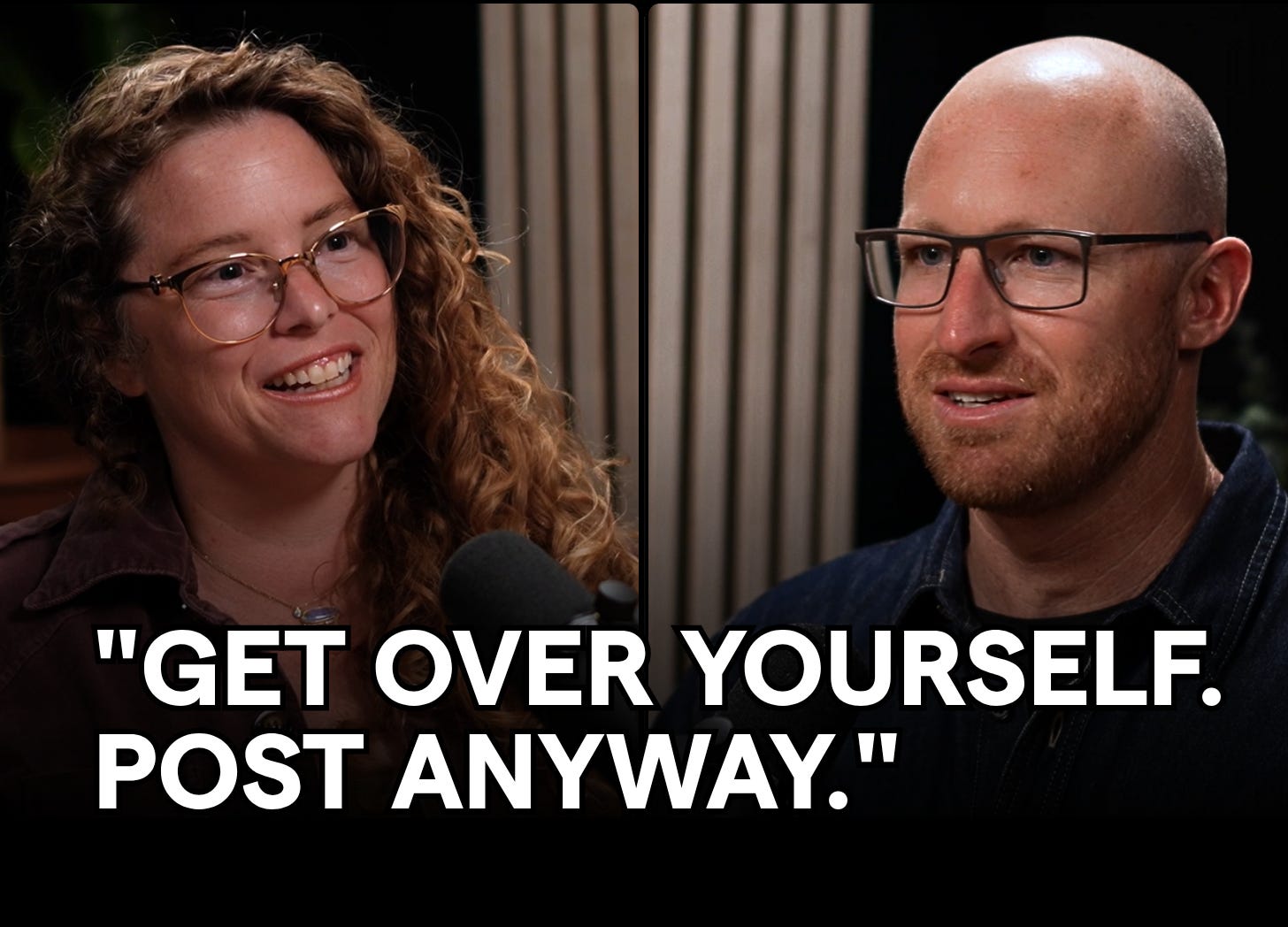
[00:14:00] “Get over yourself”: why nobody’s presence is too small to matter
[00:16:00] Eric’s own LinkedIn burnout, and what caused it
[00:18:30] The three kinds of posts: keeping the lights on, building the muscle, and the ones you can’t not write
[00:20:30] How often should you actually post? (Not as often as you think)
[00:23:00] Personal pages vs. brand pages: where ideas actually travel
[00:26:00] The sector’s discomfort with admitting failure in public
[00:29:00] Authenticity, sanitized brand voice, and what political campaigns already figured out
[00:34:00] Why LinkedIn rewards patience: posts take three weeks to peak
Notable Quotes:
[00:06:25]: “Story stems, posts with familiar patterns, get three times the engagement of posts that don’t have a story stem.” Saralynn Finn
[00:16:05]: “I’m feeling a little burnt out by LinkedIn right now, and it’s my own fault.” Eric Ressler
[00:21:10]: “Anything you’ve done is better than doing nothing.” Saralynn Finn
[00:23:05]: “Personal pages have the highest likelihood of having your ideas travel far.” Saralynn Finn
[00:28:55]: “Authenticity, it matters. People can feel it instantly.” Saralynn Finn
[00:33:20]: “This humility does not require invisibility.” Saralynn Finn
Resources & Links:
Community Health Impact Coalition — global coalition making professional community health workers standard practice.
Dr. Madeleine Ballard — CEO of Community Health Impact Coalition and 2025 Skoll Award for Social Innovation recipient.
The Sidebar — the Skoll World Forum fringe event in Oxford where Saralynn ran the workshop.
Saralynn Finn — guest’s site and consulting practice.
Visibility Beats Impact — Designing Tomorrow Podcast episode, April 2026
P.S. — Struggling to align your message with your mission? We help social impact leaders like you build trust-building brands through authentic storytelling, thoughtful design, and digital strategy that works. Let’s talk about your goals »
Eric Ressler [00:00:50]: Saralynn Finn, welcome back to Designing Tomorrow and to Seymour Studios where we record. There was more to talk about, so I thought, let’s do another episode.
Saralynn Finn [00:00:55]: So much to talk about, Eric. I’ve really enjoyed getting to know you over the last few years, and especially these last couple of months as we prepared to go to the Forum together. I really appreciated your support with the workshop I ran at The Sidebar, and having you chime in with your experience on LinkedIn and growing your personal brand was amazing. I’m excited to share it with your audience here on the podcast.
Eric Ressler [00:01:25]: We thank you first of all for inviting me to just crash your awesome session and get to meet some amazing people in Oxford. And I do think there’s more to unpack here. So I’d like to first interview you a little bit and ask how you came up with this point of view, this framework, this way of showing up specifically on LinkedIn, but I think it applies outside of LinkedIn too. Let’s talk about that. Why LinkedIn?
Saralynn Finn [00:01:55]: Absolutely. Why LinkedIn? It’s the fastest-growing platform for really anyone if you’re over the age of 30.
Eric Ressler [00:02:05]: Which is many of us.
Saralynn Finn [00:02:05]: Yes. Okay, so we can’t compete with the TikToks. I don’t want to be dancing, at least professionally. But when I show up professionally, that’s the place, and there’s so much opportunity. But as we were talking about, it’s not all about LinkedIn, right? It’s about relationship building, and it’s about being willing to be visible and vulnerable. I loved the episode you dropped recently about visibility, and the connection it makes to this work we were already planning on doing, which I think was just, dare I say, cosmic?
Eric Ressler [00:02:45]: It was a little cosmic, yeah. What I’d say is visibility is this topic that everyone’s thinking about. So I’m excited to talk about this, because we did the episode about visibility, I made a case for why it matters and how to think about it the way I think about it, at least. And then another episode about point of view. I think those two things, especially where I think LinkedIn comes in, is: LinkedIn, in my opinion, is the platform where if you have a really strong point of view, a differentiated one, you can get visibility. And that’s always at the whim of the algorithms, we could get into all of that. But I think listeners are probably like, “okay, I’m interested in being visible, I know I want to do that, I’m working on developing a point of view, but I’m scared.”
I’m scared to go on LinkedIn. I don’t want to be vulnerable. I don’t want to be public in my work. And I’m happy to share my experiences with that, I’m sure you’ve experienced that to a degree as well. But let’s start, before we get into all that, by talking about this concept you call story stems, which is a nice way to get started if you’re first getting into LinkedIn, but also even if you’ve been there for a while, right?
Saralynn Finn [00:03:55]: Absolutely. What I want to bring to your audience today is a few hacks to make the threshold between never posting and occasionally posting feel way more achievable, something you could do on a Thursday afternoon before you wrap up your workday. Story stems is one of my favorites. I like to think of them as memes for professionals. We’re all familiar with memes. Why memes work is because it’s a format we’re familiar with, and then the creator adapts that format in some novel, creative way that connects to the moment. Maybe it’s Forrest Gump sitting on that bench, and it’s something witty about something you’ve been waiting to happen. We get it, we connect with it, it’s understandable. Story stems are like that, but for our copy. A lot of times people lead with a question or a pattern. I think our proliferation of AI LinkedIn posts has really leaned into the pattern, but it’s still a good story stem. And the one that [00:05:30] I like the most is “recently I met,” insert someone you met recently. And what we know from that story stem, that copy meme, is you’re going to get a post that likely celebrates the person the poster just met. You’re going to get a human moment where they interacted, and you’re probably going to get a reason why the poster is sharing that with their audience: why this matters, what resonates, what’s the insight this person gave that connects. So to me, the story stem is a very evidence-based option. These different options I laid out, the insight, the pattern, “I met someone.” Story stems, posts with familiar patterns, get three times the engagement of posts that don’t have a story stem.
Eric Ressler [00:06:35]: Interesting. Okay, let me make sure I’m understanding this correctly. First of all, I should say one of my favorite life cycles of me posting on LinkedIn was when I was very meme-heavy in my posting, and I’m feeling like I want to bring that back. They actually performed better than some of my more serious posts. Not totally surprising. But what I’m picking up from these story stems is that they’re a hack because they build in this human moment.
Saralynn Finn [00:07:05]: I’m going to correct you.
Eric Ressler [00:07:05]: Oh, go ahead.
Saralynn Finn [00:07:05]: Yeah. They’re a hack because they build in something the audience can expect. The audience knows what they’re going to get. There’s a format that’s familiar. And we love novelty, novelty is what we’re looking for, but we want a small amount of novelty.
Eric Ressler [00:07:30]: Okay.
Saralynn Finn [00:07:30]: And that’s what the algorithm is oriented toward, unfortunately: giving us something in packaging that’s familiar, but with just a little something new.
Eric Ressler [00:07:40]: Yeah, I resonate with that. I think there are these cycles. I’ve spent a lot of time thinking about what breaks through and why. Even just as I’ve been publishing for a long time, on and off LinkedIn, I’m happy to share my current, maybe not ideal, state of LinkedIn posting. What I’d say is there seem to be these ebbs and flows of patterns. You talk about story stems working and being evidence-based because there are these patterns. And what I’ve noticed is there’s a certain point where I think some patterns are durable, they’re going to work always, and I think that third example I picked up on, the human side, is maybe one of them, maybe not. But then there are these moments where the patterns get oversaturated, and there’s a new, totally novel pattern or approach that starts to break through, that’s literally a pattern interruption. And that pattern interruption is like, oh, I noticed that. If I’m scrolling my LinkedIn feed and all the posts look like AI slop, and then there’s one that’s just some dude who’s like, “Hey everybody,” that becomes a pattern interruption. So I’d be curious to hear, you have these hacks, these story stems that are tried and true, evidence-based. If we’re talking to listeners who just want to get started, I love that easy on-ramp. At what point, and how do you know how long to ride that, and when it might be time to think about inventing a new pattern or a new story stem?
Saralynn Finn [00:09:15]: I think that when you’ve achieved your goals for visibility is when you start to mix it up. But in terms of training the algorithm on who you are, who you want to reach, and who you want to be seen by, stick with what we know works. While you’re getting comfortable with posting and figuring out the posting cadence that actually works for your real life, on top of all your other responsibilities, I don’t want to minimize the impact posting on LinkedIn has. In fact, I’d love to share a story from Madeleine Ballard, who’s, I think her title is Executive Director of Community Health Impact Coalition, a 2025 Skoll Award recipient among other amazing accolades, and work that’s made it so that millions, potentially billions, of people all around the world have access to community health workers.
Eric Ressler [00:10:20]: Amazing.
Saralynn Finn [00:10:20]: She’s incredible. And she was really anti-posting on LinkedIn. I think her point of view is going to sound really familiar to a lot of your viewers and listeners. She felt like, “who am I to be posting on LinkedIn? I’m a white woman leading this global organization. The people doing the work should be the ones who are out in front, they should be the ones who are visible.” So that’s a common one. “I don’t have time to do this. This is not mission-oriented, this isn’t going to move the mission forward for the organization. It’s vanity, it’s ego, it feels promotional.” And then there’s also, “what if I get it wrong?” Which, yes, sometimes we get it wrong.
Eric Ressler [00:11:15]: Everybody gets it wrong.
Saralynn Finn [00:11:20]: Sometimes they’re going to come for you in the comments, and that’s the risk we take in being visible, so I don’t want to discount that. Madeleine didn’t want to post on LinkedIn, and she had a comms person who said, “what if we just did a 90-day pilot and tried it out and saw what the results were?” She was so angry, at the end of the 90-day pilot, to see how successful it was in growing her organization and her personal impact. After 90 days, she said she had more inbound press inquiries than they’d ever had. Her warm introductions were getting responses. A publication she’d submitted articles to multiple times reached out and said, “would you be willing to write an article for us?”
Eric Ressler [00:12:15]: The one she’d submitted to before, yeah.
Saralynn Finn [00:12:20]: Exactly. And there were funding doors opening. Look, Madeleine is a powerhouse, Chic is an incredible coalition built on an amazing strategy. So I’m not going to say everyone who posts on LinkedIn for 90 days is going to experience these incredible results, but what if? What could just doing it for 90 days, what could that impact be for you and your organization? And it doesn’t have to be original. You’re probably not a comms person. You’re probably feeling like creativity isn’t something you have the energy for in this realm, especially if you haven’t seen it deliver impact for you yet. I’ll tell you, once Madeleine saw the impact that posting regularly and with some intention delivered, she was on board. I highly recommend you follow her on LinkedIn if you don’t already, her posts are really great. Do what she’s doing.
Eric Ressler [00:13:30]: Yeah. This is making me feel guilty that I’m not running a better LinkedIn motion right now for myself and for Cosmic. All the reasons you outlined are common objections I hear and resonate with. I love doing our show, I love having a podcast, I love sharing ideas and getting feedback from listeners. And I still cringe when I hear my voice or see myself on camera. I have some worry about being public in my work. At the same time, I’ve also felt at times that people who have that point of view, there are lots of reasons you might come to that conclusion, but sometimes it’s also like, and I said this in a recent episode, it’s a little bit of a contrarian take, but it’s kind of like, get over yourself. You’re not that special. You can post on LinkedIn too. You’re not so special that you’re too good for it, but that doesn’t mean you don’t deserve to.
Saralynn Finn [00:14:40]: I’ve thought about the privilege we currently have of having LinkedIn. Imagine people trying to move social impact ahead in the 1800s. They would’ve given their left arm to reach as many people with their message as we can potentially reach in just three months.
Eric Ressler [00:15:00]: Huge point. Huge point.
Saralynn Finn [00:15:05]: Get over yourself.
Eric Ressler [00:15:05]: Hey friends, real quick before we continue today’s episode. I’m Eric Ressler, founder and creative director at Cosmic. Cosmic is a creative agency purpose-built for nonprofits and mission-driven organizations. For the last 15 years, we’ve helped leaders like you nail your impact story and sharpen your strategy. But we’re not here to just leave you with a fancy slide deck and a pat on the back, we roll up our sleeves and help you bring ideas to life through campaigns, creative, and digital experiences. Our work together helps you earn trust, connect deeply with your supporters, and grow your fundraising and your impact. If you value the thinking we share here and want it applied to your biggest challenges, let’s talk at designbycosmic.com. All right, back to today’s conversation.
Let me reflect back some thoughts in real time, because I’m going to come out with an honest statement. I’m feeling a little burnt out by LinkedIn right now, and it’s my own fault, because I truly do believe you can complain about the algorithm, visibility, reach, the incentives of these companies, the attention economy in general, all of that, and at some level I believe there are real problems that need to be solved there. And at the same time, it’s such a gift if you approach it with the right intentions. There was a moment in time where I had this real focus around being dedicated to posting more regularly, getting clear about what my modality is going to be for posting and my vibe, and to learn and get data and work on that. I think there were a lot of really good lessons learned there. But if I can reflect on where I went too far, and what I’m hoping to change when I do come back in a more meaningful way, I felt like at a certain point I was posting out of obligation instead of inspiration. I think that’s what a lot of people feel once they get past the initial hump and start to say, “I need to do three days a week.” This is something we hear, we heard it in our session. There’s a kernel of truth to cadence, for sure. But what I found is that when I post because I feel inspired to, those posts tend to do better. My most successful posts, by every metric, reach, engagement, resonance, inbound, all the things you might measure, the posts I just typed out on a whim because something irked me, or because I had an idea with my thumbs, always perform way better than the ones I had a nice piece of art pre-scheduled and posted for. So what are your reflections on all that?
Saralynn Finn [00:14:55]: Okay, both matter, right? We have to do the KOL, the keeping-the-lights-on posts, putting ourselves out there for the building-the-muscle aspect of doing the thing, getting comfortable, and learning. The only way we learn what works for our audience is by experimenting. If you’re not giving your comms team the room to learn and experiment, that’s maybe a little aside. And when you do have the zeitgeist of the moment, or you see something you just can’t let go of and want to post about, that’s amazing. That practice of writing and posting is what will remind you, “oh, I have an idea, I should post that,” as opposed to just talking about it with your spouse over dinner, or kvetching about it to your colleague over Slack. We have a million ideas a day, most likely, and probably a handful of them could make great posts if we were oriented toward a channel.
Eric Ressler [00:19:15]: Yeah, let’s break that down a little more, because what I’m hearing is that you need a little bit of both. You need some amount of structure, because you used the word “practice,” and I think that’s a really good word. The other word I’d use is “muscle.” It is a muscle, and there’s a certain amount of it that’s just doing the reps: A, to get faster at it so it’s not as big an impact on your schedule as an executive, and B, because you’ll actually make better content doing it that way. Yes.
Saralynn Finn [00:19:45]: And I’m going to add a C.
Eric Ressler [00:19:45]: C.
Saralynn Finn [00:19:45]: C: to quiet the chatter, the “no” in your mind, to give you the confidence to be like, “shhh.”
Eric Ressler [00:19:55]: Yeah, totally. There’s science to back that up. One practice I’ve become familiar with is, upon waking, doing a stream-of-consciousness journaling to get the noise out of your brain. I think that’s a great hack or tip: when you’re like, “what should I post about,” have a scratchpad of idea seeds that live with you, whatever, your Apple Notes or an app, “this might be a podcast episode” or “this might be a post one day.” What usually happens is you come back to those ideas and you’re like, “wow, all of these are... except that one’s actually really good, still. Let’s do that one.”
Saralynn Finn [00:20:35]: Glad I didn’t post any of those. Absolutely.
Eric Ressler [00:20:40]: But let’s break this down: do you need to post three times a week, or every single day? What’s your point of view on that?
Saralynn Finn [00:20:45]: Heck no.
Eric Ressler [00:20:45]: Yeah, okay, good. Glad to hear that. I agree, by the way.
Saralynn Finn [00:20:50]: Yes, okay, good. I think, how often can I offer my audience something valuable? That’s going to vary, it’s going to vary by season, by where your organization is in its process, and by what’s going on in your personal life.
Eric Ressler [00:21:05]: Totally, yeah, I think that’s fair. That gives me a little permission to be less active than I have been in the past.
Saralynn Finn [00:21:10]: Anything you’ve done is better than doing nothing. And that’s a bar, maybe eventually you want to raise the bar for yourself. But I think who I’m speaking to is the executive director who puts all of their energy into their program, and has none left to cultivate their identity or reputation as a thought leader, or as someone who’s a connector publicly. And that’s why the encouragement of our workshop was to uplift other people’s ideas, because that’s the fastest way for both of you to become visible and then get that support.
Eric Ressler [00:22:10]: Yeah, I love that. One of the things I’m reflecting on as you say that is, we have our Spotlight series where we do interviews with social impact executive directors and leaders on this show. I love posting those because it’s like I get to post something that’s not about me, and the people I choose to interview are people I’m genuinely interested in learning from and sharing their perspective. Those posts are such a joy for me because they relieve that pressure. I have other posts I do as well, and I’ve been significantly less consistent than I have in the past, I can break down why in a bit. But I want to make something really important clear: a clear distinction between are we talking about brand pages on LinkedIn, or personal pages. Should it be the ED? Should it be the comms director? Who should be posting, and in what way?
Saralynn Finn [00:23:00]: That’s a great question. Personal pages have the highest likelihood of having your ideas travel far. Unfortunately, the brand page should be, I don’t know, an archive almost. I’d like to just turn them off, I don’t know what to call it. It’s not a place where you’re going to get as much dynamic interaction, which is just how it works, we’re relational beings and our algorithms can’t overcome that as much as we want them to. So it should definitely be on your individual page. If your comms team has the capacity to support this, that’s great, if not, go ahead and do it on your own. I think both your organization’s point of view and your own point of view can exist on your page, and that differentiation is important. Your perspective on the work of your organization is ultimately what people want to hear. It shouldn’t just be a copy-paste, “hey Claude, can you rearrange these words for me” of the post the brand did. It should really be, how are you connected to this? What are you celebrating, if you’re sharing a post from your organization?
Eric Ressler [00:24:35]: I think that makes a lot of sense. Whether it’s the algorithm, or human psychology, or a combination of the two, that’s the kind of stuff I’m personally more interested in, that I find myself engaging with. I don’t want to see the company line, that’s great, if I want to learn that I’ll go to your website and read it. I think it’s important to have a company page that’s accurate and shows it’s alive and real, maybe even reposting some staff content. That’s how we run the Cosmic page, probably not as consistently as we should, and the Designing Tomorrow page, we’re just not investing time or thought into those pages. Everything’s coming through my personal page on LinkedIn, because, to your point, it’s a personal platform. But I think the stories that feel the most raw and human, and I’m not talking about needing to know everything about your personal life -
Saralynn Finn [00:25:35]: Overshares.
Eric Ressler [00:25:35]: Overshares, or trauma dumping, or anything like that. But just give me the raw, uncut stuff that’s like, “hey, this is what we’re struggling with right now, anyone have any tips?” I’d love to see more of that content in the social impact space. “Hey, we tried this intervention and it didn’t go as well as we thought, here’s maybe why, has anyone done something similar?” That’s a tough thing to sell.
Saralynn Finn [00:26:00]: I wish our sector wasn’t as allergic to admitting failure as it feels like we are.
Eric Ressler [00:26:05]: It’s tough though, right, because then donors are like, “do these guys know what they’re doing?” Funders too. But I think that’s a bit of a trap, I don’t think it’s actually true that that’s a problem, as long as you’re smart about how you do it, and again, not oversharing.
Saralynn Finn [00:26:20]: Yes.
Eric Ressler [00:26:20]: Okay, so we’re talking to listeners here, they’re sold, they’re like, “yes, LinkedIn is the place for me.” The time thing is real, if you’re an executive director, let’s say you have a comms team, or even if you don’t. I think this has to be original content from the ED at some level, do you agree?
Saralynn Finn [00:26:40]: I agree. I agree. I think this taps into your point of view on having a point of view.
Eric Ressler [00:26:50]: Yeah, it does. Okay, we’re going real meta.
Saralynn Finn [00:26:50]: Going really meta. You have to be visible in the letters, the characters you’re writing, in the ideas you’re sharing. It can feel like, “oh, am I going to get feedback from my board for sharing something publicly that’s not exactly aligned with my organization?” Of course you’re aligned with your organization, you’re just also a human and have your own take on this, and can share your journey with this topic. You can share how you see this playing out in your day-to-day. Being visible in this is what’s going to move it forward with a broader audience than you might normally reach. That’s what makes it so that when someone gives you an introduction to someone else, and they check out your page, they see, “oh look, this is a human, not just a title.” And I trust that. We trust humans, we don’t just trust someone because they have a title. So the more you can bring who you are to your digital persona, the more that’s going to resonate.
Eric Ressler [00:28:15]: I think that’s a muscle too, because I feel like early in my LinkedIn posting, and even early in the podcast content we were doing, I felt this pressure of, “I need to be an expert, I need to share expert tips.” More and more, I think it’s really about, “here’s what I’m thinking about, here’s what’s interesting me, here’s observations and things I’ve learned,” not trying to make everything a teachable moment necessarily unless it really is one and I want to share that. What’s your take on that?
Saralynn Finn [00:28:50]: I’m going to use the word I think everyone’s tired of, but authenticity, it matters. People can feel it instantly.
Eric Ressler [00:29:00]: And you can feel it when you’re not being authentic. I’ve typed stuff and thought, “is this me?”
Saralynn Finn [00:29:05]: Cringe.
Eric Ressler [00:29:05]: And that’s always a bit of a struggle.
Saralynn Finn [00:29:10]: Yeah, and I think that’s probably the most time-consuming part, right? “Here’s my idea, this is what I want to share,” but then, how do I bring myself, my professional self, my personal self to it in a way that feels authentic? But that’s ultimately what thrives. I think the more folks in our space get used to this, the more we’re going to make our comms teams’ lives easier, because I see so often where the personality gets sanitized out of the brand voice, or we want to work with a collaborator, an influencer, a surrogate, and the process is painful to get to a yes on messaging that feels authentic for them and stays within the brand guardrails. The more executives get used to showing up visibly in their work, the more it’s going to ease the way for more successful communications, because diversity in voices, everyone singing in the choir at different levels, is what the future of successful communications looks like.
Eric Ressler [00:30:30]: Yeah, I think that makes a lot of sense. Like a lot of things in comms, I always feel individual political campaigns are a little bit ahead of trends in communications, sometimes in good ways, sometimes not. But there’s been this huge sector-wide learning coming out of the last election cycle, that candidates need to be real people, they can’t just be packaged versions of the party line. When you see candidates winning, we’ll throw out Mamdani, one of the reasons he’s been so successful is because, whether or not you agree with his politics, I believe that guy is legit. I believe he cares about the things he says he cares about, and he’s bringing his whole self into his campaign. Political campaigns and candidates are always a step ahead of social impact campaigns and comms, in my opinion, in my experience. I’m seeing a lot more of that start to happen for social impact organizations, that maybe for a long time were humming along just fine, the executive director wasn’t a household name, and funding was flowing. Now we’re in a very different ecosystem from a media standpoint, a digital standpoint, and a funding standpoint. I don’t think it’s going to fly anymore.
Saralynn Finn [00:31:50]: Absolutely not. I’m so excited to see the trend of executive directors really putting themselves out there and, beyond just the ED, program officers or impact leaders within specific issue areas are more and more putting some energy and thoughtfulness into how they show up on behalf of their organization, but also on behalf of their cause.
Eric Ressler [00:32:20]: Yeah, 100%. I think another thing I’d like to reflect on as we work toward wrapping this up, and I’m saying this out loud almost for myself, but also for our listeners: I think LinkedIn especially is a platform where you kind of get out of it what you put into it. Yes, there’s trash on LinkedIn, there’s AI slop, there’s negativity and hate, it’s not a perfect platform. But what you actually interact with and put out into the platform is what you’re going to get back. I’ve met incredible people because of being on LinkedIn who are dear friends of mine, colleagues, and collaborators, and that worked because I posted, I had things that resonated, and I slid into their DMs, and we got to actually meet, and then meet in person.
Saralynn Finn [00:33:15]: There are people out there looking for you. They want to find you, and you need to give them a signal to find. This humility does not require invisibility.
Eric Ressler [00:33:25]: Yes, that’s amazing. That’s our episode title right there.
Saralynn Finn [00:33:30]: So you’re just there, being your little beacon of you.
Eric Ressler [00:33:35]: Yeah.
Saralynn Finn [00:33:35]: I’m thinking of sonar, boop. Boop. Boop. Okay, maybe sometimes your frequency goes boop, oop, that’s fine. But the LinkedIn algorithm has a longer cadence than all the other platforms. Your post doesn’t actually reach its maximum impressions or views until about three weeks. It takes a while to understand what signals are working, and your post has a pretty long lifespan. If people are commenting on other folks’ posts, or your friends are commenting on your post, that extends the timeline for the reach of your post up to, I’ve seen, about two months. Some posts that come up in my feed are about two months old, and I’m always like, “oh, hi, this is actually not topically relevant to the world we live in anymore, because we’re in a new war or something else,” or whatever tragedy is happening, or something else has happened. But, oh cool, okay, good to know. And then I see, oh my gosh, the comments are alive and happening, that’s why this has happened. LinkedIn absolutely prioritizes your profile based on your comment activity too. So if you’re afraid to get out there and put yourself out there at first, maybe just dip your toe into the comments.
Eric Ressler [00:35:00]: I think that’s a great place to start, and for the episode, I think a great place to end. Saralynn, this has been awesome. We could go on forever about posting on LinkedIn, but hopefully this inspires some people. It’s inspiring me to get back in the game a little bit.
Saralynn Finn [00:35:15]: Awesome. In a way, can I offer your viewers and your audience, we’re doing a LinkedIn peer support learning group that I’m leading and helping to facilitate, kind of based around the workshop we did at the Forum. Hopefully Eric can put it in the show notes or on the webpage or something, and I’m happy to have your folks jump in to get some support on this. We’ve all been boosting each other’s experiments.
Eric Ressler [00:35:30]: Awesome, very cool. That sounds like a great way for listeners to get started. Saralynn, thank you so much, it’s been awesome.
Saralynn Finn [00:33:40]: Thank you.
Eric Ressler [00:33:45]: If you enjoyed today’s video, please be sure to hit like and subscribe, or even leave us a comment, it really helps. [00:36:00] Thank you, and thank you for all that you do for your cause, and for being part of the movement to move humanity and the planet forward.