


There are two camps forming around AI in the social impact space. One says boycott it. The other says you’re already behind. And most people in the sector are stuck in the middle, exhausted.
The people doing the hardest work in the world keep getting told they’re not moving fast enough. Or that touching this technology at all betrays their values.
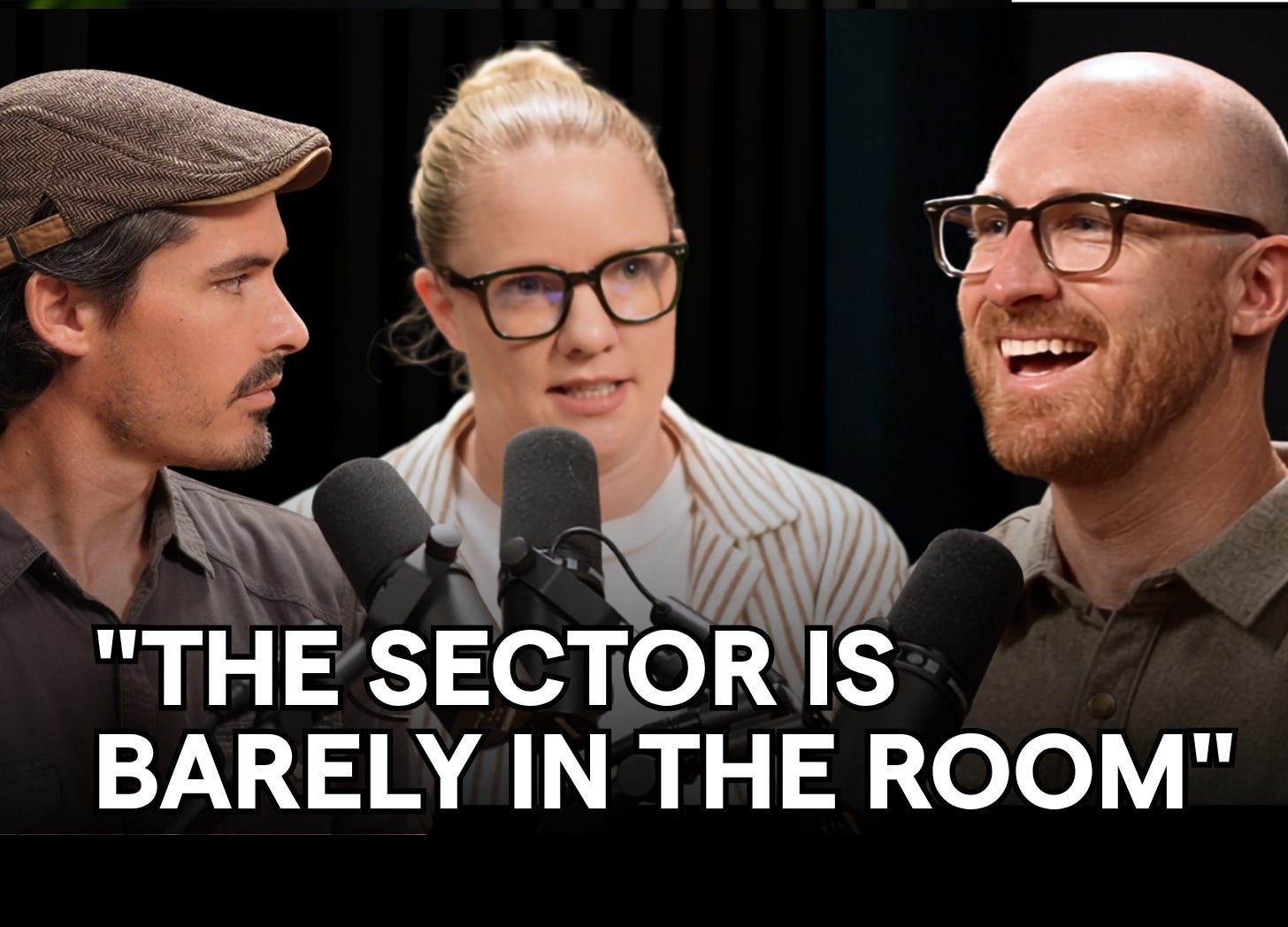
Meanwhile, the biggest decisions about AI are being made without us. By labs. By shareholders. By governments. And the sector that exists to challenge those structures is barely in the room.
So what would it take to step in? To hold space for the skeptics and the builders at the same table. To use AI as an imagination tool, the way the best of this technology was always promised.
To explore that, I wanted to talk with two people who live in that middle ground on purpose. Kaz McGrath and Stephen Silveira run a company called PLAI, for Purpose-Led AI. They’ve spent their careers inside the nonprofit sector, and they don’t show up as AI evangelists. They show up as guides.
Their approach starts with play. Real play. It’s what gets a guarded room to loosen up and talk honestly. Then they ask the question most people skip: what actually furthers your mission?
Episode Highlights:
[00:01:00] Meet PLAI and the “you don’t have to use it for that” philosophy
[00:04:30] “You are behind” — the exhausting message the sector keeps hearing
[00:08:00] What if nonprofit professionals became the builders?
[00:09:00] The roles we all play in change: trailblazers, hospice workers, and the bridge between
[00:12:00] From ethics-first to “speed run it” — how the AI narrative shifted
[00:15:30] Tracking endangered species in the Amazon, led by Indigenous elders
[00:19:00] The one filter for every AI decision: does it further your mission?
[00:23:30] Imagining the best case, and the moment it gets emotional
[00:26:30] The environmental truth nobody mentions: your impact depends on where you live [00:35:30] Decisions are being made for us, not with us
[00:36:30] Play as a serious intervention
[00:40:30] Why mindset matters more than mastering the tool
Notable Quotes:
[00:04:30]: “People in this sector are brilliant. The most passionate, dedicated, giving people that I’ve ever met. They just need the right teacher, the right guide to help them be also excellent at AI.” Kaz McGrath
[00:08:00]: “These amazing people we’re talking about are closest to the actual problems that need to be solved. What an exciting opportunity that they can now be builders and solve some of these problems directly.” Stephen Silveira
[00:19:10]: “There’s a billion things you can do with AI. We try to center folks on: yeah, but what’s actually going to help your mission? Because anything else might just create more busy work for you.” Stephen Silveira
[00:26:10]: “People are using AI to be that silver bullet. They want this future we’re trying to describe, and they want to say AI is the thing.” Stephen Silveira
[00:35:55]: “These decisions are being made for us, not with us. For us, not without us. And it’s in that space, I think, we need to, as a sector, step up into the role we can play.” Kaz McGrath
[00:38:50]: “We’re not going to go to a five-year-old kid and present a PowerPoint on learning how to share. We’re going to play. And I think sometimes adults just need to admit that we’re all still kids.” Kaz McGrath
Resources & Links:
Purpose Led AI (PLAI) — Kaz McGrath and Stephen Silveira’s organization, helping nonprofits move from AI-curious to AI-capable
The Playground — PLAI’s newly launched always-on live AI experiences for the sector.
Conor Grennan’s AI Mindset — the mindset-shift framework Kaz references
Berkana Institute — Two Loops Model — Margaret Wheatley and Deborah Frieze’s model of change roles (trailblazers, hospice workers)
New York Climate Week — where Kaz encountered the Amazon conservation project
P.S. — Struggling to align your message with your mission? We help social impact leaders like you build trust-building brands through authentic storytelling, thoughtful design, and digital strategy that works. Let’s talk about your goals »
Eric Ressler [00:01:15]: So Kaz and Stephen, welcome to Designing Tomorrow. Thank you so much for joining me here today. You guys are called PLAI, P-L-A-I, purpose-led AI. And I’m recognizing that for our listeners who don’t have as much context around you and PLAI, just tell us a little bit more about the work you’ve been doing and the work you are excited to be doing, who you’re becoming as an organization, and what you see as an opportunity for the sector right now with regards to AI, but also just with regards to all these different ways of working and transforming the sector.
Kaz McGrath [00:01:45]: Well, I’m going to start with what we’re so excited to be doing, which to me is we’re just so excited to show and make people feel what is possible now in this space. And at the same time, be a team who knows our stuff, who’ve worked in the nonprofit sector our whole lives, who’ve been there, and can guide people into ensuring that that’s aligned to their values, to their principles, to what they care about in the world, what they care about for the environment and their future. So for AI, that looks like guiding leaders and teams in designing epic, fun, incredible new solutions, and then also being able to set up those boundaries of what we never want to do. The craft — we’ve worked with journalists and storytellers and fundraisers, and their shoulders drop when we remind them, you don’t have to use it for any of that stuff. Keep writing stories, keep having those relationships. Don’t let it influence your craft in what you see. And I think that unlocks a lot of possibilities of AI in the space.
Stephen Silveira [00:03:00]: Another aspect — regardless of the product or the way we’re working with clients, there’s that aspect, and there’s also the aspect of we start talking about AI and we’re like, “All right, what do you want to do? What’s your use case? Okay, what’s the workflow?” And those are actually the chunkier bits that we end up helping people design. Often people are like, “I don’t know, I’ve never mapped a workflow before.” And so you need to be able to do that to decide where AI fits, where the human fits. So much of what we’re talking about with bringing that humanness or deciding where to put your boundaries depends on knowing what the workflow is. And I think we often run against people who are brilliant, have all of that, but they’ve just never mapped it out in a certain way or done that design process. And so a lot of what we teach or help people go through is that. AI is the topic, but it could be another topic and it’d be a very similar thing. And the aha moments we see in people — sometimes it’s AI being like, “Oh, I don’t have to use it for my writing. Thank God.” And sometimes it’s like, “Oh, that’s interesting. I’ve never thought about who else is in this workflow with me and what they would think about this.”
Kaz McGrath [00:04:05]: I’m feeling quite fatigued at the moment by a lot of the messaging around the sector in social impact, and especially in nonprofits, with this — you are behind, you don’t know enough, you have to do more. We have to add, we have to continue to be in that frantic rat race. And what we’ve seen is the opposite, which is people in this sector are brilliant. The most passionate, dedicated, giving people that I’ve ever met. That’s why I love working in this sector. And they just need the right teacher, the right guide to help them be also excellent at AI. And that doesn’t mean excellent at using it for everything, but it’s about getting teams and leaders to that place where they feel equipped to make really confident decisions that feel aligned to how they want to tell stories, how they want to connect, so they can go and create an amazing new app that changes how they can engage in their mission or in their work. And then also have boundaries, feeling like we’re not getting carried away with everything else going on that we feel is against what we stand for.
Eric Ressler [00:05:20]: I want to acknowledge and lift up part of that, which is what you said around these are some of the most brilliant, passionate, talented people. And frankly, our sector to me in the public discourse sometimes feels like a second-class citizen. Like, oh, isn’t that cute you work for a nonprofit? Or, oh, that’s great you do this kind of give-back work. What did you do in your serious career before doing that? And this is all wrapped up in a catch-22 on the scarcity mindset, because frankly the sector at large does not have enough resources to do the work, because the work is the hardest work in the world. And so there’s almost no amount of resources that would be sufficient, but clearly what we have is generally — not speaking sector-wide here — not enough. So I want to elevate that.
And then I want to ask about — let’s get into the AI thing a little bit, because we’ve touched on it on our show, but we haven’t had an opportunity to go really deep. If there’s ever a complex issue that should not be a black and white issue, it’s probably AI. So AI is, in my mind — and I want to hear how you guys think about this — possibly not proven yet, but possibly the single most transformative technology ever invented for humankind. And at the same time, there are huge ethical and maybe even spiritual concerns around how it’s being done, how it’s been done, who’s leading it. And what I’m noticing is that there are these very polarizing and different camps of thought. I see people in the social impact space who are outright essentially boycotting AI. And I think they have some valid criticisms around the extraction and how these models were built and the climate impacts and some of those kinds of things. And then you have the AI bros who are just like, yeah, you’re behind already if you don’t have a 26-orchestrated agentic workflow writing your fundraising copy for you. Obviously somewhere in the middle is likely where we are and where we’re going, but how do you guys think about this moment and balance all of that in a sector that is rightfully there to challenge some of these structures in society? And there are, in my opinion, some things about AI in general and how AI is being done that are worth criticism.
Stephen Silveira [00:07:50]: 100%. We sometimes have to convince people we’re not those AI bros that are just like, just do everything with it, you’re so behind. And we really believe that these amazing people we’re talking about are closest to the actual problems that need to be solved. So for me, what an exciting opportunity that they can now be builders and solve some of these problems directly without having to depend on this infrastructure of agencies and consultants and everything all the time. But then there’s this worry that it’ll be like most other technologies where it won’t be available to them. So where’s this gap, and who’s able to use the really cool things with this technology? Right now so much — tokens are free and easy — and will that change? Because it’s really exciting to think of nonprofit professionals being the builders and being able to like, let me mock this up real quick, or let me put that up on my own without having to go through all this red tape first.
Kaz McGrath [00:08:40]: Listening to you speak around that, I immediately picture those people that we work with and what this moment feels like for them. And sometimes it can be frustrating when there are opinions that feel not grounded on what the technology is and can do and is set up to be. But I really think about, for people in the sector right now, it is — and for all of us, it is — exciting, it’s scary, it’s nerve-wracking. It pushes on a sense of identity and of the future that I haven’t seen us in my lifetime meet before, other than the start of massive shifts in COVID. But this feels somewhat bigger than that. And in those moments, all of us are needed. There’s this incredible model of disruptive, huge change by Deborah Frieze that talks about the different roles when we go through change — the trailblazers, the hospice workers, the different elements of bringing everyone along. And there are going to be some people pushing those new possibilities. And there are going to be some people trying at all costs to protect what has come and gone. And I like to remind people that we are all needed. In a team, we need people who are asking the questions and pushing harder and saying, “But what are we not thinking about? What is unsafe?” And we also need those who are sparking new possibilities. And I think for us, we see our role as sitting as the bridge between that — to be able to see those new possibilities and push the hopefulness forward, but also fight against the worst of it. It’s like, how might we make the best of AI and use that for ourselves, our lives, our missions, and how can we fight the worst? And what we’re seeing a little bit of is those conversations not including the other.
And I think we need both. It’s back to your point on getting away from binaries. And we can achieve that. And I would love, in the sector, from those who are skeptics and who are saying we need to ban AI — I would love them to talk about what AI means for people living with a disability, what it means for someone who could communicate in language that they previously couldn’t access, translation. I would love them to see my mom, who’s got a chronic health condition, whose life has changed because of what AI has done for research in that space. And then vice versa, I would love those people who are pushing the possibilities and saying, “We need to do this, this is the next big thing,” to sit with their colleagues who are scared about this, who think it’s a terrible idea, and say, “Tell me why. Tell me more. I want to listen to that.” And that’s the power of those conversations, and why facilitation and gathering and why design is so important — because there isn’t one answer. We need to sit together and then we need to design our way forward of what comes next.
Eric Ressler [00:11:55]: It’s funny, because I feel like when this started to become seriously mainstream — which to me was essentially when ChatGPT first launched, even before it became public-public, but that’s when it was like, okay, this is a breakthrough, this is coming — it seemed to me like there were a lot more of those conversations happening around the ethics of AI, even from the AI labs and safety. And then there was a moment where it seemed to be — and tell me your guys’ point of view on this — from what I saw is like, “Oh, well, we can’t actually have guardrails because China’s not going to. So now we’re just going to speed run this thing.” And so early on, at least the messaging and the marketing from the major labs and the providers, and the people within those teams who I genuinely believe are just super excited builders and thinkers about this — if you just separate the economics and the shareholder primacy from this, the people in these labs are deep thinkers, and they’re geeks, and they’re excited about this and they see the potential. And there was a lot more talk about the social impact potential around, yes, drug research, medical research. And then all of a sudden it seemed to be like, “Oh wait, we’re going to solve coding.” And to a degree, even you see folks from Anthropic saying, “We’ve solved coding.” But then you look at their uptime status page and you’re like, “Maybe not quite yet.”
So what I would question for us in this room and for the sector is how do we — like you said, I’m inspired by the way you just described. We need to get everyone into the room and hold space for all of those points of view. I want people who are out there protesting AI. We need those people who are holding these companies and governments accountable to the extractive nature of what’s happening, the climate impacts of what’s happening, which I think are much more nuanced than are being described, based on my research at least. So I guess my question to you all, in terms of how you think about it, is: now we have this opportunity, especially you two and your company, to prove out that this does have transformative potential for creating positive social change beyond just writing automated funder email sequences. Great, it might be able to do that, but how can we use it as an imagination tool alongside of that?
Stephen Silveira [00:14:25]: I love that. That’s a lot of the framing. Sometimes our most powerful workshops are holding space, like you said, for people to talk through that. And then once they’re able to get some empathy, then those exciting possibilities come up. But if you don’t start with that, they don’t come. I like to think we try to do that at a meta level with the work and the things that we offer. And in each individual intervention — workshop, lab, immersion, whatever we do — we’re going to start with holding that space. And we’re going to tell the skeptics, we need you. Please speak up. Sometimes, like you said, when AI was new, people were talking and more discussive, but then people start picking a side, and you either hate it or you love it. And people start workshops like that sometimes like, oh, Jerry’s a skeptic, so don’t bring him. It’s like, no, we need Jerry. We need Jerry in there right alongside the person that’s been using Claude on his own in secret with nobody knowing.
Kaz McGrath [00:15:20]: And I think it’s helping people towards their own imagination. What we’ve seen often in these rooms is, because of the push towards productivity and efficiency and saving time, the brand image of AI was that — or creating funny memes, or whatever the ChatGPT image trend of the moment was, the order on an airplane or something. And what I think is really important for our sector is: yes, of course we have to do that. I don’t know anyone in our sector who doesn’t have five other roles that they’re playing that they could 100% save time and automate and use AI on, tiny models that don’t have much of an impact on the environment. But the more powerful thing we need to be doing is finding and telling and imagining those stories of the deeper work. On a small example, we’re meeting in a room with 50 of our colleagues, and by the end of a two-hour workshop, seven people got to talk. And there’s so many ideas there. There’s so much passion and perspective and context that we can collect and sense-make and process together, to not remove that connection but to lead us further towards it.
I was at New York Climate Week, and there was — I’ll find the name and put it in the podcast notes, I can’t remember the organization’s name — but they’re using AI to track endangered species in the Amazon in real time to inform decision-making, and do it in a way that supports indigenous employment, protection of the rainforest. And I want to be telling those stories to people, because what they were doing was never otherwise possible, but they were doing it fully in connection to the elders there and to how that community wants to operate. They led it. It wasn’t led by someone bringing it in. And that was long before ChatGPT — this program existed years and years ago. So one of the things that will break this down is people actually starting with learning. You don’t have to enter it by doing. We can learn and explore what is possible and not just talk about AI as a chat-based interface over a gen AI model. Talk about the possibilities of this and lead people to things that will create further connection, that will allow complexity thinking, that will allow us to process a billion data points rapidly so we can have new approaches and new answers to things.
And the final bit — we talk a lot about bias in AI. The thing that made me smile about bias is: there are definitely some organizations and institutions that have done deep, incredible, sustainable work in the area of bias. There is a lot that haven’t. And there is a lot of one or two humans, or a small team of humans, that make decisions influenced by their background. I’m part of the queer community, but I’m white. I went to a private school. I worked for an NGO. I can never make decisions in that space without being biased. It doesn’t matter how much training I do. So sometimes it is an important mirror for that as well, in terms of when do we need to acknowledge that, hey, that actually is a better solution than how we would approach it. And how do we have the right discernment and decision-making so that isn’t removing the deeply human connected work that we do?
Stephen Silveira [00:19:05]: Just real quick, to pull out of that what we didn’t quite phrase succinctly: it has to be focused on furthering your mission. There’s a billion things you can do with AI. And so we try to center folks on, yeah, but what’s actually going to help your mission? Because anything else might just create more busy work for you. There’s so many things you can do, and if it’s not mission-centric, then a lot of these things start to matter more about how much resources they’re using. But that rainforest example — they’re using it for this specific purpose of their mission, which they believe is bigger than these other things. So you could tell someone’s had that conversation. And I don’t think people are having that enough. They’re saying anything is bad, versus like, okay, but what can you do to actually further the reason you exist in the first place?
Eric Ressler [00:19:45]: I think this is the reason why narrative change is so important, especially on this topic, because I do think right now the narrative is really bad for AI. The narrative is, first of all, in a practical way, you load up a chatbot and you ask AI to do your work for you. That’s the framing I think most people have. And because of that, if you’ve had an AI experience where you’ve tried to use AI without the proper context or the proper training or the proper understanding, it’s going to produce bad work. It’s going to produce inaccurate work. It’s going to hallucinate, whatever it is. And the models are getting better at all of that just inherently, but still, I think a lot of people have tinkered and written it off without having the right conditions to truly assess it. Not to mention that it’s changing every week.
So there’s that part of the narrative that I think needs to be fixed around what does it mean to use AI for social impact at large? And it’s not an exclusively chat-based individual worker system. That’s not how it should be thought of or imagined. And then there’s the broader narrative around AI is here to replace knowledge workers and eventually more than knowledge workers — this displacement theory of AI, which we need to be taking seriously, because there are some real, already some data to show that that could be happening. Then there’s a counter-narrative around companies starting to look at the cost-benefit of token costs versus paying humans to do the work. So all of that’s messy. And so if we were to instead — what’s the narrative that should be out there for social impact? If we imagine together right here at this table, 10 years from now, 20 years from now, this is a transformative technology and everything goes wildly great and positively. Let’s pretend the world doesn’t suck and everything—
Kaz McGrath [00:21:50]: That’d be really nice.
Eric Ressler [00:21:55]: But what is that? What’s that imaginative state? Because I think there’s so much in this space where we suck at imagination collectively. Not all of us, not individually — there’s counter-examples — but we spend a lot of time talking about problems in this space and the injustices. And that’s true. We need to do that. And that’s happening for AI. But what if we were to imagine the best case of this? What would that look like, and what would that unlock for the sector?
Stephen Silveira [00:22:20]: I’d love seeing — back to people in the sector tend to be so close to the problems — having that be celebrated, because there’s a human, real-person aspect to that that you can’t really replace. So seeing the nonprofit industry looked at as the experts, and seeing them maybe, maybe not, being the builders with the AI tools, but regardless, people that build the tools or orchestrate things would need them because they have the relationships, they have the understanding of the issues. There’s clearly the burnout — everybody, honestly — but people in the sector could be working 20-hour weeks and be getting paid more because the impact’s there for it. I think that’s a dream that’s very there for us if we can control the capitalism of the technology.
Kaz McGrath [00:23:05]: Oh, I love that dream. But also — I’ve just noticed in my body, trying to imagine that and holding that at the same time as what we’re seeing going on is physically hard for me in this space. And that is what comes up for people. So to me, I envision bush walks with my nephews. I envision surfing and having time to sit by a campfire and tell stories. I envision being able to have help on the tasks that I struggle with, and communicate more effectively. And when we are coming together to design new solutions in our nonprofits, it allows us to have the individual thrive in that’s made possible, and kind of solve the busy work for us, but also help us at the things we’re not good at. It would allow us to collaborate across INGOs in multiple different languages. It supports inclusion and people living with a disability being able to break down those walls and those barriers that have created an alternate experience for them that keeps those spaces away. It means medical research — it means I could... I didn’t think I was going to get emotional in this podcast, but I just did.
Stephen Silveira [00:24:25]: Eric said it’s okay to cry on this podcast.
Kaz McGrath [00:24:30]: Exactly. It would mean that medical breakthroughs mean my mom can actually come for a walk with me longer than 20 minutes on that beach. And holding that is such a beautiful thing. But I also think it’s only one piece of that imaginative... there we go. I wonder how in focus the tears are. I think the way we get there is so much more about who we are and our identity and how we make decisions, and not about AI. I think AI is the thing of the moment right now. But if we ignored everything that was developed in the future and nonprofits only used ChatGPT 3.5 from November 2022 — I ran workshops on this stuff — if all we did was that, with that model, and we did it in an intentional way and we prioritized our work and we reimagined what that looked like, we would have incredible progress in the sector. And now we have this suite and menu of possibilities and of tech, and everyone wants multi-agent teams and all this stuff. Amazing. We can show you how to do that. But we can’t get there without better collaboration with our colleagues, without healthier cultures, without having deeper questions about burnout and about why are we here in this sector, and without reimagining things with AI, reimagining them without AI. So I love the vision of that future, but I also think it’s so far beyond AI.
Stephen Silveira [00:26:05]: Yeah, it’s not AI. Because I think people are using AI to be that silver bullet. They want this future we’re trying to describe, and they want to say AI is the thing. That’s what we walk into workshops with clients with all the time. They’re like, just give me the advanced analytics tool. It’s like, wait, wait — half your team does not want to touch the tool. You have to figure that out first before you get on the advanced analytics tool, which, by the way, your data’s not ready for.
Kaz McGrath [00:26:35]: 100%. And it connects to all these side conversations we have with clients — which are great, which we love, the side conversations. We love them, but we never expect them. One of them is the environment. And something that shocks people is the bigger impact of your AI usage is just where you live. There are places around the world in which the energy mix and the impact of these things is completely different. And there is net-zero impact in certain types of AI and in certain locations. And then in other places around the world, just because of where that comes from, it’s 80 times worse, 200 times worse. So we want people to have those conversations and be able to meet and gather and talk about the reality of them without simplifying and scrolling over these things.
Eric Ressler [00:27:30]: Hey friends, real quick before we continue today’s episode. I’m Eric Ressler, founder and creative director at Cosmic. Cosmic is a creative agency purpose-built for nonprofits and mission-driven organizations. For the last 15 years, we’ve helped leaders like you nail your impact story and sharpen your strategy. But we’re not here to just leave you with a fancy slide deck and a pat on the back. We roll up our sleeves and help you bring your ideas to life through campaigns, creative, and digital experiences. Our work together helps you earn trust, connect deeply with your supporters, and grow your fundraising and your impact. If you value the thinking we share here and want it applied to your biggest challenges, let’s talk at designbycosmic.com. All right, back to today’s conversation.
Eric Ressler [00:28:20]: On the environmental front, I think a lot of the conversations around the environmental impacts have shifted towards data center creation. And the tragedy of this to me is that — again, I want the counterpoint to this, I want people protesting and questioning these things — but I also want us to develop more of a bountiful mindset around: isn’t this just one more reason why we should be accelerating clean energy? Why are we thinking in a constraint-driven way around energy when we basically have the potential for limitless energy in the world with the tech that we have right now? We just need the cultural will and the political will to make it happen, which is easier to say than to do.
But all that to say, what I’m picking up on is this — and this is where I go too — sort of how you shared your vision of this, Kaz: the medical breakthroughs, the potential for human progress. And also, to me, in the utopian sense and what was promised early on, this reclaiming of the human spirit and a way for most workers who are not billionaires — and even billionaires are working like crazy, because maybe you have a personality defect or something, I’m not sure — but I’d love to be able to accomplish as much as I do right now and work half as much and have more time to just be a human. Not that working isn’t part of humanity, but I think a lot of people in our sector feel like there’s not enough space and time. And that space and time is where imaginative thinking happens. It’s where solutions are born from. Even the simple example of a shower. We run a four-day week at Cosmic and have for over a decade, because creative thinking happens when you’re not putting pen to paper on the project all the time. And our creativity and that spirit of creative problem-solving — we’re in the business of that at Cosmic in one way or another, whether we’re doing strategy work or branding work or whatever.
And so if we don’t have space — and I’m speaking personally here for me and my team, but I see a corollary in the social impact space regardless of whether you’re in fundraising or you’re an executive — we need to go out and live our lives too. And unfortunately, a lot of people aren’t doing that to the extent that they would like to. And now we have this new technology that promises that, but you can also get spun up — and I’ve done it — of like, well, I just need to hit this one more time and get this AI workflow set up. So it can fill the space too. So how do we ensure... And I think it needs to be grassroots. I don’t think this is going to be some kind of globally or government-sparked worker protection thing. Even if that happens, it’s going to be because a bunch of badass people came together and demanded it. So can we create space in the sector to be critical and optimistic about this technology? And can we take a moment to think about redesigning our lives in the process, in kind of a true design-thinking way?
Kaz McGrath [00:31:35]: I just want to pull on a thread at the start, which is: the technology already exists to solve a lot of this stuff. My older brother Chris ran a solar startup, and it was incredible to watch that grow over the last seven to 10 years and learn deeply about what sustainability and the energy mix looks like around the world, and what already exists that we’re not using. And I think that’s the reality. We’re not hitting Paris. We’re seeing governments and industries go backwards. We’re seeing terrible decision-making, lack of accountability, divisiveness. And at the same time, in the political landscape, we’re seeing people like Mamdani give us the hope to gather again — what is this meant to look like? What is connecting and accountability in politics meant to look like? And when we talk about AI and the future and what do we need from governments and all these things, I think gathering and being able to have more time with our friends and our families isn’t just a hopefulness, it is survival as our world continues to change. Living in Australia, you feel every day the impacts of the climate crisis. And people all over the Pacific, communities around the world, already are feeling this. So if we don’t do that well, if we don’t find ways to gather, to strengthen our local communities, to strengthen our nonprofit sector, that is the heartbeat and the foundation of so many of our communities and our structures — we have to do that, because what is coming is going to get worse in that space. And when we then interweave AI into it, there is everything from, “Hey, the climate thing is already done, we need to be talking about existentialism and how do we survive through the collapse of our climate,” and people saying, “Well, therefore throw everything at AI, no matter how much energy, no matter how many data centers,” because that is our only hope.
Eric Ressler [00:33:40]: That’s our out.
Kaz McGrath [00:33:40]: Yeah, that’s our out. And incredibly smart people who are wise, who have been deeply involved in the climate space, in the environmental space, are saying that. And then the opposite end of the spectrum, of course, exists. But I think we need to have hopefulness for what we can reimagine together. I would’ve paid a lot of money to believe that Mamdani was going to be able to get in New York. I would’ve paid a lot of money to believe that all these things happened that surprised us. And that is when we reimagine what this needs to look like. I think we do need to demand of governments to support our systems. Will that happen? Maybe not. But maybe Bernie Sanders will live to 200 and be able to support us all through this. There is hopefulness in these. But I think the first step is believing that we can make that happen. And I truly, truly think we can. We’ve seen that in a one-hour workshop, and we’ve seen it in multi-month processes with people — that they can create better solutions. They just need to be guided along that process.
Stephen Silveira [00:35:00]: And like you said, it’s grassroots. We can’t expect the tech companies or government to do it for us. It’s the same thing — the tech companies are like, let’s do the advanced analytics without figuring out, all right, how does this all work infrastructurally and as a society?
Kaz McGrath [00:35:15]: But also, one thing I hope we do is we stop separating. We need government. We need these companies. We need the skeptics and the believers and everything. We need to have conversations with our elders who have lived through changes like this. In so many of these conversations, I’ve seen that one of the reasons why people are so scared or so unsure or so concerned is they haven’t been part of the conversation. We’re seeing this in Australia at the moment with discussions on IP infringement and musicians and authors — beautiful friends of mine having very powerful conversations. And that is because these decisions are being made for us, not with us. For us, not without us. And it’s in that space, I think, we need to, as a sector, step up into the role we can play. Because I’m not seeing people in these rooms, and the space is there for them to step up into it and to take it and be part of these conversations. And it’s not a conversation about productivity and using gen AI. It’s a deeper place.
Eric Ressler [00:36:25]: Before we wrap up, there’s one big topic I want to hit on that I think is really important. We touched on it very briefly at the beginning, but it’s worth its own segment — and it’s an intentional pun. You guys believe strongly in the power of play — play as a serious intervention. Let’s talk a little bit about that, because I don’t feel like our sector, and the current experience of being in a knowledge field, usually feels playful. It feels very serious. It feels sometimes corporate. It feels high-stakes. It feels urgent. And all of those things can be and are true. But I’m really intrigued to learn more how you guys think about how play can come in and be an intervention for positivity, both in terms of the experience and the outcomes of the work that we’re doing.
Stephen Silveira [00:37:10]: Yeah, it’s integral. Look at the threads we’ve just pulled on — it’s like, oh, it’s heavy. And I think that’s part of what we can bring: we can be that outside, more neutral party that can bring a group together and create a sense of play. And people’s shoulders can drop and they can have real conversations. And by the end of it, they’re like, wow, look how far we came. Wow, I never knew Joe thought that about this. There’s a million examples, but our ability to create that container of play is actually also creating safety, and it’s creating a space for creativity and just openness — so people can talk about these in a weird, complex, interconnecting way without worrying so much about having a solution every time. So that’s quite broad and hand-wavy, but I think our ability to create that container is really special, because to your point, people don’t get that enough. Maybe in the golden age of tech that was everywhere in the corporate space, but that was even only a sliver of people in the professional space. And it works. There’s data there. I think there’s a lot of data to back up that creating that sense of play leads to better outcomes.
Kaz McGrath [00:38:20]: Oh, there’s so much data. My team say to me in Zoom chats privately, “Don’t talk too much about the neuroscience,” because I’ll get on something and I’ll be explaining, I’m so ready — and they’re like, and the workshop’s over. We did a whole other podcast on me nerding out about it, but it’s science. It’s what our brains need. It’s what our brains need to be in a different placement of what area of our brain are we using. It’s what our brains need to retain differently. We’re not going to go to a five-year-old kid and present a PowerPoint on learning how to share. We’re going to play, and we’re going to share, and we’re going to go through the mistakes of that. And sometimes adults just need to admit that we’re all still kids and we have so many cognitive biases. And we like to pretend that we’re not filled with cognitive bias and flaws. I love reminding people about how much they love play, and then being able to show them that not only do we love play, but we just cracked through that really tricky topic. So for example, how hard is it to ask an organization, “Hey, what’s broken right now?” It can either be really uncomfortable, or people feel scared, or it can be filled with a whole heap of “everything’s wrong, everything has to change,” and it’s not a great feeling. But when you do that in a structured process with play that allows people to engage in different ways, we can tackle really difficult things. And also just creative juices — being able to get people into that imaginative space is really hard when you’re working in a nonprofit and you’re writing a grant proposal at 1:00 AM and you’re wearing five hats and you feel overwhelmed. So being able to pull people and support their brains in that space is really important.
Stephen Silveira [00:40:15]: And that’s more important than learning the tool, in our opinion. Someone leaving one of our workshops and feeling like imagination and playfulness and a willingness to engage it with curiosity is more important than them knowing exactly how to prompt perfectly for a specific use case. In our opinion — because we want them to go build what’s important for them. We’re not going to tell them just go do this thing and be dependent on it.
Kaz McGrath [00:40:35]: And for people listening — Conor Grennan, AI Mindset, has nailed this aspect of shift in mindset, and it’s a core part of what we do, which is: of course this is hard. This tool is brand new. It doesn’t work well with how our brains work. It changed an hour ago. It doesn’t work well with different forms of pattern recognition. There’s a reason why people who, like me, are neuro-spicy or neurodivergent can approach AI in different ways, because of the newness and the pivoting and, oh, well what about this, what about this — I’m just going to press the buttons more and more and more, and the exploration. And others struggle more with it. But it’s because we are retraining our brains to engage in a completely new technology. And we also have no idea what it holds in the future. So mix those things — mix political disruption and economic crisis and personal things and breakups and frantic work-life balance and all these things, and AI. Of course this is hard right now. So we do need totally different approaches to make this work for our organizations and our people.
Eric Ressler [00:41:50]: Love the topic around imaginative play. You mentioned watching kids — and we all have young kids in our lives in various ways, as we’ve talked about off the pod. When I watch my daughters do imaginative play, it’s so incredible, because you can see how it’s hardwired into their development in terms of how they learn, how they process. These games can get quite complex if you sit and actually pay attention and watch — you can see them problem-solve and develop as humans. And so it’s innate into our biology and our psychology. And then there’s this corporate world in which play is frowned upon — or not even play, but even unseriousness. But that’s the state in which the biggest problems actually get processed and solved, not the like, okay, we’re going to be in this rigid structure. And there’s a place for that too in the professional world and in the social impact space — we want it to be rigorous, we want it to be evidence-based. But I think we’ve leaned so far into that style of academic thinking that we’ve lost the humanness of it. And that might be my own point of view, and how we do the work and the type of work we’re exposed to. We’re not out there on the front lines all the time, and there’s a lot of folks in the space who are doing that work and see that humanity in their daily lived experience too. But that’s just my sense of the overall flavor of the sector right now. And I think it’s worth challenging and rethinking. And if there ever were a time to do that, it’s literally right now. It’s from the fallout of COVID. It’s from the fallout of all the DOGE bullshit and the USAID stuff being spun down, and the fact that the sector is so fundamentally unsustainable in terms of how and how much money is flowing and who makes those decisions and how that trickles down. To me, I see this opportunity, and I’m seeing discussions around — we can reimagine the sector, but we all have to do it. And I’m sensitive to like, oh, one more thing now that you have to do as a fundraiser writing a grant proposal at 1:00 AM. But it really does, I think, take all of us just deciding, and doing conversations like this, to imagine it together. So I appreciate you guys coming in. I’ve been really compelled by a lot of what we’ve been working on on the side, and just meeting you two — so I wanted to have you on the pod. I want to give you guys a chance to do a plug for our listeners who are like, okay, I’m sold. Where do I start? What can Play help me with? What other resources are there? Where would you guys want to point people?
Kaz McGrath [00:44:35]: Straight to our website — so weareplai.com, spelled wrong, so P-L-A-I. Reach out. If you are thinking bold and big and you want to really reimagine what things look like, reach out to us. Let’s have a conversation. For everyone out there working in the sector, we’ve just launched The Playground, which is always-on live experiences around AI and the skills and mindsets we need to be able to navigate all this wild change right now. We would love for people to join and be a part of that kind of growing community. And otherwise, say hi on LinkedIn, jam with us, share your favorite facilitation questions. Tell us if you are terrified or excited or have cool new things that you’re exploring.
Stephen Silveira [00:45:30]: That’s right. And we don’t play all the time, but we play a lot. So come check it out. And we believe pretty strongly that it’s not just for the C-level executive suite that should have these experiences of play and a well-facilitated space. So we’re all about how can we bring in lots of people from the sector, do those in big groups and still feel connected, but you’re not having to pay for a fancy offsite in the mountains. So yeah, come play.
Eric Ressler [00:45:50]: And so for our listeners, whether you are at the C-level and want to do a leadership-type thing, or bring your whole team or a particular department in — you guys have, I’m impressed by the kind of suite of offerings you’ve been designing. Everything from you can just do this on your own, if you’re within a nonprofit or starting a new social enterprise — you guys really do have a good suite of resources to meet people where they are, which I really appreciate. So to our listeners, go check it out. Kaz and Stephen, thank you so much for joining me today. This was fun. Thanks so much.
Stephen Silveira [00:46:20]: Cheers, man. Thanks for having us.
Eric Ressler [00:46:30]: If you enjoyed today’s video, please be sure to hit like and subscribe, or even leave us a comment. It really helps. Thank you. And thank you for all that you do for your cause, and for being part of the movement to move humanity and the planet forward.