


Every social impact leader believes in their mission.
Funders assume that too. What they actually want to know is why you, specifically, over the ten other orgs working the same issue, or the bigger name with more reach and a longer track record.
Most leaders answer with passion, good programs, being impactful. Genuine things that still don’t add up to a strategy.
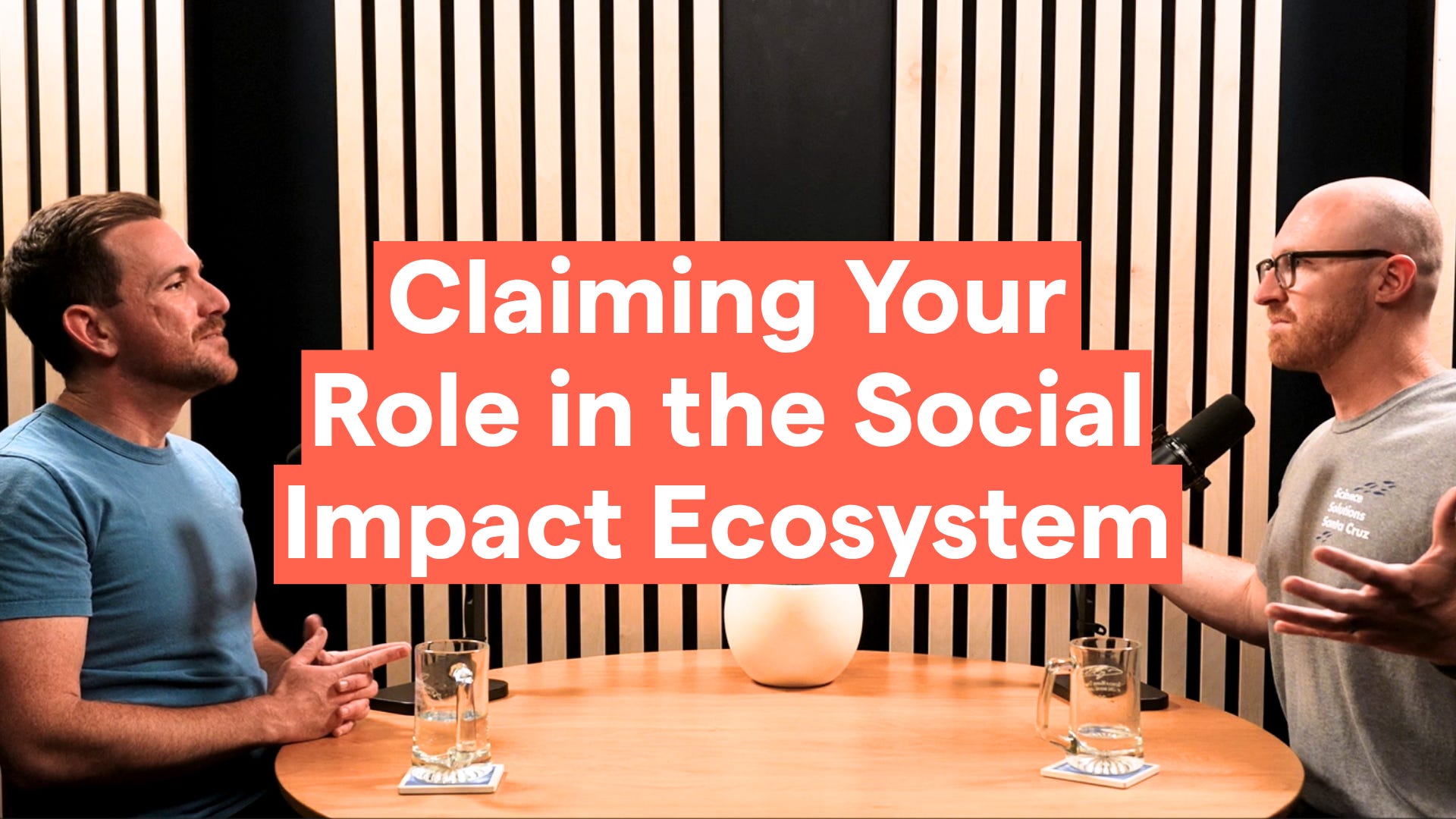
In this episode, Jonathan and I dig into a framework we use with clients constantly: naming your organization’s exact role inside a broader social impact ecosystem, specific enough to defend, credible enough to believe, and clear enough that funders, staff, and partners all describe your org the same way.
The framework itself is simple to describe and hard to actually do: map who else is working your exact issue, get honest about where you’re uniquely positioned inside that field, and build a story you can defend when someone pushes back on it.
Jonathan brings Seymour Center into it as a live example, working through the question in real time. You’ll probably recognize your own org somewhere in his answer.
Episode Highlights:
[00:00:46] Why differentiation is the one thing social impact leaders don’t spend enough time on
[00:01:24] Every organization has a role to play in a broader social impact ecosystem
[00:02:28] What nonprofits can learn from how B2B and B2C startups think about differentiation
[00:03:25] Why “we do good work” isn’t enough to win over savvy funders
[00:04:45] Jonathan’s own evolving answer to what role Seymour Center plays in Santa Cruz
[00:06:38] The vague language and buzzwords that quietly sink an organization’s positioning
[00:09:24] Why believability matters more than boldness when claiming a role
[00:17:18] How passion becomes a brand story, and why that’s a trap
[00:19:44] Finding the “core durable truths” that define an organization’s identity
[00:21:24] Mapping the ecosystem: the first exercise Cosmic runs with every client
[00:22:14] Getting brutally honest about strengths, weaknesses, and what should stop [00:27:41] The moments that call for revisiting your role, from new leadership to ecosystem disruption
Notable Quotes:
[00:19:20]: “Passion is not a strategy. It’s not a position. It’s not a role. We can’t compete on being the most passionate, because who’s going to claim otherwise?” Eric Ressler
[00:04:55]: “One of the decisions I made pretty early was to align more with the environmental work in town, rather than the other museums, and position ourselves as an amplification force for the environmental work happening here.” Jonathan Hicken
[00:06:25]: “People get about 70% of the way there, but they don’t do the hard work of getting the rest of the way. It looks like vague language about describing who they are. It looks like buzzwords that sound good but confuse people.” Eric Ressler
[00:17:45]: “Someone’s like, I love the ocean, I want to save the ocean, so we’re going to create a museum to save the ocean. But that’s the vagueness we’re talking about.” Jonathan Hicken
[00:24:35]: “The better you can be about naming and claiming your role in the ecosystem, and doing that with conviction and clarity, the better you’re going to be at attracting the fundraising you need, the team you need, and the internal strategic clarity to make the right choices.” Eric Ressler
[00:23:00]: “That’s how organizations get stuck for decades. They’re usually aware of their ecosystem, they’re just not willing to act on it.” Jonathan Hicken
Resources & Links:
Seymour Marine Discovery Center: Jonathan Hicken’s organization, used throughout as the working example
The Nature Conservancy: mentioned as an example of a large, well-established environmental org
P.S. — Struggling to align your message with your mission? We help social impact leaders like you build trust-building brands through authentic storytelling, thoughtful design, and digital strategy that works. Let’s talk about your goals »
Full Transcript:
Eric Ressler [00:00:35]: Jonathan, there’s something that I wish social impact leaders and social impact orgs spent a lot more time thinking about than they do. There’s actually a couple things, but for today’s episode there’s one thing I want to focus on, and that is, call it what you want, I’m going to call it differentiation. Let me go into some detail around that, and I’d love for you to grill me on this and poke holes in my thinking.
Jonathan Hicken [00:01:00]: That’s my favorite thing to do.
Eric Ressler [00:01:00]: That’s like what the show is, right? So here’s how I think about this, and I have a better metaphor that I use that seems to make more intuitive sense to folks. I’m going to make a claim here: if you are doing work in the social impact space, especially if you’re doing work that is systems-level, big, intractable work, you are part of a social impact ecosystem. There are many players in this space, collaborators, maybe sometimes competitors. There are forces working against your issue at times, and it’s a complex, moving, fluid ecosystem. The way I think about this, and that I wish more people would think about it, is that you need to be able to clearly name and claim your role in that ecosystem.
Jonathan Hicken [00:01:45]: For who?
Eric Ressler [00:01:45]: For yourself, as an organization, and this will connect the dots a little bit for the people you need to power your mission, whether that’s funders, staff, supporters, or volunteers.
Jonathan Hicken [00:01:55]: I mean, I think this is something I actually think a lot about right now, with Seymour Center as a museum and sort of one of these public spaces, but also as an environmental organization. I think a lot about how we’re positioning ourselves within this whole ecosystem and the different categories we might fit into. So I think it’s a valid thing to dig into today.
Eric Ressler [00:02:15]: So I’m going to do something that I know nonprofit people love, and I’m going to compare them to not-nonprofit organizations. My background early on was working in Silicon Valley with B2B startups and B2C startups, and those folks think about this every day, right? Even before they go to market, it’s like, how are we going to differentiate within the market?
Jonathan Hicken [00:02:35]: Yeah, I was in B2B SaaS for years, and every executive meeting had that theme in it.
Eric Ressler [00:02:40]: So we’ve got two white dudes talking about B2B SaaS. I’m now bald, which is even better. Now we don’t just have a two-white-dude podcast, we’ve got one of them being bald. We’re just checking all the boxes.
Jonathan Hicken [00:02:50]: I have two podcasts.
Eric Ressler [00:02:50]: So you’ve got two. All right, okay. So all that to say, I still believe, and I wish more people would spend time in the social impact space thinking about this. The reason is, I think it’s too easy to gloss over. We get stuck in this mindset of, well, we’re doing good work, our programs are successful, we’re impactful, maybe even we’re doing pretty well from a fundraising standpoint. But I say, not enough. And I also say, usually if you haven’t done this work, those first few things are likely not to be true. So when you go into a potential funder meeting, one of the things the funder is going to be asking is, why support you? A lot of times folks in this space think about that as, why support me, what’s my credibility? But I actually think most, especially the savvy funders, are thinking about why you’re the right fit to solve this problem against other people also working on that problem.
Jonathan Hicken [00:03:50]: This is interesting, because I do a lot of the fundraising, major donor and foundation work, and I often think about myself as a philanthropic matchmaker.
Eric Ressler [00:04:00]: Yeah. Exactly.
Jonathan Hicken [00:04:00]: Where I’m like, I just want to match this funder with whoever’s going to do the work that delivers the most impact. There’s some genuine authenticity to that, where it doesn’t matter if it’s me. But also, if I don’t have a good answer to why their investment in me might have more of an impact, or the kind of impact they want, than somebody else in the ecosystem, then, brass tacks, I might lose out on that opportunity to bring in funding.
Eric Ressler [00:04:30]: Yep. Actually, I’d love to ask you: as you’ve been evolving your leadership and your position within the broader social impact ecosystem here in Santa Cruz, and in the environmental and climate space, how do you think about naming and claiming your role? Have you thought about it from that perspective before?
Jonathan Hicken [00:04:45]: Yeah. When I first started, Seymour Center was viewed as one of the museums.
Eric Ressler [00:04:50]: Yeah, one of the museums in Santa Cruz.
Jonathan Hicken [00:04:55]: One of the museums in Santa Cruz. And one of the decisions I made pretty early was to align more with the environmental work in town, rather than with the other museums, to position myself as, hey, we are an amplification force for this environmental work happening here. Although lately I’ve been thinking about whether we should position ourselves more as a science communicator, as opposed to environmental work. So this is a question I’m actively toying with.
Eric Ressler [00:05:20]: And all of those are role-based questions. Are we playing the role of a museum? Are we playing the role of environmental org? Are we playing the role of a communications org?
Jonathan Hicken [00:05:35]: Well, I mean, there’s role, but I also say it’s sort of like our position in the ecosystem. Because in each of those ecosystems we could occupy or claim a particular spot within it. Within the museum space, we could be the science museum. Within the environmental space, we could be the storytellers. Within the science communication space, we could be the local solutions amplifier. So in each of those ecosystems, we would play a role. But yeah, this is a question I’m thinking about literally this week.
Eric Ressler [00:06:10]: The reason why I think this is so important to spend time thinking about, if you’re a leader in this space, is because it’s kind of this upstream unlock that makes all kinds of other decisions a lot easier. And here’s what I’ve noticed: people get 70% of the way there, but they don’t do the hard work of getting the rest of the 30% of the way there.
Jonathan Hicken [00:06:30]: Well, what is that?
Eric Ressler [00:06:35]: What does that look like? It looks like vague language about describing who they are. It looks like glomming onto buzzwords that sound good but kind of confuse people. And what that means is you end up being able to justify all kinds of activities, investments, and partnerships that are not in your sweet spot. So another way to think about this is: what is our sweet spot as an organization? Where are we at our best? Where are we uniquely positioned to make the biggest impact, given the constraints, given the state of play, given our skill set, given our background? A lot of times when we’re helping orgs through this, we go all the way back to the origin story. What’s the core part of your DNA as an organization? Who even are the founding team? Because a lot of times, even for orgs that have been around for quite a while, that DNA carries through in the culture, in the skill set, and in who they hire into, and what the team members are actually well-versed and good at. I’m not saying you should never pivot, or grow, or upskill. But what I am saying is that you need to have a very clear sense of what your sweet spot is.
Jonathan Hicken [00:07:40]: Let’s unpack the implications of doing this well versus doing this poorly. So, you alluded to one already: are you missing opportunities to bring in funding? Where my mind goes on that is, maybe if you don’t have a good sense of your spot in the ecosystem, you’re talking to the wrong funders.
Eric Ressler [00:08:00]: Might be talking to the wrong funders, yes.
Jonathan Hicken [00:08:00]: They may be interested in a very specific piece of the work that you might actually do, but if you’re not able to articulate that that’s your role in it, then you might miss out on that partnership.
Eric Ressler [00:08:10]: So that’s one flavor.
Jonathan Hicken [00:08:10]: Yeah.
Eric Ressler [00:08:15]: Another flavor is you’re talking to the right funders, but they don’t know it, and you don’t know it, in the sense that you can see a potential there, but you don’t ever quite get over the finish line. You have a lot of conversations, and those feel good, but you never get the check, or you get a check that’s a third of what you wish it could be, because there’s not enough clarity around what funders want, which is confidence and clarity that their investment is going to lead to an impact, in the best case.
Jonathan Hicken [00:08:40]: So one of the things that goes through my head, in my executive director role, is I have to find this balance between painting this big vision, painting this big reason why our work matters. The risk in doing that, of course, is that you go so big or so vague that you lose the clarity in what impact you’re actually delivering, and what your role in that ecosystem is. The risk of going too small is, well, that problem doesn’t sound like it matters too much. So for you, where do you draw the line, in terms of claiming your spot in the ecosystem, when it comes to the spectrum of the size of the problem?
Eric Ressler [00:09:20]: There’s a framing art there, I’d say. It needs to be rooted in truth, at just a baseline. I’m not suggesting listeners take away that they should go find the biggest, boldest way to tell their story and stake a claim, because there’s a believability element to this. This especially becomes relevant if you’re working on a complex, systems-level problem, where the solution or the desired future state is this major thing that’s going to require multiple organizations, public-private partnerships, sometimes even multiple states or communities coming together to solve. So what I’d say is, it needs to be rooted in truth, and the story can go something like this: hey, we envision this kind of world, don’t you also, funder, or whoever we’re talking to? Yes. Well, we see one problem in us getting there is this particular thing, and we tend to be really good at that. That’s our focus. We believe X, Y, Z, and this is the solution to that. There are other partners that matter in this, and by the way, we’re doing this cool initiative with that partner who’s really good at this thing. But this is the thing we’re uniquely positioned to do. And we need to make a case, and now we’re kind of coming off the dialogue here for our listeners, we need to be able to make a case that this part matters, it’s important, and it’s distinct enough that we can make a meaningful, believable claim that we’re positioned to do that part better than anyone else.
Jonathan Hicken [00:10:45]: So it’s actually not, my framing of this, the size-of-problem spectrum is actually kind of a red herring. That’s not really the way you’re thinking about it. It’s that clarity in your role in the ecosystem actually delivers meaning, delivers weight, delivers a sense of real possibility in the impact.
Eric Ressler [00:11:05]: I think that’s right. And the scale of the problem is highly dependent on what kind of org you are. Even to use Seymour Center as an example, you’ve made a strategic choice to draw lines around Monterey Bay and Santa Cruz specifically, to a degree, the scope and scale of your focus as an organization.
Jonathan Hicken [00:11:25]: On your shirt right there, that is literally the scope of what we’re doing.
Eric Ressler [00:11:30]: Science, Solutions, Santa Cruz. For people who are listening. So thanks for the shirt, by the way.
Jonathan Hicken [00:11:35]: You’re welcome. Looks good on you.
Eric Ressler [00:11:35]: So it kind of fits, right? We’re like, hey, okay. So in that way, though, you do have impact outside of this role you have here, but that’s part of your sweet spot. It’s one element, one ingredient in how you claim and name a role within a broader ecosystem. You’re saying part of that is our region, a regional focus, which can be totally legit.
Jonathan Hicken [00:12:00]: You brought up this idea of, or alluded to a moment ago, the other players in the ecosystem. And I think what’s unique about social impact, versus the private sector, is that it’s actually important, I believe, to be in dialogue with the other people in the ecosystem. Because those funders are talking to everybody.
Eric Ressler [00:12:20]: Yep, 100%.
Jonathan Hicken [00:12:20]: And if, in talking to everybody, they don’t actually put the pieces together for your role in it, you have this risk of being less credible, because you don’t exist in a vacuum in these funding conversations. So you need to make sure, in some ways, that your partners in that ecosystem are also bought in to your role in it all.
Eric Ressler [00:12:45]: Yeah, which I think is an interesting distinction between the private sector and the social impact sector: we’re not really competitors. Even if we’re competing for money, we’re all ideally working toward the same thing. There are exceptions to that, when you’re on different sides of an issue, anti-climate people or anti-whatever issue.
Jonathan Hicken [00:13:05]: That’s a good point.
Eric Ressler [00:13:05]: But when you’re talking about allies, let’s use that term, I think a good heuristic is to ask: what if the funder I’m talking to also talks to everyone else in our space? What are we going to say that everyone else is also going to say? Great, might not even be wrong. But how can we help a potential funder or supporter make the best decision? That might even sometimes be, well, we need to fund the Seymour Center and this other org, because they’re intersectional, or because they’re collaborative, or whatever it is. But it’s a more compelling story, a more honest story, and a more persuasive story when you can say, this is the thing, this is the role we’re best at, we’re uniquely qualified for. It takes you out of this mode of trying to impress, talking yourself up. All that matters too. You want to be good at impact storytelling and having credible proof points. But if you have this framing of being clear and convicted about your particular role, and you can tell that story to a potential funder, I think it’s a way more powerful story.
Jonathan Hicken [00:14:15]: I have some theories about why we don’t always—
Eric Ressler [00:14:15]: Always do that
Jonathan Hicken [00:14:20]: —do this. But from your seat, having talked to however many dozens of organizations you’ve worked with, why do you—
Eric Ressler [00:14:25]: Hundreds.
Jonathan Hicken [00:14:25]: Yeah, why do you think that happens? Or what do you think is the main block for an organization going where it needs to go?
Eric Ressler [00:14:35]: What I’ll say is, this isn’t a universal problem, but it is a pretty persistent one. I see this pattern a lot, and I see it with orgs that are new, and with orgs that are, by many metrics, pretty successful and have been around for a long time. For the new orgs, I feel like it is, or maybe a new chapter of an org, it’s an uncertainty. It’s an unprovenness. We don’t actually know what our role is yet, we’re still figuring that out, here’s what we’ve done in the past, even maybe on different teams, we’re starting this new org, or the space is changing so we don’t quite know what our role should be, or maybe the role it was is no longer relevant. And for orgs that have been around a long time, what often happens is they start to see the full intersectional scope of the problem, and they try to solve more and more of it. I think that can sometimes work, if you’re a big enough org, and you break it down into divisions with multiple teams, where you’re almost like a federated, multidisciplinary org with unique teams for unique portions of the role. So you also have to have a litmus test: for the size org you are and the level of ambition you have, and the scale and scope of the problem, is it credible for you to claim that role? Because at some level, it has to pass that litmus test. A savvy funder is going to be like, okay, you’re an X-million-dollar-a-year org in this space saying this is your role. Does that pencil out? Does it pencil out for me? Do I believe you can do that?
Eric Ressler [00:16:20]: Hey friends, real quick before we continue today’s episode: I’m Eric Ressler, founder and creative director at Cosmic. Cosmic is a creative agency purpose-built for nonprofits and mission-driven organizations. For the last fifteen years, we’ve helped leaders like you nail your impact story and sharpen your strategy. But we’re not here to just leave you with a fancy slide deck and a pat on the back. We roll up our sleeves and help you bring ideas to life through campaigns, creative, and digital experiences. Our work together helps you earn trust, connect deeply with your supporters, and grow your fundraising and your impact. If you value the thinking we share here and want it applied to your biggest challenges, let’s talk at designbycosmic.com. All right, back to today’s conversation.
Jonathan Hicken [00:17:05]: I have a theory, and it’s kind of the other side of the coin for what I think makes the social impact space special, which is that we, executive directors, all of us who work in this space, often approach the work because we care. It’s that passion piece. This is what makes it so powerful. And I also think the other side of that coin is that passion can sometimes become the brand story, where it’s like, just to use Seymour Center as an example again, and this isn’t speaking about me, but hypothetically, someone’s like, “I love the ocean. I want to save the ocean. So we’re going to create a museum to save the ocean.” But that’s the vagueness we’re talking about, right?
Eric Ressler [00:17:55]: Well, and also, believability is a factor. A low-millions-of-dollars-a-year org in Santa Cruz, positioned to save the ocean? No, no. No org is positioned to save the ocean. That’s a ridiculous claim. Now, you can have a vision for what the world looks like if you and other players in your ecosystem are wildly successful. Great, tell me about that. What could our ocean system be in ten years, instead of the doom-and-gloom narrative we hear? Okay, I’m on board with that, as a funder. I want that too. I care about the ocean, I want to save the ocean at large, I happen to live in Santa Cruz or have some connection to you. So, Jonathan, what’s your role in that? Exactly. That’s the next logical question. How do you create impact, and why are you the org I should fund instead of the Nature Conservancy, or some other big-name org more credibly suited to take on a bigger piece of that puzzle?
Jonathan Hicken [00:18:55]: But do you think this passion thing is maybe what takes us down the wrong path in our storytelling?
Eric Ressler [00:19:05]: Yeah, I think that’s a pervasive element in this space, and I think it’s a good thing overall, as long as we think about it in the right way. I think passion is a powerful force, and not one we should try to snub—
Jonathan Hicken [00:19:20]: —diminish. Or diminish.
Eric Ressler [00:19:20]: But passion is not a strategy. It’s not a position, it’s not a role. We can’t compete on being the most passionate, because who’s going to claim otherwise?
Jonathan Hicken [00:19:30]: Right. This exercise we’re doing now is essentially the exercise we invite listeners to go through. What is that passion? And then drill down through all these steps and answer all these questions.
Eric Ressler [00:19:45]: So, for listeners who are saying, okay, I buy your argument, Eric and Jonathan, I need to figure out what my role is, now what do I do? I’d encourage people to look at their core, depending on the size and stage of your org, caveat, caveat, but what are those core elements, those core durable truths about your identity, individually as a leader and at an org level, that will always be true? This is something I think about a lot as we do our own brand strategy work for Cosmic. I always come back to, what will always be true, no matter what we do, about our organization? There will always be some kind of design element to what we do, no matter how much deeper we go on strategy, no matter how we change our operating model, our engagement model with clients, design and design thinking. That mindset will always be part of, and true to the core of, how we do our work. So that’s one example for me. For you, it may be some of your beliefs around place-based change, or, based on past discussions we’ve had, what else comes to mind for you?
Jonathan Hicken [00:20:50]: Yeah. We have a beautiful building on the ocean. That will always be true. We exist in Santa Cruz. That will always be true. So these are just some of the things that would be the core truths for us.
Eric Ressler [00:21:00]: So distill down to some of your core truths about the elements of your identity and organization that are durable, that will always be true, or at least for the foreseeable future, will always be true. Start there and build off of that. Then be real honest. When we do this positioning and brand strategy work for clients, one of the first things we do is map the ecosystem. We ask, who are the other collaborators, credible players in your space? We like to look above and below in terms of size. We literally map this, on a four-quadrant, or x-y, axis. Part of it is, how do we frame even that axis, what’s the x and y lines on these graphs? That in itself is a strategic choice, because there are limitless ways to make a graph like this, and some of this becomes performative if you’re not careful. But map the ecosystem, and be willing to be brutally honest, because if you want this work to actually make a meaningful difference, and not just be an exercise you check the box on, you have to be willing to be brutally honest about your strengths and weaknesses.
Jonathan Hicken [00:22:15]: And to be clear, when you talk about brutally honest, where my mind goes is, I have to look at my organization and identify what’s working, what’s not working, what are we uniquely good at, what are other people doing. And then the next thought, from an executive director’s chair, is, what does that mean for my people?
Eric Ressler [00:22:30]: What does that mean for my people?
Jonathan Hicken [00:22:30]: Yeah, honestly, that’s where it goes, because if I’m being brutally honest, what I’m thinking about is programs that should or shouldn’t exist.
Eric Ressler [00:22:40]: Sometimes it’s that—
Jonathan Hicken [00:22:40]: Right?
Eric Ressler [00:22:40]: —or people who need to be upskilled, or who maybe aren’t a good fit, once you have that clarity. But as much as that can be difficult from a leadership standpoint, avoiding it is not a good strategy long-term either.
Jonathan Hicken [00:23:00]: Oh, absolutely not. No, that’s how organizations get stuck for decades on end, because they haven’t made those changes, maybe they’re aware of—
Eric Ressler [00:23:05]: They usually are.
Jonathan Hicken [00:23:10]: Yeah, their ecosystem, but for whatever reason, they’re not willing to act on it.
Eric Ressler [00:23:15]: I’ve seen different versions of this, but back to the brutally honest example: is it the people, is it the programs? I think brutally honest really means being clear-eyed about where you’re actually, tangibly, measurably making an impact, and where it’s more aspirational, and where you are on the trajectory of your vision. Because usually you’re midstream on some strategic plan or growth plan, and you need to be brutally honest about what’s truly in your sweet spot and what’s starting to be on the outskirts of that. I’m not saying you need to focus down to doing one thing perfectly. Sometimes that’s a good strategy, sometimes it’s not. I think about it like a bullseye: what’s in the absolute middle, what’s in the first ring, the second ring, and what’s off the board. You need to make a choice as a leader around how big of a bullseye you draw, and how big of a board you’re drawing. But to me, mapping the ecosystem is the first step, so you can compare who else out there can make these claims, and whether that claim is more or less true or credible. Because often in this space, a lot of people are making the same kind of claims. You’ll know, if you’re in the space, what’s real and what’s not. Funders may hopefully get to that point too, but it’s not guaranteed. So the better you can be about naming and claiming this role in the ecosystem, and doing that with conviction and clarity, the better you’re going to be at attracting the fundraising you need, the team you need, and the internal strategic clarity to make the right choices around what moves you make as an org.
Jonathan Hicken [00:24:55]: All right, so we’ve got being aware of and being brutally honest about your core strengths and weaknesses. We’ve got mapping the ecosystem. What’s left?
Eric Ressler [00:25:00]: So, if you have those two ingredients, you’ve got at least a pretty good start. Now you need to craft some kind of narrative that goes something like: because we have these core strengths, we can claim this role in the ecosystem, and because we can claim that role, that helps the cause at large, because X, Y, Z. That’s terrible messaging, but logically, you need to be able to tell some kind of story like that.
Jonathan Hicken [00:25:30]: And I’d say then you actually need to go road-test that. This is where you’d go to the people in your ecosystem, and directly or indirectly, pressure-test it. Is this different from them? Does this accelerate what they’re doing, or does what they’re doing accelerate what I’m doing? Do we have that positive feedback loop?
Eric Ressler [00:25:50]: Yeah. So now let’s talk about how you know if you’ve chosen right, or if it’s working. How do we measure this when we do this work with clients? None of this is a breakthrough on its own, but it still leads to breakthroughs. What I mean is, we’ll literally interview, we do 360 interviews with leadership and stakeholders closely tied to the org, board members, partners, and ask, what is this org’s role in the space? We look at how much coherence there is in those answers. This data is going to be messy, some people are going to have a weird, zany answer influenced by their own perspective, no matter how good you’re doing as an org. But you start to see patterns emerge, either a coherent picture or a complete scattershot, or somewhere in between. When you start to map those, you should see some kind of pattern forming. We’ll also run basic surveys with supporters: how do you think about the org, what do they do, what’s their focus, why are they different than other people, we do this all the time. And the answers we get can be so insightful, because you can see how people are perceiving you as an organization. Here’s a caveat: if they’re not perceiving you well, is that because you haven’t done a good job strategically at naming and claiming a role in your ecosystem, or is your messaging, your communications, or your distribution of that story broken? Both can be true, or either can be true. So watch out for that, to our listeners.
Jonathan Hicken [00:27:25]: How would you rank this, going back to our strategic tier ranking? When do I do this, and is there ever a good, better, or bad time to be doing this exercise?
Eric Ressler [00:27:40]: Anytime you’re making major strategic choices as an organization. Let’s talk about what some of those moments might be: a new executive director coming in, a major milestone, any kind of transformational or pivotal point, a new strategic plan, a strategic plan being sunset, a new one being built. Anytime you’re making big moves or big choices, it’s worth checking in on this. Is this still our role in the ecosystem? Should it be? The other thing I’d point to is, did the ecosystem get disrupted? Everyone in the world right now, in one way or another, if you’re in this space. Is the funding landscape different? Is the issue landscape different? Anytime there’s a disruption to the state of play, it’s worth double-checking, is this still the right role for us to play? You have to use your common sense and best judgment, because I don’t recommend you pivot this role all the time, or you’re never really claiming it. People get confused: wait, I thought you were this org, now you’re saying you’re this other org. You only get to do that so often—
Jonathan Hicken [00:28:30]: Because—
Eric Ressler [00:28:30]: —part of this is you have to build a reputation. So you have to use your best judgment about when to sit still on this, and when it’s the right time to make a pivot, and how big of a pivot you’re making. But I’d say any of those major strategic moments, either because of internal pressure or external state-of-play change, are worth revisiting this.
Jonathan Hicken [00:29:00]: All right, so what did we miss?
Eric Ressler [00:29:00]: I’d say, if you’re a listener thinking about starting an org, this is, in my opinion, crucial.
Jonathan Hicken [00:29:00]: Yeah, this is kind of step one, almost.
Eric Ressler [00:29:00]: Almost. Should I even start an org? Are there seven orgs already in this space that I should just be joining or supporting? There’s a lot of talk right now about mergers and acquisitions. This is one of the reasons why, there’s frankly a lot of redundancy in the space.
Jonathan Hicken [00:29:30]: And you’re like, I go through that whole exercise and I don’t actually see the role I can claim. Great, okay, let’s merge, or let’s sunset, or whatever.
Eric Ressler [00:29:30]: So I’d say that would be another time, if you’re just starting an org, where you really need to look at this. I feel like this is really important, and you could describe it as positioning, you could describe it as differentiation. I’ve found that the metaphor of your role in the ecosystem is easier for folks in our space to grok, and I think it’s actually a better way of thinking about it. So I’m glad to riff on it with you today. There are other episodes we can link to around some of these topics. But Jonathan, this was fun. Thank you, man.
Jonathan Hicken [00:30:00]: Thank you, Eric.
Eric Ressler [00:30:00]: If you enjoyed today’s video, please be sure to hit like and subscribe, or even leave us a comment, it really helps. Thank you, and thank you for all that you do for your cause, and for being part of the movement to move humanity and the planet forward.
Great episode. After listening, now I imagine I'm standing before two doors.
One leads to immediate eternal unrestricted funding for anything I want to do. The other leads to immediate permanent expulsion from my ecosystem
There are two guards. One always tells the truth, and the other always lies.
I don't know which is which, and I'm permitted to ask one question only to just one of the guards
How do I determine which door is the correct one for me? 🤷🏾♂️ 😉